
There Were Three Doors on C Wing. In January I Counted Four
In one sentence: A night security guard at a shuttered hospital notices something off about a corridor he’s been pacing for months.
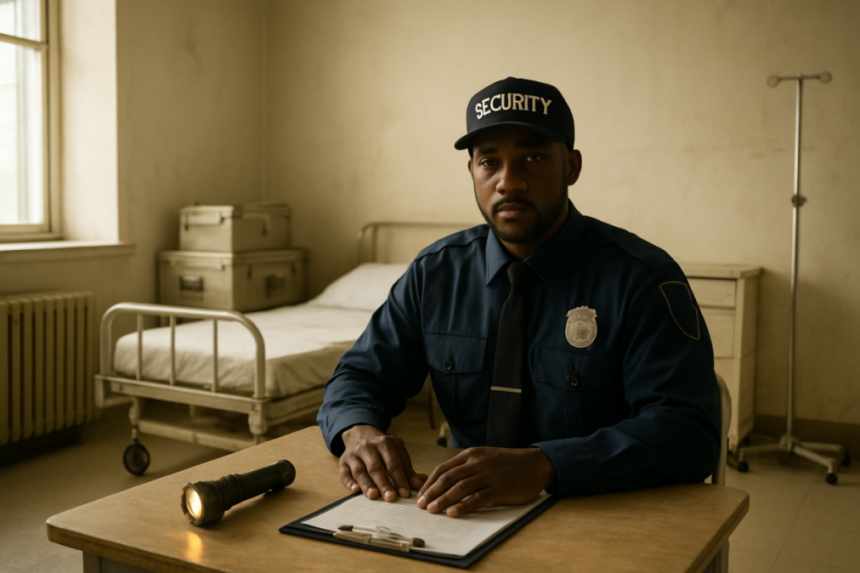
I did nights at a dead county hospital for $14.75 an hour, punching a clock station by station while they stripped it for demolition. The floor plan says three doors between stations 14 and 15. Some nights my punch tape says otherwise, and I never opened the fourth.
* AI Illustration
First impression: judge by the title and the picture alone — you get the real verdict after reading.
Swear It Happened — CASE FILE #558
JURY PENDING
COLD CASE — this file never got enough jurors. Your verdict counts double here (morally).
In March of 2018 I was 33 and I had a right knee that clicked when I went down stairs and locked up about once a week when I went up them. I did that to myself in a distribution warehouse outside Utica, coming off a dock plate wrong with a hand truck, and the comp settlement was smaller than people think those are. After the lawyer it was enough to cover about seven months of my half of the rent. I needed something where I mostly sat, and where nobody expected me to lift anything heavier than a clipboard, and in central New York in 2018 that was security. Guardline Security Services, out of a strip-mall office in Rome with a cardboard sign in the window, hired me off a twenty-minute interview where the only hard question was whether I had a valid driver's license. The pay was $14.75 an hour. I remember it to the quarter because I spent thirteen months looking at it on a pay stub, and because Guardline got it wrong twice, which I'll get to, since apparently I'm the kind of person who holds a grudge about $137.
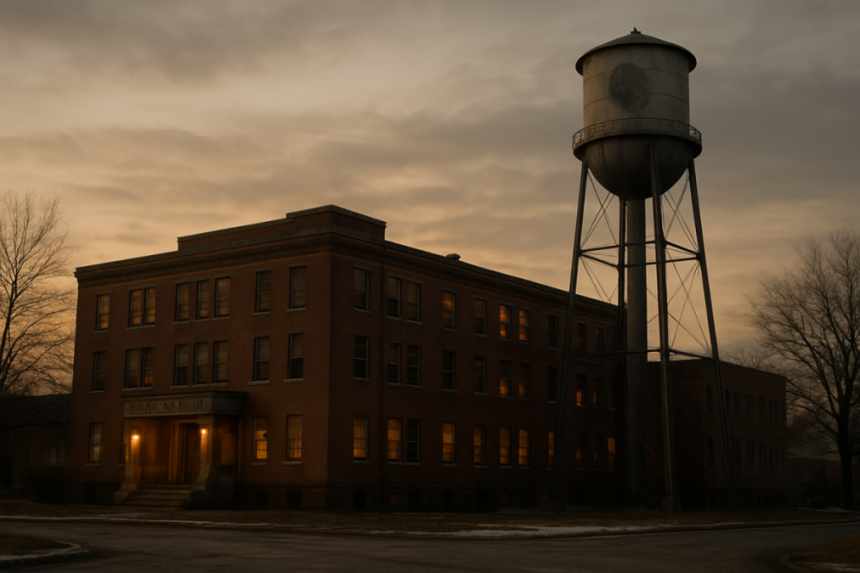
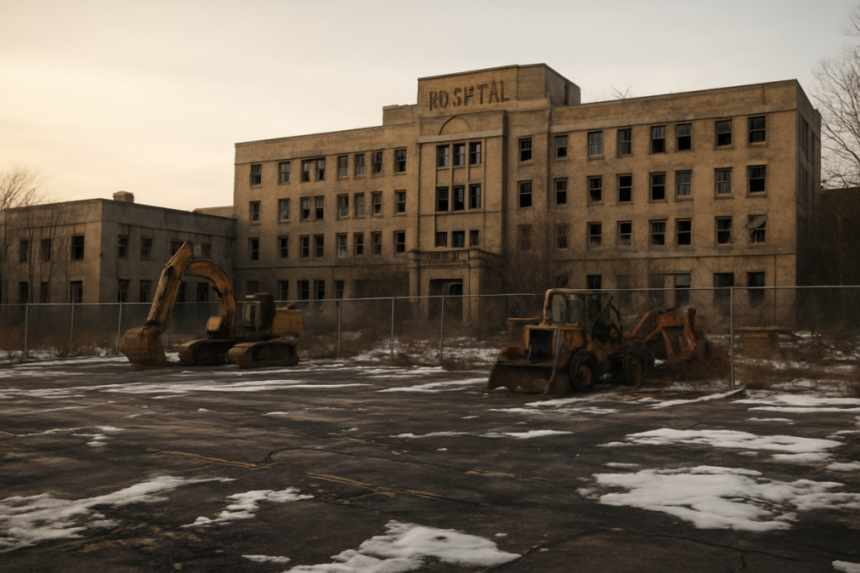
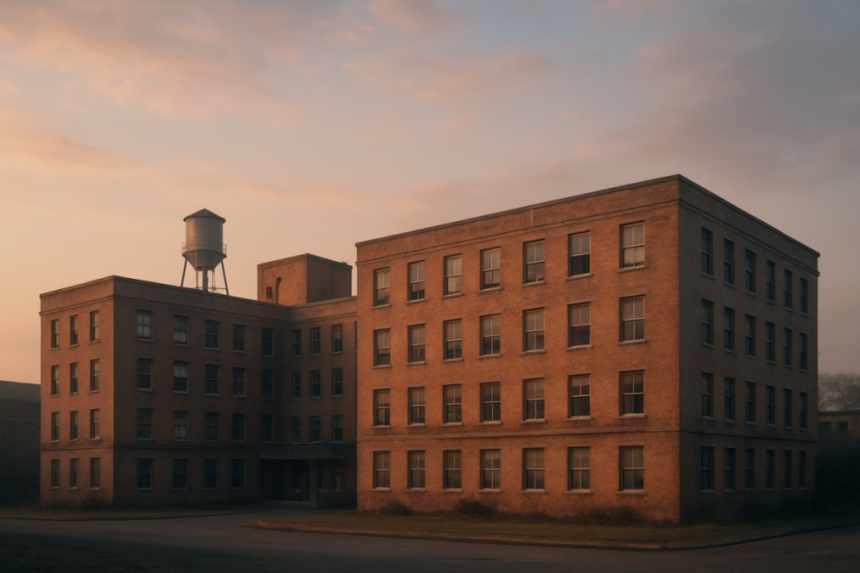
The post was the old Halloran County Hospital outside Brandt Falls. If you're from that part of the state you might know the building even if you don't know the name, because it sat up on a rise off Route 12 with a water tower behind it, and the water tower had the county seal on it until the seal faded into a gray smudge that looked, at dusk, like a thumbprint. The hospital closed for good in 2011. The county had been trying to sell it since before that, nobody wanted it, and eventually the plan became: strip it, scrub the asbestos out of it, and knock it down. The stripping and scrubbing part is called abatement and it takes way longer than you think. There was a whole year where the only people inside that building on a given night were me, or a guy named Marcus, or a guy named Wade who quit in June and I never learned his last name.
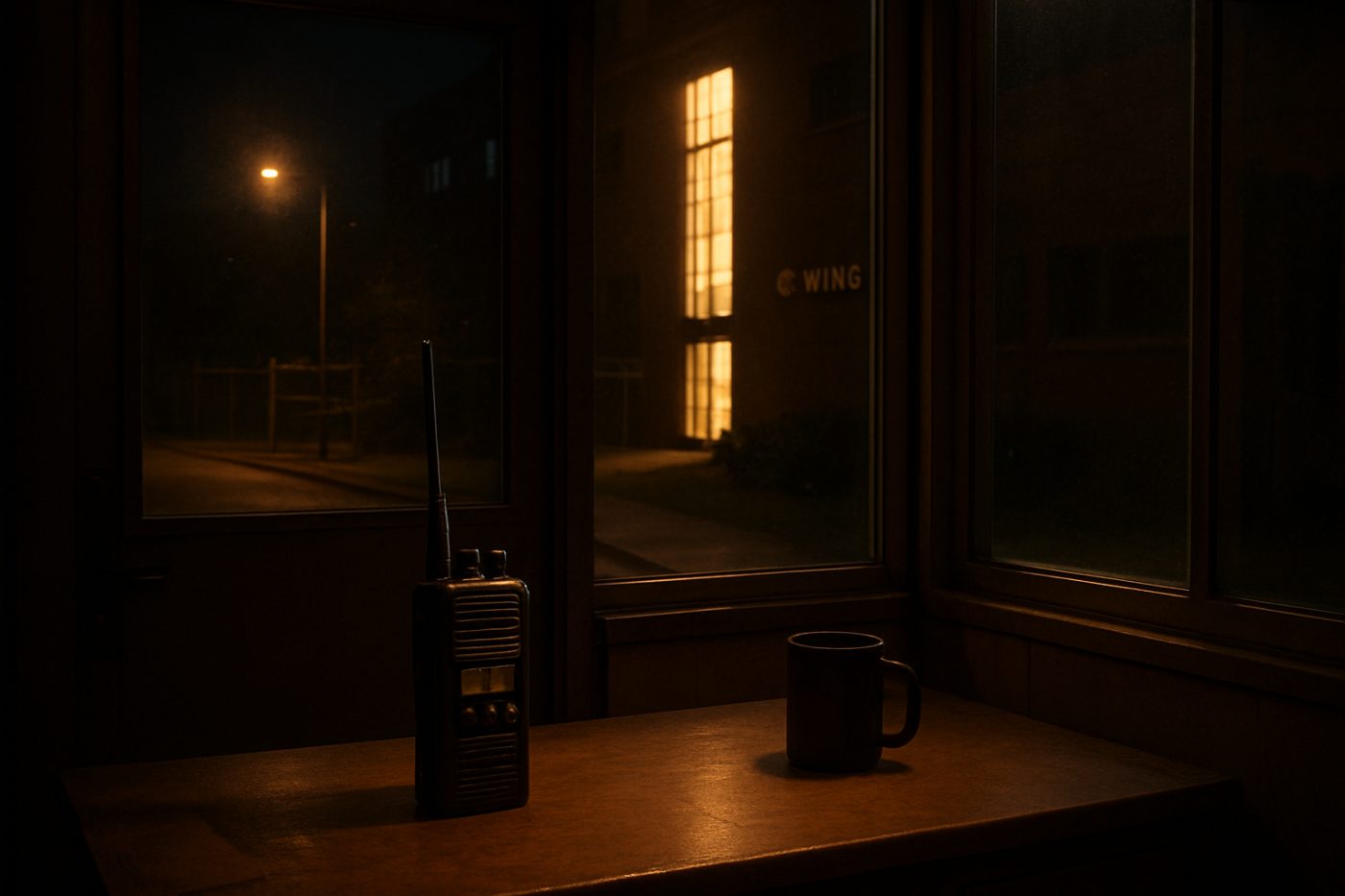
Guardline's contract said one unarmed officer on site from 1800 to 0600, seven nights, and two officers was a fantasy that existed only in the contract. In practice it was one of us alone, four nights on, with a radio that reached the gate shack and, on a clear night, maybe the Stewart's down the hill. The client was the abatement contractor, Straub Environmental Group, and what Straub was paying for was simple. They had equipment in that building. Negative air machines, HEPA vacuums, scaffolding, a couple of skid loaders in the old ambulance bay, and about nine hundred pounds of copper that hadn't been stripped out of the walls yet. They wanted a body on site so their insurance was happy and so scrappers didn't back a truck up to the loading dock. That's it. Nobody hired me to have experiences. I want that on the record.
The building was a T shape, sort of, if the T had been drawn by a county architect over four different decades. The main block faced the parking lot, five stories, 1950s brick, and the wings came off the back. A wing was administration and the old ER. B wing was surgical, two stories, added in the 70s, flat roof that leaked. C wing was the long one. Four stories of patient rooms, opened in 1961 according to the cornerstone, and it ran back toward the water tower so that from the gate shack you saw it end-on, one window wide, like a chimney lying down. Straub was working the building in order. They did A wing first, then the main block floor by floor, and they didn't get serious about C wing until the fall of 2018, which matters for the timeline, so hold onto it.
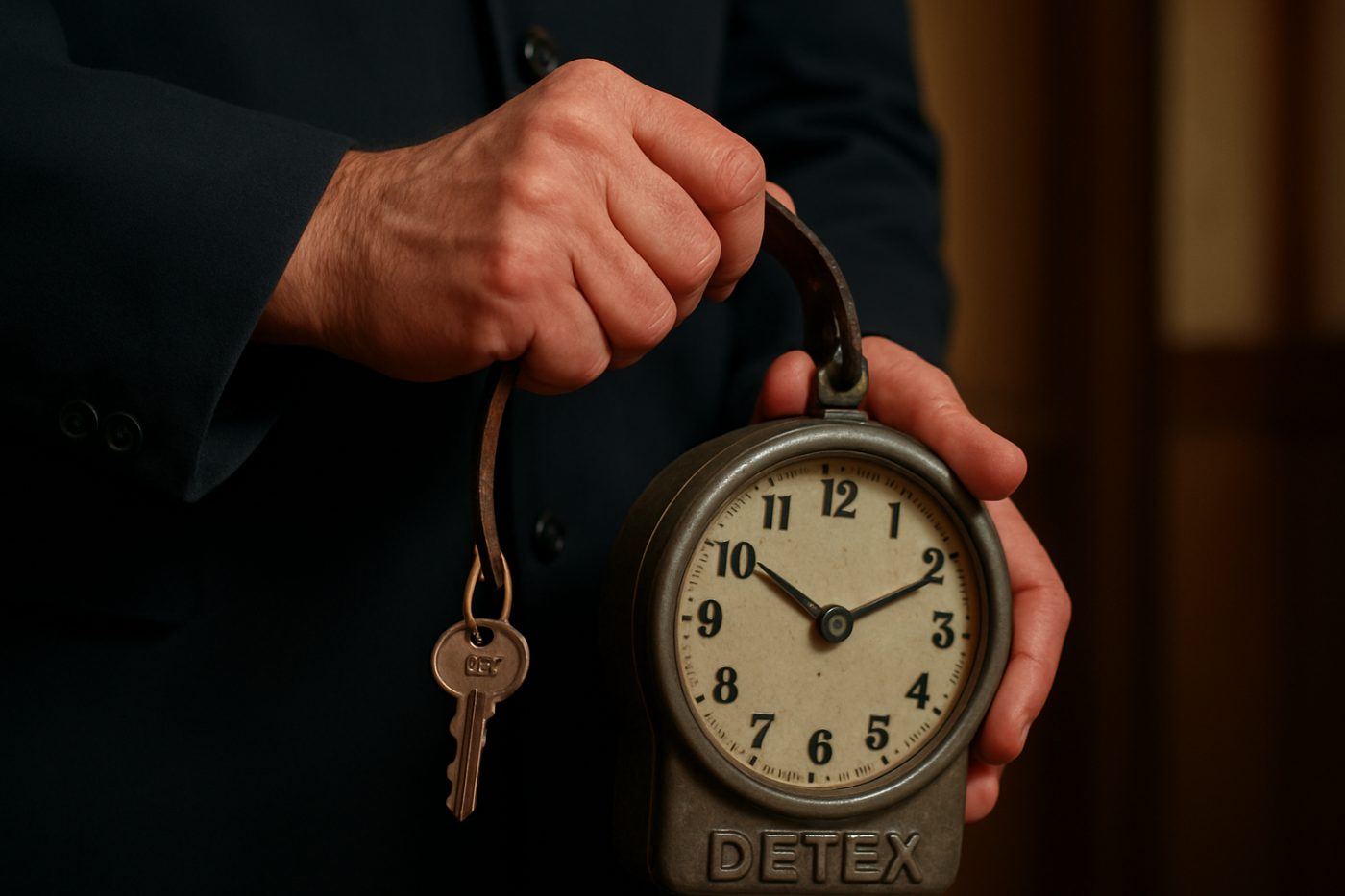
Now the clock. If you've never done watchclock rounds I need to explain the Detex, because the Detex is the whole spine of this and if you don't understand the machine you'll think I'm telling a ghost story. I'm telling you about a machine.
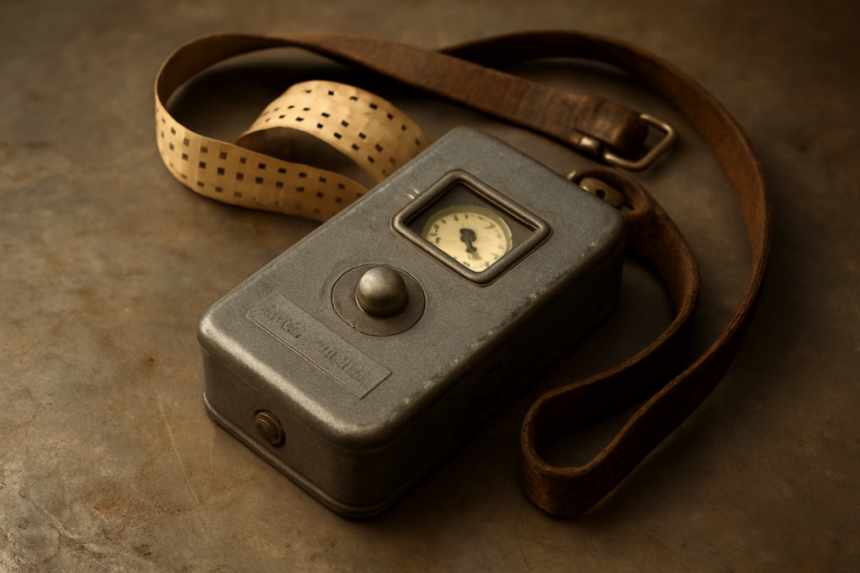
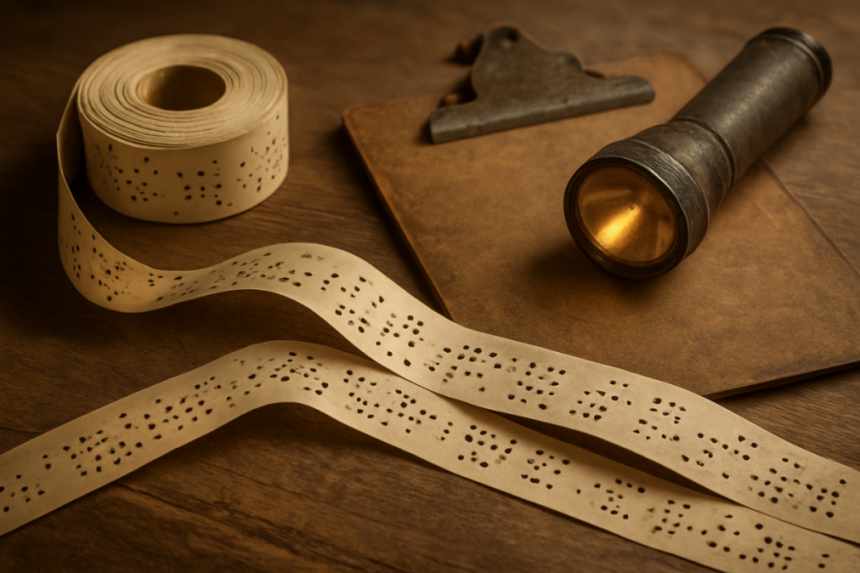
It's called a guard tour clock. Ours was a Detex, an old one, gray steel drum about the size of a big thermos, six pounds, on a leather shoulder strap that had been chewed soft by thirty years of guys like me. Inside the drum there's a wind-up clock movement and a paper tape. Bolted to the walls around the site, at numbered spots the client picks, there are little steel boxes, and chained to each box there's a key. Not a key that opens anything. A key with a number cut into the bitting. You walk your route, you get to station 6, you take the station 6 key on its chain, you stick it in the slot on the drum, you turn it, and the clock movement stamps the tape: station number, time, ding. The key never leaves the wall. The tape never leaves the drum until the supervisor unlocks it with his key, which you don't have, and pulls the tape to check that you actually walked the building instead of sleeping in your car. That's the entire technology. It was old when I was born. There's no software, no batteries, no wifi, nothing to glitch in the way things glitch now. It's a spring, some gears, and a hammer that presses a number into paper. Hold onto that too.
Halloran had 22 stations. Straub's project manager had laid them out off the abatement floor plans so the route forced you past everything they cared about: the equipment cages, the transformer room, the ambulance bay, the copper floors. Four rounds a night. The post orders said 2000, 2300, 0200, and 0430, and the tape had better show all 22 stations in order each time, within a reasonable window, or Denny would call you.
Denny Kowalcik was the Guardline field supervisor for our half of the county, a retired corrections officer with a white mustache and a Ford Ranger with a magnetic SUPERVISOR sign he'd stick on the door when he remembered. He pulled the tapes every few days. Denny is going to come off in this story as a guy who didn't listen to me, and that's true, but I want to say up front that Denny was fine. He got my pay fixed both times. He gave me his own flashlight when mine died, a good Streamlight, told me to keep it. When I quit he shook my hand and said I was one of maybe three guys he never once caught ghosting a round. Ghosting is when you punch stations without actually walking the spaces between them, or worse, when guys figure out how to pop a key box off the wall and take the keys home so they can punch a whole round from an armchair. It has that name in the trade. I didn't make it up, and I heard it for thirteen months before it got funny in a way I didn't enjoy.
A full round at Halloran took 52 minutes if the elevators had power, which they never did, so it took about 65 with my knee. You went out the gate shack, across the lot, in through the main lobby where the reception desk was still bolted to the floor with a 2011 phone book still in the drawer. Station 1 was behind the desk. Then the main block, ground floor, stations 2 through 5. A wing, 6 and 7. Down into the basement, which everyone imagines is the bad part of a dead hospital and honestly wasn't; the basement was warm from the one boiler they kept alive for freeze protection, and it smelled like clean laundry somehow, years later, near the old laundry room. Stations 8, 9, 10 down there, with 10 on the door of the morgue cooler, because whoever laid out the route had a sense of humor or didn't think about it at all. The cooler was propped open and empty and full of paint cans. Then up the B stairwell, B wing, 11 and 12. Then C wing.
C wing you did bottom to top. Station 13 was first floor by the old nurse call panel. Station 14 was in the third-floor stairwell, chained to the standpipe, right inside the fire door. Then you walked the length of the third-floor corridor, all of it, to station 15 at the far end by the C-3 nurse station, then up one more flight to 16 on four, then the roof door check which had no station but was on the sheet, then all the way back down and out the connector to the powerhouse and the exterior stations, 17 through 22, around the fence line. If you're counting, yes, that skips C-2. Straub had C-2 sealed as their containment staging even before they got going in earnest, poly sheeting over the stairwell doors, and the plan drawings just said HOLD. Nobody walked C-2 for a year. That's not part of the mystery, I just don't like leaving gaps in a description. It was sealed, it stayed sealed, and nothing about it comes up again.
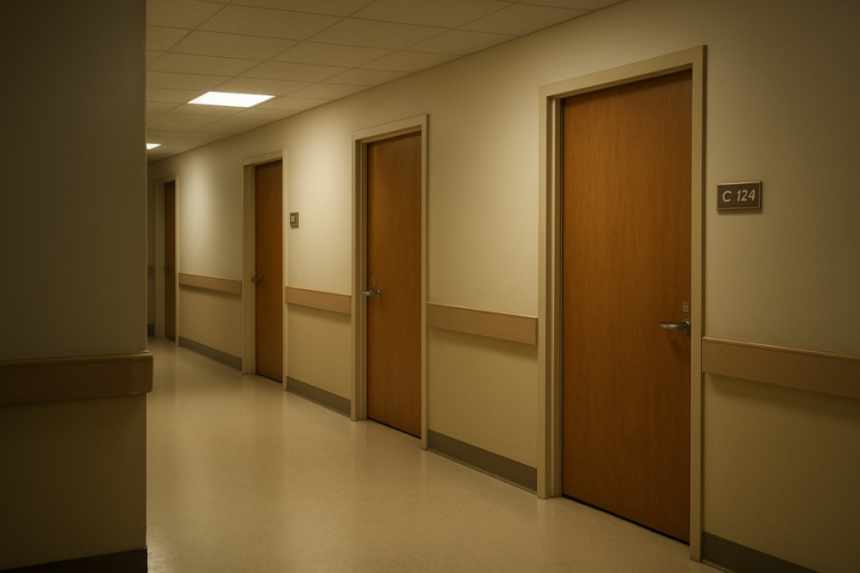
The stretch that matters is the walk from 14 to 15. Third floor, C wing. The corridor was about two hundred feet, terrazzo floor, that green-gray terrazzo every institutional building in New York got poured in the 60s, and it carried sound like a rifle range. Patient rooms down the right side going out, the left side was windows onto the roof of the connector, chicken-wire glass. The rooms had been cleared out years before, beds gone, but the doors stayed, heavy wooden slabs with a little stainless frame screwed on at eye level to hold the room number plate. Most plates were gone. Souvenirs, I figure. People strip a dead hospital the way ants strip a sandwich, in an order you can't predict, and apparently room number plates go early.
Between station 14 and station 15, on the right, there were three patient room doors. Three. I'm going to spend a lot of this story on the number three so I want to establish how I know it, because "the guy counted the doors" sounds like the guy is either lying or was in a mental state to miscount, and the answer to both is the job itself.
Here's the thing about four rounds a night alone in a big dark building: your brain will not idle. You can't listen to music, post orders said no earbuds and for once a rule made sense, you want your ears. You can't look at your phone while you're walking because the floors are full of conduit stubs and floor drains with the grates scavenged. So you count. Every guard I've ever compared notes with does some version of it. Marcus counted stairs. Wade, before he quit, told me he recited the route stations backward, 22 to 1, and if he lost his place he made himself start over. I counted doors. Not on purpose, at first. Somewhere in my first month my head just started keeping the tally the way it keeps the number of steps on your own staircase at home, and by summer I could have walked that building blind giving you the count for every corridor. Second floor main block, east corridor: eleven doors and the janitor closet with the kicked-in louver. A wing ground: six, one welded. C-3, station 14 to station 15: three doors on the right, then the nurse station opening, which isn't a door, it's a gap, then 15 on the wall at the end. Three. For ten months, three.
I know how that sounds. Stay with me, because I was you for most of this, and I had better seats.
The first ten months were the best job I ever had, which tells you something about my resume. I read forty-some books in the gate shack. I ate a lot of gas station chicken. My knee liked the schedule, four tens, three days off, and the walking was flat and steady, which the ortho guy had actually recommended, so I could tell myself the job was physical therapy that paid $14.75 an hour. The building didn't bother me. I want to be clear about that because people assume the place spooked me from day one and it just didn't. A shuttered hospital in daylight is sad. At night it's not even sad, it's just big. The rooms don't feel like people died in them, they feel like a school in August. Whatever the building was to me at the end, for most of a year it was square footage.
The nights had a texture you fall into. Straub's crew knocked off at 4:30 in the afternoon, so when I came on at 6 the lot would still smell like diesel from their pickups leaving. Their negative air machines ran all night on the floors under active abatement, blowers pulling air through HEPA filters and blowing it out through flex duct they'd run out a window, so from outside the building had a hum, one note, like a refrigerator the size of a county. Inside a containment floor you don't go past the poly, you walk the clean corridor and look through the plastic sheeting where they zippered viewing panels in, and everything inside the containment is fogged and orange from their string lights, and honestly it looks more like a haunted house than anything I'm going to tell you about, and it's the most mundane thing in the world, it's guys' extension cords.
Marcus had the nights I didn't. We overlapped only at shift change on Saturdays, but he'd leave notes in the gate shack log, and the notes were 10 percent security and 90 percent fantasy football. Marcus ran two leagues. During the season the log would say things like "2130 all secure. 0200 all secure. If Denny reads this, Denny you started Cousins over Goff and you deserve everything that happened to you." He kept trying to get me into his second league because a guy dropped out, and I kept saying no, and he treated my no like a negotiating position for four straight months. That's Marcus's whole part in this story, almost. He never saw anything at the site, or if he did he never wrote it down or said it, and I've thought about which of those it is more than I've thought about some of the actual events. Marcus, if you ever read this, I know your first note to me will still somehow be about Kirk Cousins.
I should do the copper thing here because chronologically it's September and because it's the incident that cost me my credibility budget, which turns out to be a real thing you spend.
Mid-September 2018, three nights running, I heard movement in the B wing crawl attic. Real movement, weight, something dragging. B wing still had copper in the ceilings, Straub hadn't gotten there, and copper theft was in the Observer-Dispatch about every third week that year. Crews were hitting closed schools and churches all over the valley, and there'd been a genuine incident at a shuttered rehab place near Barneveld where a guard got a rebar swung at him. So I did it by the book. Called Denny, Denny said call it in, I called the sheriff's line, and two deputies came out around 1 a.m. and we stood in B wing listening to something absolutely, positively walking above the ceiling tiles. Deputy gets his light up through an access hatch and it's raccoons. It's a family of raccoons the size of couch cushions that had been coming in through the flashing where the flat roof met the wall of the main block. Fine. Nobody's mad, animal control gets a work order, deputies leave, and it would have been a funny story except that I'd written "possible copper theft crew, multiple actors" in the log the night before, in ink, with times, like a war correspondent, and Denny pulled that page for the client file before the raccoon verdict came in. So Straub's project manager read it. For about a month after that, the PM, a guy named Kearns, would ask me at shift change if the wildlife was staying in line. Every time. "Wildlife holding up?" That's the credibility budget. I spent it on raccoons in September and I needed it in January, and it was gone.
The other thing September gave me was the first payroll screwup. Guardline's checks came out of a payroll service in Syracuse, and my check came in $104 light because someone had keyed me at the $11.50 trainee rate for one pay period, five months after I stopped being a trainee. I caught it because I check. I checked stubs, I checked the tape times against my own watch, I kept my own log in a $1.29 composition book on top of the official log, and I want you to notice that this is the same guy who's about to tell you he counted doors. That's the argument, right there. Either I'm a careful, borderline tedious record-keeper, in which case take the records seriously, or I'm sloppy, in which case explain the pay stubs. It took Denny two calls to fix and they shorted me $33 again in November on the holiday differential and fixed that too. $137 total, held hostage a combined five weeks. I bought a used impact driver with it when it finally came through, which has nothing to do with anything, that's just what $137 was.
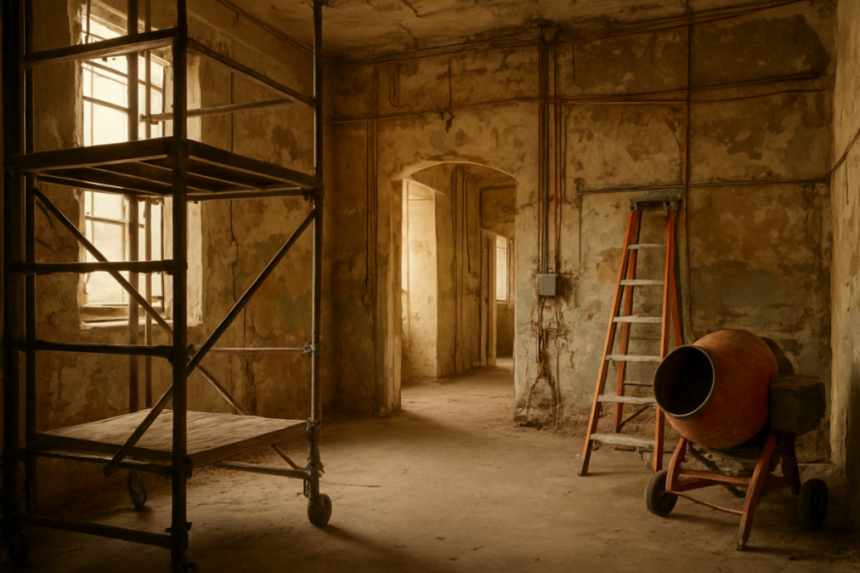
Straub opened up C wing in earnest in late October. They worked it top-down, roof insulation and fourth floor first, and C-3, the third floor, went under prep in December. Prep meant the corridor filled up with their stuff: rolls of 6-mil poly, cases of spray glue, the negative air machines staged and ducted, warning signs zip-tied to everything. It also meant the chalk. Somebody on Straub's crew, I think the foreman, a big quiet guy the crew called Moose although his actual name was Gerald, walked C-3 with a lump of railroad chalk and marked every door that was coming out. Big X, corner to corner, white chalk on brown wood, and a scrawl of numbers on the frame that meant something to their demo sequence. Every door on the floor got one. I watched the chalk age over the following weeks the way you watch anything on a route you walk four times a night. Chalk on old varnish dusts off. Guys brush past it, duct rubs it, and within days every X on that floor was smeared at shoulder height, ghosted, softened. Remember that. It's going to matter more than the printer, in my opinion, and everyone always asks about the printer.
The census printer. I'll introduce it now since we're standing at the nurse station anyway. The C-3 nurse station was a horseshoe counter mid-corridor on the left, past the third door, with the sliding chart racks still in it, and behind the counter on a shelf there was a printer. Not a modern one. A big beige laser thing, early 90s, the size of a mini-fridge lying down, with a paper path you could lose a cat in. Whoever cleared the hospital in 2011 took the computers and left the printer, because the printer weighed as much as a transmission and was worth nothing. First week I had the post, back in March, I did what I did with everything on my route: I checked it. I'm not saying that's normal. I'm saying it's me. I traced its power cord and the cord was coiled on top of the printer, unplugged, and the nearest outlet was on the other side of the counter anyway, and out of pure idle curiosity I pushed the paper release and worked the rollers with my thumb and the rollers were seized. Not stiff. Seized, like a rusted bolt, the way rubber gets when it sits for seven years and fuses to its own spindle. There was no paper in the tray. I noted it in my composition book, "nurse stn printer dead, unplugged, rollers frozen," March 22, because I noted everything that first month, and then I forgot about it for ten months, and I would give a lot to still be a person who'd forgotten about it.
So that's the stage. A dead building humming with fans, a clock full of paper, chalk X's aging on doors, a printer that couldn't print, a guard with a composition book, and the number three.
The night I'd point to, if you made me point, is Wednesday, January 9, 2019. I have the date because of the weather, which was the kind of cold that gets named. It had been minus something stupid for three days and I was doing my rounds in the good Carhartt bibs with the radio inside my coat because the battery contacts got sulky below about ten degrees. The 2300 round, C-3, through the fire door at station 14, punch, ding, and I started down the corridor doing what my legs did while my head was mostly on whether my car would start at 0600.
And the count came up four.
I want to describe the actual moment honestly, which means describing how small it was. There was no cold spot, no sound, the hair on my neck did nothing. It was the feeling of a pocket where your keys should be and aren't. I got to the nurse station and some sub-clerk in the back of my head filed its little report, four, and the rest of me stopped walking. And then, and this is the part people believe least, I went, huh, and I walked back and counted again, got four again, thought, I have been miscounting this corridor for ten months, and finished my round. That's what I thought. I promise you that's what I thought, and I think it's what you'd think, because "there is one more door than there used to be" is not a thought your brain will hand you. It's not on the menu. Your brain will hand you "you're tired," and I took it, and I punched 15, and I did four and the roof door and the fence line and went back to the shack and ate my sandwich.
The next night I counted on purpose, going out and coming back, and it was four both ways, and the night after that it was four, and that Saturday I stood in that corridor for I'm going to say twenty minutes trying to prove I was an idiot. Here's everything I tried over the next two, three weeks. I'm going to be thorough about this because this stretch, me versus my own count, is most of what the experience actually was. The door itself did nothing for weeks. The argument was entirely between me and paper.
First, the abatement floor plan. Straub kept a laminated set hanging on a nail in their break area on C-1, life-safety drawings with their containment zones markered on, and the base drawing was the real architectural floor plan of the wing. I wasn't supposed to handle their stuff, but I didn't lose sleep over it. C-3, right side of the corridor, between the stair enclosure and the nurse station: three patient rooms. C-301, C-303, C-305. Rooms past the nurse station ran C-307 through C-315, odds, and the evens were the far side of the floor past the elevator lobby, don't ask me why, some 1961 architect had a reason and it's under the rubble now. Point is the plan showed three door swings in that run of wall. I counted the swings with my finger on the plastic. Three drawn doors. Four wooden doors. I stood there in my bibs at one in the morning genuinely comforted, which sounds insane, but a discrepancy that's written down becomes an error, and errors have owners. Somebody drew this wrong, I decided. In 1996 or whenever this sheet was traced, a draftsman skipped a door. Case closed for about four days.
What reopened it was paint. The corridor walls were that two-tone institutional scheme, tan up top, brown dado below, with a bumper rail. Repainted who knows how many times, last time maybe 2004, and old paint records everything. Every outlet cover they were too lazy to pull, every sign they painted around. If a doorway had been added after the last paint job, cut into the wall, framed in, there'd be a seam, new mud, a color difference under a flashlight held at a raking angle. I know what that looks like because of a hundred boring nights, not because I'm a contractor. So on my 0200 round I put the Streamlight flat against the wall and skimmed the beam down the corridor, and the wall around the fourth door was the same skin as everything else. Same alligatoring in the brown, same faint roller stipple, one continuous unbroken paint job flowing around that door frame like around every other frame. The trim profile matched. The hinges matched, three knuckle, ball tip, painted over at the edges same as every door on the floor, and the paint on the hinges had the same chips. And the door had scuffs. That's the detail that got under my coat. Black heel marks low on the wood, a pale worn patch around the push plate the exact height a person's hand falls, forty years of hands, on a door I could not make exist before January.
The number plate holder was there too, the little stainless frame at eye level. Empty. No plate. But every scavenger who ever pried a plate off a Halloran door left screw dents and shine marks, and this holder was smooth. It didn't read stolen. It read never issued. Though I'll grant you I don't actually know what never issued looks like, I'm telling you the impression, and impressions at 2 a.m. in an empty wing get to be worth what you paid for them.
Radiators. Big cast iron units along the window wall, evenly spaced, one per structural bay, and the doors on the corridor's room side lined up more or less opposite them, because the rooms were laid out on the same bays. Ten months of walking that hall and the rhythm was radiator, door, radiator, door, and your body knows a rhythm the way it knows a song. I paced it off heel to toe one night like a lunatic. From the stair door: fourteen paces to door one, then the spacing repeated, give or take my limp, door two, door three, and door four sat in a bay that also had its radiator, its window, its everything. Which would mean, if I'd been right all those months about three doors, there'd been a bay with a radiator and a window and a blank wall where a room's door ought to be. And here's what I can't give you, and it's the fairest question in the world: I cannot picture the blank wall. I have no memory of ever noticing a missing door in that run, no memory of thinking huh, odd, no door on that bay. I just have the count. Three, three, three, ten months of three, and a corridor that in every physical detail insisted it had always been four.
So I did the reasonable thing, which was to conclude I was the broken instrument. I even worked up the mechanism. You count the doors you pass, one of them sits in shadow between the emergency lights, you fell into a habitual miscount early and locked it in, the way you can misremember a phone number confidently for years. That theory held actual weight with me. I'd have signed it. The one thing it couldn't carry was the floor plan, three drawn doors, but a lazy draftsman covered that, and if it had ended there, that's the story I'd be telling at the diner. Guy counts wrong for a year, feels weird, the end. It didn't end there because of the tape.
Third week of January, Denny did a tape pull. Normally that was nothing, he'd swap the roll, initial the log, gone in ten minutes. This time he came into the shack holding the old tape like a doctor holding an x-ray and said something like, you been double-punching 15? And I said no, why would I, you can't anyway, the drum indexes forward when a key turns, and he laid the tape on the desk and walked his finger down it. Round after round: 13, 14, 15, 16. And then, on the 0200 round of one night, between 14 and 15, a stamp that read 15A.
I remember the shack was very quiet except the heater, and I remember saying that there is no station 15A, and Denny saying, yeah, and the way he said yeah had no spook in it at all, it was the yeah of a man looking at a payroll error. Because Detex tapes actually have a name for garbage stamps, which I didn't know until right then. Old clock, worn escapement, a key half-seated or a guy jiggling a key, and the hammer strikes between positions and prints a mangled character, a half number, an offset stamp. Ghost punches. That is a real term, servicemen use it, and Denny had seen forty years of them and was fully prepared to see this one, and I looked at where his finger was and the stamp was not mangled. It was 15A, clean strike, dead level with the others, and the time on it was 2:19 a.m., which sat exactly where a stamp would sit if a man walking my pace had punched a station midway between 14 and 15. On a corridor with four doors. Where the fourth door hung between 14 and 15. I did the 0200 rounds of that stretch every night that week, and I never put any key in that clock between 14 and 15, because between 14 and 15 there was no key. I want to say that as flatly as I can. There was no station in that corridor. There was nothing to punch.
Denny wrote "clock service due" on his sheet and took the tape, and I asked him for it, and he let me keep it because to Denny it was trash. I still have it. I have four of them, ultimately, because it happened more nights, and they're in a folder in a fire box in my apartment, and no, there's no photo of them in this post, and I know exactly what that does to my case, and I'll say why later. But the date on that first 15A stamp was the night of January 6. Sunday. Three nights before January 9, which is the night I've told everyone, including you, ten paragraphs ago, that I first counted four. The clock had the door before I did. I've checked my composition book against that tape a dozen times hoping I wrote the dates down wrong, and either I did, and my whole system of being the careful guy is worth nothing, or the corridor changed on the 6th and my famous count walked past it for three nights without noticing. Pick whichever one comforts you. Neither one comforts me.
February I went a little bit down a hole, and I can see that now, and honestly I could half see it then. Not a scared hole. A project hole. I've always been the guy who, when a thing doesn't add up, will sit with the receipts until it adds up, that's the same wiring that catches an $11.50 trainee rate, and the wiring doesn't have an off position. So February was me running a little private investigation on my own corridor, while the actual paranormal explanation stood politely off to the side, not pushing, like a guy at the end of the bar who knows you'll come to him.
The 15A stamps kept up, and they had a schedule I couldn't find. Between Denny's pulls and my own notes I had eyes on most of my nights that month, and 15A printed on I believe six nights in February, always the 0200 round, always a time that fit the middle of my walk, and never on a night off. That last part is either the most important fact in this whole account or a coincidence of scheduling, and I genuinely don't know which. Marcus's nights, clean tape. My nights, sometimes, 15A. If you want to build the case that the clock only did it when the broken instrument was carrying it, meaning me, I've already built that case in my head, in February, at 4 a.m., with graph paper. The problem with the case is that the drum is a sealed mechanical unit and the man carrying it doesn't get a vote on what it prints. The other problem is the fans.
The negative air machines. I said Straub ran them all night on active floors, and C-3 was active by then, corridor prepped, containment built at the far end past the nurse station. Those machines hold the containment at negative pressure so any leak pulls inward, clean to dirty, and the pressure isn't a vibe, it's a number. There's a gauge, a manometer, ink pen on a paper chart drum on the older ones, and Straub's compliance guy changed the charts and filed them, because if your pressure fails you're legally supposed to know. In late February I'm at the gate shack at shift change and Kearns, the PM, is on his phone in the lot, aggravated, and the half I could hear was about pressure excursions. Third floor unit dropping out of spec at night, alarms in the log, and the crew checking it every morning finding nothing wrong. Filters fine, duct fine, poly tight. He got off the phone and asked me, not accusing, just running down his checklist, whether I was opening doors on C-3 on my rounds, because a big door swinging open on a containment floor will spike the pressure. I said I opened the stairwell fire doors at 14, same doors, four times a night, all year. He grunted, that made sense, that wasn't it, and he was walking away when I asked, and I swear I asked it casually, which nights.
He read them to me off his phone. I stood there holding four dates in my head like water in my hands, and walked, didn't run, walked to the shack and wrote them down. That night I laid his four February dates against my tapes. All four were 15A nights. The excursions in Straub's pressure log clustered right around two in the morning. I want to be careful here and tell you what I can't prove: I never saw the actual charts, I got dates secondhand from an irritated man reading his phone, and he was aggravated about his problem and had no idea he was feeding mine, and I never told him. Cowardice, partly. The raccoon file was in that same cabinet, is what I told myself. Wildlife guy comes to the PM with, your pressure drops when my clock prints a station that doesn't exist. There was no version of that conversation I could afford at $14.75 an hour.
Instead I did the dumbest thing in this entire account, and I'm including standing in front of the door at the end. I decided to get video. I had a cheap Android with 11 gigs free, and my plan, if you can call it that, was to set it on the nurse station counter propped on my lunch cooler, camera down the corridor, film the whole 0200 window, catch either a door being a door or nothing, and either way have something that wasn't my own eyeball. First attempt, I framed it up in the dark, walked my round, came back at 3, and I had ninety minutes of beautiful stable footage of the wrong direction. I'd propped it facing the window wall. Chicken-wire glass and my own flashlight bouncing back at me at 2:19 like a little star. Second attempt two nights later, framed it right, checked the framing twice, and the phone, which held charge fine all day every day, was dead when I picked it up. Not low. Dead dead, cold as a stone, wouldn't wake up until it had been on my dash vent for twenty minutes, and yes it was a cold night in an unheated wing and lithium batteries hate cold, and yes I'd had that same phone in that same wing on fifty other cold nights while it sat warm in my bib pocket instead of alone on a counter. Both explanations available. Take your pick, again. I never tried a third time. The honest reason isn't in the tapes or the pressure charts, it's that walking away from that propped phone, both nights, felt exactly like walking away from a guy you've left tied to a chair, and I quit doing it.
Now the chalk, which I flagged back in December, and which is the piece I'd keep if I could only keep one.
Gerald's chalk X's aged. All winter I watched them dust down, smear at shoulder height, soften. By February the X on C-301 was a ghost of an X, the one on C-303 had a big wipe through it where somebody's shoulder or duct or Christ knows had dragged, C-305 about the same. The fourth door had an X too. I honestly can't tell you when it got one, whether Gerald chalked it in December with the rest, because in December I wasn't looking, the fourth door didn't exist in December, or did and I hadn't. You see the problem with everything I know. But by the time I was looking, it had its X, and its X was fresh. Every night, fresh. Crisp edges, bright, chalk sitting up on the varnish like it went on that afternoon while three feet away C-303 wore its two-month-old smudge. I watched a hundred marks age on three floors that winter, and this one didn't. It was like the door wouldn't keep anything. Like marks slid off it on some schedule slower than my eye but faster than everything else in that building.
And then the first week of March, one night, the X was wiped. Not faded. Wiped, one stroke, a single clean swipe about the width of a hand, right through the middle of it, corner to corner the opposite way of the X itself, so the chalk left behind made a shape I'm not going to try to name. The wipe had finger drag in it. You know how a hand wiping dust leaves lanes from the finger gaps. Four lanes. I stood there with my light on it doing the math on who'd been on that floor since my last round, which was me, station 14, this hallway, station 15, ninety seconds of my own footsteps and nothing else, and that was the first night I skipped counting the doors on the way back, because I did not want the number.
The printer was March 11. A Monday morning. I know because it was the morning after my weekend, so I'd been off two nights, and Straub's guys found it, not me, which is both the best and worst thing about it. Best because it means it's not just me, worst because I wasn't there and everything I know arrived secondhand and confused, the way real things arrive. What I was told, by two different guys whose stories differed a little: the early crew got to C-3 around 6:40 and the corridor smelled like hot dust, the smell of an electric heater the first cold morning, and the nurse station printer was warm. The unplugged printer. Cord still coiled on top, I'd have bet my truck on that, though when I asked, neither guy had specifically looked, they just knew the machine had no business being warm, and one of them popped the lid because guys poke things, and the rollers turned. Free, smooth. Seven-year seized rubber. And in the output tray, face up, one page.
I saw the page. That part is firsthand, because Kearns brought it down to the gate shack that afternoon at shift change to ask, with the weariest face I ever saw on that man, whether I'd been running a printer in his containment area at night. He held it out and I read it standing next to the gate arm in daylight, and here is what was on it, as close as memory gets me, and my memory of this page is very good because I have gone over it the way you go over a car accident. It was a patient census sheet. The header said HALLORAN COUNTY HOSPITAL, then CENSUS, UNIT C-3, in dot matrix looking type from a laser printer, which is its own small wrongness, and a print date and time in the corner: 11:47 p.m., with the date of the previous night. A Sunday. Nobody in the building. The body of the page had ruled columns, room, patient, admit date, attending, and only one row filled in. Room: C-15A. Patient name: black. Not redacted with marker on top of the paper, I held the sheet, I felt it, the black was printed, solid toner rectangles laid down where a name would go, glossy the way heavy toner is, slightly raised under a thumbnail. Admit date, blank. Attending physician: E. PROSSER, M.D.
I told Kearns the truth, that I'd never run a printer in his life and neither had that printer, that I'd checked it in March a year back and it was unplugged and seized, and it was even in my book with a date, and he looked at me for a while, and the raccoons sat in the air between us, and he said something like, keep the crew's stuff off your rounds, which wasn't fair, and folded the page in half to leave. And I asked if I could have it. He gave it to me. He was tired and it was garbage to him, same as the tape was garbage to Denny, and I've noticed that, how every physical piece of this came to me because to its rightful owner it was trash. The census page went home in my cooler, then into a manila envelope, and it's currently in a banker's box in my mom's garage in Deerfield with my tax stuff from those years, and I know. Believe me, I know. The single best artifact and it's in a garage. When I moved out of the old apartment in 2021 I put the box there myself, and every time this story comes up somebody says drive over and get it, and my mom's garage is a two-hour round trip, and one of these weekends I will, and I notice, same as you do, that I've been saying that for a while now. I don't fully understand the foot-dragging, except that having it in my hands again is a thing I apparently want at a distance and not up close.
E. Prosser. There was no reason that name should have meant anything, and it didn't, and I couldn't leave it alone, and this is where I did the thing I had no business doing, so let me just own it cleanly. The hospital's old records had mostly been hauled out in 2011, but the basement had a room, past the laundry smell, past station 9, marked RECORDS ANNEX, county padlock on it, and the county padlock had been cut for months. Straub cut it, I assume, and it hung open on the hasp all winter. My post orders said exterior and interior patrol of assigned stations and common areas, and a locked county records room was neither, and the room being unlocked didn't change whose room it was. I went in anyway. Twice. First time five minutes, just looking from the doorway with my light, mostly empty shelving, mouse dirt, a rolled fire hose for some reason, and along one wall a run of framed photographs stacked on the floor, leaned face-first like they'd been taken down and never made it onto a truck. Second time, a week after the census page, I went in and flipped through the frames like flipping records in a crate. Retirement plaques. An aerial photo of the campus from probably the 70s, the water tower with its seal sharp and dark. And the staff photos, the long panoramic kind, everybody assembled on the front steps, a row of dates in white ink in the corner. I found four from the 80s. On the one marked 1984, bottom margin, in tiny typeset names, left to right, third row, I found PROSSER, E., between two other names I've lost.
Third row, I counted heads to his position. Everybody in that photograph is doing what people in institutional photographs do, squinting, hands folded, frozen solid by a slow shutter on a bright day, every face crisp enough to shave in. His is blurred. One face, motion blur, smeared sideways just enough that you can't say a single thing about the man except that there was a head there and it moved. And people move in group photos, someone always blinks or turns, I know that, you know that, the photographer knew it too, which is why those panoramic staff shots were taken three or four times and the good frame got printed. Somebody looked at that print in 1984, with one ruined face in it, and said good enough, and framed it, and it hung in a corridor for decades with him smeared in the middle of it. Or it didn't happen that way at all and I'm building a cathedral on a guy who sneezed. I left the photo in the records room, leaned where I found it, face to the wall like the rest, and I never went back in there, and if the county wants to bill me for two trespasses into their annex, the account's right here, that's what I did and that's everything I did.
I keep saying take your pick, and I should be straight about where I actually was by the middle of March, because the deadpan version of me can make it sound like I was coping fine, running my little checks. The checks were the coping. By March I was sleeping badly through the days, so I couldn't even blame the door for all of it, nights do that anyway. I'd wake up at 2 in the afternoon having dreamed about nothing, just corridor, no events, corridor, and lie there doing the count against the ceiling. My girlfriend at the time, who asked not to be in this back when I first wrote a version of it down, said the thing that put a crack in me. She said I'd started counting other things out loud. Parking meters. The doors down the hallway of her building, under my breath, every visit, and I had no idea I was doing it. It's one thing to have a haunted corridor. It's another thing to find out the corridor has been coming home with you for a while and other people can see it riding on your back.
And still, nights, I did my job, and mostly the job was the same job. That's a thing the stories never get right, how much nothing keeps happening even in the middle of it. Straub stripped C-4 and started tearing out the C-3 rooms beyond the nurse station, and their guys hollered about March Madness in the lot at shift change, and Marcus's league had its offseason drama because a guy tried to change the keeper rules, and the Stewart's down the hill got a new fried chicken warmer, which at my income level was genuine news. Four rounds, 22 stations, 88 punches a night. The 15A stamps came and went on their no-schedule, I quit keeping the graph paper current in March, which tells you something too, and the fourth door stood in its bay with its fresh chalk, and I passed it eight times a night, four out, four back, and it was just a door, the way a dog on a chain is just a dog, right up until March 26.
The 0200 round, which by the clock stamps that Denny still has, or threw out, ran normal through station 13 at 2:07. Up the stairwell. Punched 14 at I want to say 2:11. Through the fire door, and the fire door at 14 had a hydraulic closer with a wheeze you could set your watch by, and I let it wheeze shut behind me like always, and I turned down the corridor and the fourth door was open. Ajar. An inch, inch and a half. Dark past the gap.
I didn't stop walking right away, that's the detail of my own behavior I find most interesting, my legs carried me maybe ten more feet on pure rote while the information went up the chain of command, and then I stopped about level with C-303 and stood still, thirty feet from it, light on it. The gap didn't move. Nothing about it moved. And every door on that floor had been shut and latched for fifteen months, I'd have known, the count and the latches were the same habit, and patient room doors in that wing didn't drift, they were hung heavy, and there was no draft on that floor that could move a slab of oak, the containment fans made sure of that, all air on C-3 went one direction, gently, always, toward the far poly, which meant toward the door, not out of it.
Air was coming out of it.
I didn't feel it at thirty feet, don't let me build it into a wind. I walked closer, and I'm not going to pretend I know why I walked closer, there was no thought in it that I can find on any replay, and at about ten feet I came into it the way you come into the space around an open oven, that first soft edge. Warm air, from the gap of a door on an unheated floor of an unheated wing in a March where the corridor sat around forty degrees. And not furnace warm, this was the warmth of the inside of a car someone just got out of, the warmth of a bed on the side that isn't yours, low and even and organic, air that had spent a long time close against something that was 98 degrees and had all of it to spare. It did not smell like anything. People always ask about a smell, and I'd trust the story less myself if it had a convenient one, and it had none, and that was worse. Warmth with no source and no smell is a very specific piece of information, and every animal part of you knows how to read it, and what it says is occupied.
I stood there. My light was on the gap and the gap gave back nothing, not blackness like a void, just the plain dark of an unlit room at night, which is what it would give either way, and that's the trap of it. I could hear the negative air unit droning down past the nurse station, and my own zipper pull ticking on the flashlight when I breathed, and I stood there long enough for my radio to give its low battery chirp, one soft electronic peep from inside my coat, and I can tell you exactly what that chirp meant, it meant the battery had sagged below whatever threshold, it did that most cold nights somewhere along the route. And I can tell you what it meant standing in warm air ten feet from that gap at roughly 2:20 in the morning, it meant a timer went off. It meant something said, that's enough of that. I couldn't tell you whether I stood at that door for forty seconds or six minutes. The chirp is the only clock I have for it, and when it chirped I was done.
Here's where I have to defend the thing everybody, and I mean everybody, from Denny to my own brother to every comment section this story has hit, has needed me to explain. I never opened it. I never opened it that night with it standing there gapped like an invitation, and I never opened it on any braver night before, with a body-warm inch of open dark in front of me and a legal right, more or less, to open any door in that building. People ask why I never opened it like they'd have opened it. You wouldn't have. The question is honest, but you're asking it from a kitchen, in daylight, in a world where doors have rooms behind them, and you're picturing yourself with your daylight brain walking up and doing the simple thing. Your hand knows things your mouth argues with. At the actual distance, in the actual air, the animal runs the meeting. And the animal had read the warmth, and the animal was not curious even slightly, the animal had exactly one item on its agenda. There was also one clear procedural thought, which I've never admitted before because it sounds deranged, but it's the truest sentence I can give you about that moment: the door was ajar the way a thing is ajar on purpose, and everything that door had ever done had been on a schedule, the stamps, the chalk, the page at 11:47, and it had never once needed me to participate, and now here was the first thing that did. It could print its own stations. It could warm its own printers. The one thing it apparently could not do was open its own door the rest of the way. I have thought about that inch for seven years. That inch was the ask. And you don't fill in the ask.
I backed up. Actually backed, four or five steps, before I trusted turning around, and then I did the thing I'd never done in thirteen months and never did again: I walked the route backward. Back through the fire door at 14, down the stairwell, and I skipped 15, 16, the roof check, the entire rest of the building, and I punched the exterior stations out of order coming around the fence the wrong way, and the tape for that round, wherever it is, is the only garbage tape I ever produced, stations climbing then collapsing then running in reverse like the clock had a stroke, and if Guardline ever audits its 2019 archives, the night of March 26 is me, that was me, no mystery on that one. I got to the shack at some time before 3 and I did not go back in. I sat in my car. I want to be accurate: I sat in my car with the engine running and the doors locked, in the gravel lot of my own workplace, from about 3 until the sky went gray, watching the end-on face of C wing, one window wide, and no window on it ever lit and nothing ever moved, and at 6 in the morning Straub's first pickups came up the drive and I walked in with my composition book and wrote 0200 round abbreviated, officer felt unwell, which is the only false statement I ever put in that log, and I've decided I'm at peace with it, because officer felt unwell was, in its way, the situation.
I gave it two more weeks. The tape would show I made my rounds those two weeks, and the tape would not show that on the 0200 pass I took the corridor at the fastest walk my knee had in it, light straight ahead, and did not count, would not count, counted anyway, you can't not, and it was four, closed, chalked, every night, like nothing had ever been asked of anybody. Then in mid-April the whole question got taken out of my hands in the least dramatic way possible: Straub compressed the schedule and moved to running day shifts only with a hard site lockup at 1900, and Guardline's contract got restructured to a dayside post and drive-by checks overnight. Denny offered me days. Days at Halloran, same $14.75, standing at the gate arm logging trucks in the sunshine, and I heard myself say no thanks before I'd consciously decided anything, and that no thanks is maybe the purest testimony in this whole account. Days there would have been fine, sixty guys around, sunshine. Didn't matter. I was done being on that property in any light, and I gave Denny my two weeks, and he said the thing about me never ghosting a round, and I drove home with the Streamlight he let me keep on the passenger seat, and that was the whole exit. No confrontation, no closure. I went to work for a beverage distributor's warehouse office for a while, checking seals on trailers, which my knee hated, and that's a different and much more boring story.
C wing came down in August of 2019. They chewed the campus down over about six weeks with high-reach excavators, and I know the schedule because the Observer-Dispatch ran a photo, and because I drove past it once. Once, on purpose, on a Sunday, parked on the shoulder of Route 12 where you could see up the rise. The wing was about half down that day, opened up like a doll house, and you could see corridor cross-sections in the standing half, the tan and brown paint, tiny at that distance, and I did not get out of the car, and I did not count anything, because from that angle, God's honest truth, you couldn't make out doors at all, just the paint bands. I sat about ten minutes. The water tower was already gone. I'd missed it entirely, they'd dropped it in July, and for some reason that's the piece that made it real, that smudged thumbprint seal just being air now.
The foreman thing was the following winter, so, early 2020, at Pep's on Route 12, a diner I'd been going to since the Halloran days, only thing open at 6:30 in the morning off shift. The demolition outfit's foreman, Carl, ate there too, we'd been nodding at each other over eggs for a year and a half, he knew me as the security guy from up the hill. He slid into the counter seat next to me one morning, this is months after the site was a gravel pad, no lead-in, no question from me, we were talking about his truck, and somewhere in the middle of the truck he laughed to himself and said, you know we could never square the count off your old building. I said what count. He said the debris count, that on a job like that the demo contractor tallies certain materials out against the abatement contractor's inventory, fixtures, doors, frames, chain of custody on anything that could hold contamination, and their C wing third floor numbers came out heavy. I said heavy how, and he shrugged and did a little thing with his hand like a scale tipping and said, door frames, we counted out one more than the survey said the floor had, someone miscounted somewhere, always happens, and he went back to his truck story, and I sat there with my fork not moving. He didn't know a thing about any of it. That's what I'd ask you to sit with. Carl had no story to fit it into. To Carl it was a rounding error in a pile of rubble, one extra steel door frame on a flatbed in a stack of frames, signed off and hauled to wherever contaminated steel goes, and he'd have forgotten it by the parking lot, and I've thought about that flatbed more than I've thought about the photograph, the page, any of it. Somewhere it got weighed in. Somewhere there's a scale ticket.
So that's all of it, and I'm aware of what I have and what I don't. I have four paper tapes in a fire box that I've never photographed for any of the times I've told this, and the reason is stupid and real: the two times I got them out intending to, I ended up just sitting with them on the kitchen table for a while and putting them back, and I can't tell you what that's about except that scanning them felt like plugging something in, and I live alone now. I have a census page two hours away in Deerfield under a lid I taped shut myself. I have a trespass I've admitted to and a photograph I left leaning in a room that no longer exists, so that one's gone for good, the county surely shredded or dumped whatever was in that annex. I have dates that don't line up by three days and I've shown you exactly where. If you want to vote fake, there's your kit, I handed it to you myself, and honestly the version of me from before that job would be right there with you, and I'd rather have you vote fake than have this get smoothed into a better story than it was. It wasn't a good story to be in. It was thirteen months of a number being wrong.
These days I do retail security, loss prevention adjacent, at a big-box store off the arterial, and I'm not going to name the chain because they have opinions about employees posting. It's bright in there. That's not nothing, I picked it partly for the brightness, a quarter mile of white ceiling with not one shadow in the whole building, and the doors are automatic and made of glass and you can see through every single one of them all the way to the parking lot. I'm decent at the job. My knee gets a stool near the exit, and the worst thing that happens is a guy with a duffel bag full of Tide, and when people ask why I got out of contract patrol work I say the nights wrecked my sleep, which is true, and complete enough for a break room.
But I count doors. Everywhere, involuntarily, the way you check your phone, that same little hand-to-pocket reflex with no thought in front of it. New building, any building, my head takes the tally before I've even clocked what color the walls are, my dentist's hallway is five, the DMV is seven if you count the one marked staff, my mom's place in Deerfield is a front door, a back slider, garage side door, and the garage's main panel, and I could go on because that's the thing, I can always go on. It doesn't scare me anymore, it's just the shape my attention got bent into, the way warehouse guys' hands stay curled for a hand truck years after. The count has come out right in every building for seven years, if you're wondering. It always comes out right. I count anyway. Last month they remodeled our store's back corridor and put in a second office door for the new assistant manager, and I stood in that bright hallway while my head redid the number, and it took a second longer than it should have, and then I went to lunch.

AI illustrations. Please judge the story itself. About AI images.
Filed by its author.
Before you peek: what share of readers believes this story?
50%
No votes yet
Total verdict votes: 0
Guess first! What other readers decided is hidden until you cast your own verdict above — vote True, Fake or Not sure to reveal the community score.
Changed your mind? Read the strongest arguments of the other camp below. If they convinced you — change your verdict (once).
Your new verdict:
Why did you vote that way? Pick up to two:
Noted — thank you, detective.
My case notes (private — stored only in this browser)
Saved in this browser.
True or Fake? — play the detective
How it works: cast your True/Fake verdict above and see whether you matched the reader majority. Then hit "Next case" for a random story and keep your streak going. Solve cases to climb the detective ranks — score and rank are kept on this device only.
Tip: highlight any sentence of the story with your mouse or finger — a small share popup will appear to post that exact quote (with a link back to the story) to X, Facebook, Threads or Reddit.
Something similar happened to you? Tell your version — the jury is waiting. Tell your story
Keep investigating
- More Late Night cases
- More Security Guards cases
- More Hospital at Night cases
- A case the jury believes: The Toll Booth Regular Who Died in 1994
- A case the jury believes: Camera Six Watches a Corridor We Sealed
- A case the jury believes: Mile 47 Wants You to Slow Down
- The full Night Shift Stories archive
- Cases the jury cannot settle
Comments (0)
Comments here are case materials: pick a role — ask the author a question, or file your evidence FOR or AGAINST the story — and it lands in the right column. Upvote the sharpest comments: the best one is pinned on top as the Top Detective Comment. Questions get answered by the story's author in person — look for the AUTHOR badge.
No comments yet. Be the first!