
The Pencil Marks Behind My Door Kept Getting Taller
In one sentence: A tenant notices strange changes and unexplained marks in her basement apartment, leading her to question what’s really happening around her.
The math said I couldn't afford to move, so I stayed and ran experiments instead: flour on the floor, thread on the latch, a cheap camera on the doorframe. My landlord never once came in while I was out. The marks measuring my height went up anyway.

* AI Illustration
First impression: judge by the title and the picture alone — you get the real verdict after reading.
Swear It Happened — CASE FILE #562
JURY PENDING
COLD CASE — this file never got enough jurors. Your verdict counts double here (morally).
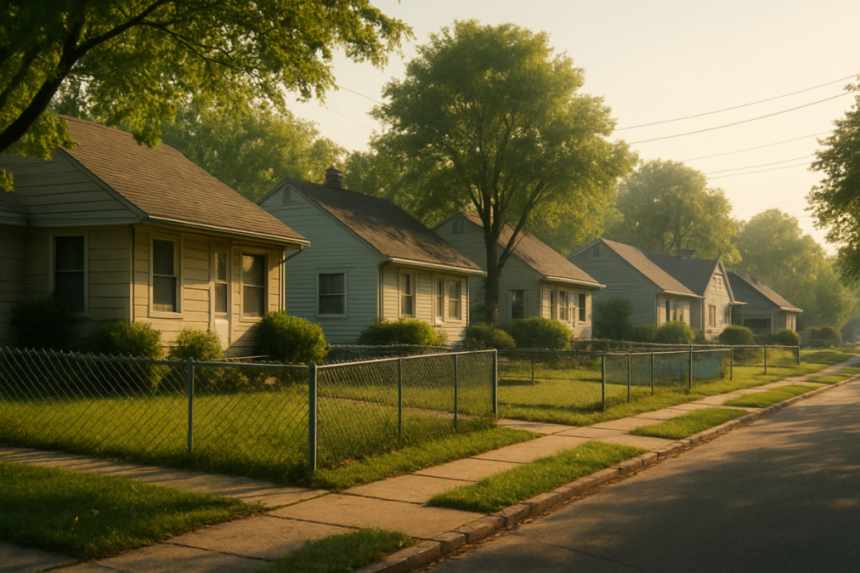
The apartment was the basement of a house on Delling Avenue, on the west side of Columbus, a couple blocks off Sullivant. If you know Columbus you know roughly what I mean and if you don't, it's a neighborhood of small houses from the forties and fifties, chain link, above-ground pools, some blocks kept beautiful and some not, everything a little tired in a way I found restful after two years in the student neighborhoods east of campus. The house itself was a story and a half, pale green asbestos shingle siding, built in 1954 by the parents of the man who still owned it. His name was Edward Halloran. I'm changing the street and I thought hard about changing his name too, but he's gone now, I checked, he died in the spring of 2023, and the name matters to how I tell it, so. Mr. Halloran. He was seventy-four when I met him and he did not look it, or he looked it only in the hands.
I found the listing on Craigslist in July 2018. My previous living situation, a four-person house on Chittenden that I'd been in since I started the program, had come apart in the ordinary way, one girl graduated, one moved in with her boyfriend, and the two of us left couldn't cover it and didn't like each other enough to try. I had about three weeks to find something. The listing was four sentences and one photo of the outside of the house, and it said, and I remember this because it was such a specific thing to promise, QUIET TENANT UPSTAIRS AREA, SEPARATE ENTRANCE, NO ONE WILL BOTHER YOU. All caps his. When I called, Mr. Halloran answered on the second ring like he'd been sitting next to the phone, and we had a conversation that was mostly him asking whether I was quiet, whether I smoked, whether I had a dog, and then a pause, and then he asked how tall I was.
I want to be careful here, because I know how memory works, I study language for a living and I know that people revise their own transcripts constantly and sincerely. So I'll say it this way: I remember him asking how tall I was, on that first phone call, in July, before I'd ever seen the house. I remember thinking it was a strange question and deciding it was about the ceilings. Basement apartment, old house, low ceilings, of course, he's asking if I'll be banging my head. That's the file I put it in. I said five seven, and he said, and this part I'd swear to, he said "that's fine, that's fine," twice like that, and moved on to asking whether I owned a bicycle, because there was a side yard I could keep it in. The ceiling explanation held up fine when I saw the place. Six foot four in the main room, lower under the ducts. A tall man would have hated it. I'm five seven and I cleared everything except the one duct by the bathroom door, which I hit my head on approximately every day I lived there anyway, because it was exactly at the height where you stop registering an obstacle and start absorbing it.
I saw the apartment on a Saturday morning. Mr. Halloran met me in the driveway, and my first impression was that he was the most carefully dressed landlord I'd ever met, pressed slacks, a short-sleeved button-down ironed to a shine, one of those thin old-man cardigans even though it was July. He smelled like pipe tobacco. I'm putting that here, in the first scene, because it matters later and I want it established honestly: the smell was on him the first day, sweetish, a little like raisins burning, and I noticed it and thought my grandfather, because my grandfather smoked a pipe until my grandmother made him stop, and the smell has only ever meant safety to me. Keep that in mind for later, when it stopped meaning that.
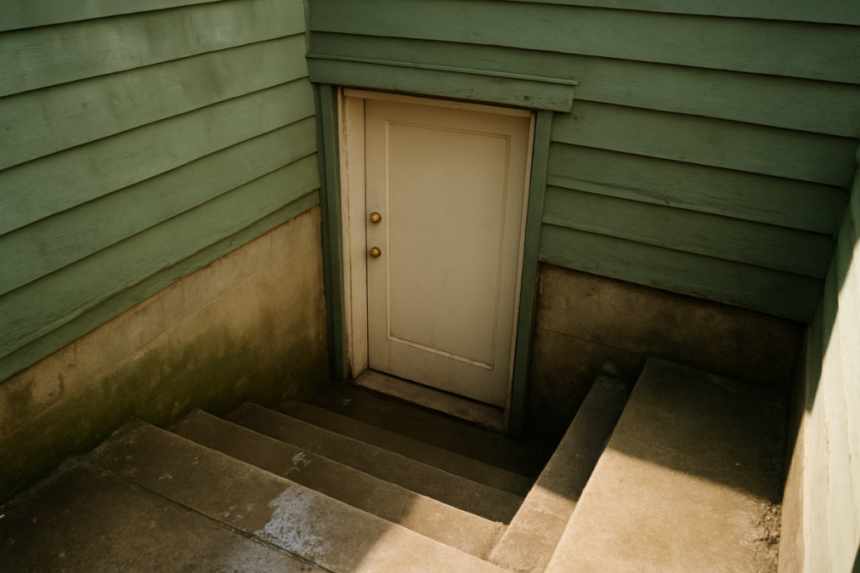
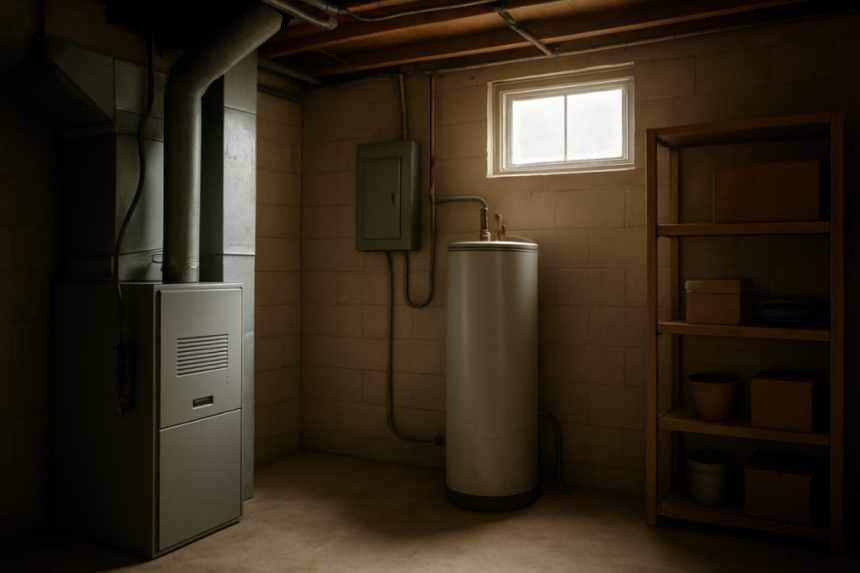
The basement had its own entrance around the side, down four concrete steps into a little well that flooded lightly every time it rained hard, which he showed me himself, pointing at the drain, telling me to keep leaves out of it, an honest man about his property's faults. Inside, the door opened into the kitchen, which had a doorway into a short hall, and off the hall a main room, a bedroom barely bigger than the bed, a bathroom with a shower stall, and at the end a utility room with the water heater, the electrical panel, my breaker box, storage shelves, and the furnace for the upstairs unit, which meant, and this is a normal arrangement in old converted houses but I didn't love it, that technically the upstairs tenants' heat lived behind a door in my apartment. There was also, in the utility room, low in the wall that faced the back of the house, a plywood panel about two feet square, painted the same yellowed white as everything else, with a little wooden turn-latch painted over so many times it had become a lump. I asked what it was and Mr. Halloran said the crawlspace, the house was only dug out under half its footprint, the other half sat on a crawlspace, dirt floor, and the panel was the access. He said, "You'll never need to go in there," and I said great, because I never wanted to go in there, and we both meant it and neither of us knew we were saying something important. Or he did. I've gone back and forth on that for years, whether he knew that early. I don't think he let himself know things, is where I've landed. I think he was a man with a system for not knowing something that lived in his own house, and the system was old and worked well.
Rent was $495, first month plus $400 deposit, and he didn't run a credit check, he called my department office to confirm I worked there, which mortified me because the office administrator, Renata, told everyone, and for a week people I barely knew were asking me about my new landlord who telephones. He had me sign a lease he'd clearly typed decades ago and photocopied ever since, the font had that softened look, and clause eight said the tenant shall keep the utility room accessible to the landlord for furnace maintenance with 24 hours notice, and clause eleven said no alterations to walls, doors, or trim. Trim. I remember reading "trim" and thinking it was a funny thing to specify. You'll see.
I moved in on August 4th, 2018, with my sister Dana's boyfriend's pickup and six trips up and down those concrete steps in the rain, and the drain worked, I'll say that. Dana lives in Dayton, she's three years older, she manages a dental office and she is the person I text when anything happens, so she's all through this story in quotes that I'm reconstructing from memory because I lost that phone in 2021 and the backups didn't go back that far, which I know, believe me, I know how that sounds. The texts I quote are close. They're the gist. The first one I remember from move-in day was me sending her a photo of the kitchen and her replying something like "it looks like where a hostage lives but in a cozy way," which was fair. Concrete floor painted brick red, cabinets from the Johnson administration, a window over the sink at ground level so my view was the underside of a hosta. I loved it. I want that on the record too. For two months I genuinely loved that apartment, the coolness of it in August, the quiet, the little well of green light at the kitchen window, the feeling of having a door that was mine, which at twenty-six, after years of roommates, was a physical sensation like a warm bath. The apartment had its own weather. Sixty-six degrees in August without trying. The water heater refilled after a shower with a long swallowing rumble I could hear from bed, and the baseboard heat, once the weather turned, ticked down the length of the main room and always pinged once, hard, near the bookshelf, ten minutes after I shut it off. Painted concrete under socks is its own specific feeling, smooth and cold, gritty at the edges where the paint had worn, and under everything the place smelled like cold cement and, on Sundays, fabric softener, the neighbor's dryer vent exhaling warm Bounce-smelling air across my window well. I'd sit at the kitchen table grading intro linguistics quizzes with the window open, listening to the sprinkler tick around the yard next door, and I felt like I'd gotten away with something. Four ninety-five. I told everyone the number. It was practically my personality that August.
The upstairs tenants were three undergrads, Tyler, Devin, and a third one whose name I heard variously as Cam, Kam, and once Cameron, and I never got it settled in fourteen months of living under him. They were juniors, business majors I think, and they were fine. I want to be fair to them because for a stretch in October I was building a whole case against them in my head, and they turned out to be exactly what they looked like, which was three twenty-year-olds who owned one couch, a TV the size of a door, and a grill they used in ways that violated several municipal codes. Their noise was normal noise. Footsteps, the TV bass, the toilet, laughing at 1 a.m. on weekends. Twice that fall they had real parties, and both times Tyler came down the next day and apologized, and the second time he brought me a six-pack of a seasonal beer I didn't like, and I mention the apologizing because it tells you what kind of kids they were, and I mention the beer because it sat in my fridge unopened for three months and became, later, one of my little markers, a thing I knew the exact position of. But that's ahead of where I am.
August, then. The first thing I noticed, and I've tried to date this and the best I can do is the third week of August, was the pipe tobacco. I came home from campus on a Tuesday or Wednesday around six, unlocked my door, and the kitchen smelled faintly like Mr. Halloran. Sweet, raisiny, unmistakable if you know it, and gone almost as soon as I noticed it, the way smells are, you get one clean read and then your nose spends it. My first thought was not alarm. My first thought was the furnace clause, he's been in for the furnace, and my second thought was that he was supposed to give notice, and my third thought was that he was old, and old landlords treat their buildings like their houses, because the buildings usually were their houses, and I decided it wasn't worth being the new tenant who makes a thing out of clause eight in her first month. I didn't even text Dana about it. That's how minor it was. A smell, a shrug, dinner.
The dish rack was the second thing, and the dish rack I can date, because it was the Friday before Labor Day, August 31st, because I'd been at the department picnic and I remember scraping potato salad off a paper plate into my trash before I saw it. My dish rack lived to the left of the sink. I'd set it there on day one without thinking, the way you do, and my kitchen habits calcify fast, I'm the kind of person who has a mug and a bowl and washes the same four things in a rotation. It was on the right side of the sink. Everything in it undisturbed, the mug, the bowl, the pot from Wednesday's rice, the water spots on the chrome all dried in place, but the whole rack was sitting to the right of the sink, square and settled, like it had always been there. I stood there with my trash bag in one hand doing the thing you do, which is run the tape backward. Did I move it. Could I have moved it. I could reconstruct washing the pot Wednesday night and setting it in the rack on the left, I had a body memory of turning left from the sink. But body memories are cheap, I know that, I'd been reading about proprioception for a seminar, your body will testify to anything if it makes the story smoother. So I filed it as: I moved it and forgot, or I bumped it and slid it and forgot, even though it had sat there like it had been placed by somebody with a level. I moved it back to the left. I did text Dana that time, something like "either I'm losing it or my landlord rearranges dish racks," and she said something like "landlords don't do dishes, you're losing it," and we let it go. I want to keep being honest about the pace of this. Nothing about August scared me. The scale of everything was so small. A smell. A dish rack. You cannot call your sister in Dayton and tell her you're frightened of the position of a dish rack. There is no version of that conversation that leaves you sounding like a person doing okay.
September I mostly remember as busy, which is its own data point, because the things that happened in September happened around the edges of a life that was full and ordinary and, honestly, pretty good. I was TAing two sections of Intro to Language, which meant a hundred and ten freshmen and a hundred and ten weekly quizzes with my Sunday nights, and I was supposed to be narrowing my thesis topic, which at that point was somewhere in the neighborhood of vowel mergers in central Ohio speech, which meant I spent hours listening to recordings of people from Circleville saying "cot" and "caught" until the words stopped meaning anything. I mention the thesis because it's why I was home so much at night, headphones on, at the kitchen table, and it's also why I can tell you with some confidence what I did and didn't hear, because I spent that fall professionally listening to things, marking tenth-of-a-second intervals in Praat, and I want that on my resume for this story. My ears were in shape. The rest of the job was less flattering. Quiz grading worked out, if you did the division, which I did once and regretted, to about eleven dollars an hour, less if you wrote comments, and I wrote comments, because I was twenty-six and still believed in them. Groceries were $25 a week at the Aldi on West Broad, $30 reckless, and I knew that store's prices cold, the 89-cent flour, the $1.19 eggs. Beth kept telling me to donate plasma, forty-five dollars a visit, and the one time I tried it I got lightheaded in the parking lot after, from skipping lunch, not the needle, and never went back.
There was also the union thing, which I said I'd mostly skip, and I will, but it was the background hum of that whole semester. A group was trying to get TAs to sign cards for a graduate employee union, and a woman in my cohort, Priya, was one of the organizers, and she was relentless in a way I admired and dodged. Coffee meetings, hallway ambushes, a group chat that I muted and felt guilty about. I signed my card in October at a table outside the library mostly so Priya would stop looking at me with that particular disappointment, and then nothing happened, the drive stalled out sometime in the spring for reasons I never followed, and the reason I'm telling you about it at all is that for about two weeks I wondered, seriously wondered, whether the weirdness in my apartment was connected to it. Whether somebody was getting into my place to rattle me because of a union card. Write that down as the first fully stupid theory I built, there are more coming. At the time it felt almost rational. It was the only thing in my life with any conflict in it. When strange things happen, you go looking for your enemies, and my entire enemies list was: the university, abstractly. So for two weeks in my head the university was moving my dish rack. The brain would rather have a dumb story than no story. That is the single most important thing I learned that fall, and I learned it from every direction.
Also in September my bike got stolen, which has nothing to do with anything, and I know it has nothing to do with anything because I got to watch it having nothing to do with anything, but for a few days it felt connected, because everything was starting to feel connected, which is a sentence that should have alarmed me more than the bike did. It was a green Schwinn hybrid I'd had since undergrad, locked to the chain link in the side yard like Mr. Halloran had suggested, and on September 16th, a Sunday, the lock was cut and the bike was gone. Cable lock, so, my fault, everyone online will tell you a cable lock is a suggestion. I filed a police report on the non-emergency line, the officer typed with the phone audibly against his shoulder and told me bikes go to two places in this town and neither has an address, and that was that. Tyler upstairs saw me looking at the cut cable and said a bunch of stuff had been getting taken on the street, somebody got a leaf blower out of an open garage, and this made me feel weirdly better, being part of a general local misfortune instead of a specific one. Mr. Halloran, when he heard, came by and put a new hasp and padlock on the side yard gate, unasked, and wouldn't take anything for it, and stood there in the yard turning the old cut cable over in his hands with an expression I didn't understand at the time and think about a lot now. Not anger. Something more like relief that it was only this. Like a man triaging.
The smell came back twice more in September, both times on days I'd been out until evening, and the second time it was in the hall, not the kitchen, and by then I'd stopped being philosophical about it. I know the lease said furnace access with notice. I'd gotten no notice. And some things had moved. I'm going to list the September things all together even though they were spread across weeks, because the list is what eventually moved me to act, and I want you to see it the way I saw it, accumulating. The dish rack again, left to right, same neat placement. My shower curtain reversed on the rod, the seam that had faced the wall now facing out, which is such a nothing detail except that I knew, I knew the way you know your own handwriting, that I hung it seam-in. A kitchen chair, I always tucked both chairs fully under the table because the kitchen was small, found angled out, not dramatically, angled out the way a chair is when someone has just gotten up from it. And my books. This one bothered me the most and is the hardest to explain. I kept a stack on the table, thesis stuff, library copies, maybe six books, and the stack was always in the order of use, most recent on top. I came home on the 25th and the stack was reordered by height. Tallest on the bottom, shortest on top, a perfect little ziggurat. Nobody does that by accident. But here's the thing, and I remember saying this out loud to Dana on the phone, standing in the kitchen looking at it: a burglar doesn't do it either. Nothing was ever gone. Nothing was ever damaged. My laptop sat in plain view through all of it. Whatever was happening in my apartment, its only visible activity was a kind of light, patient tidying, and Dana said, and this is close to verbatim because it became a joke between us for a while, she said "so call the police and tell them a poltergeist is organizing your books by height, see if they send the SWAT team," and we laughed, and I hung up, and I did not laugh again for a while after that, because that night was the first time I heard the chair upstairs.
I'll come back to the chair. I'm trying to keep things in order and the chair doesn't get bad until later. In September it was one sound, one night, barely a sound at all: I scooted my chair back from the table, wooden legs on painted concrete, that specific dry scrape, and overhead, maybe half a second behind, the same scrape. Same duration. Same little hitch in the middle where my chair always caught its bad leg. I sat there and then I said to the empty kitchen, "coincidence," out loud, like an idiot, because Tyler and them had chairs too, and upstairs floors carry everything, and two people can move chairs at 11:40 on a Tuesday. That's true. It stayed true right up until it didn't cover the facts anymore, and I'll get there, but I want it noted that "coincidence" was correct for a long time, or at least unfalsifiable, and I clung to it with both hands, because the alternative theory had no name yet.
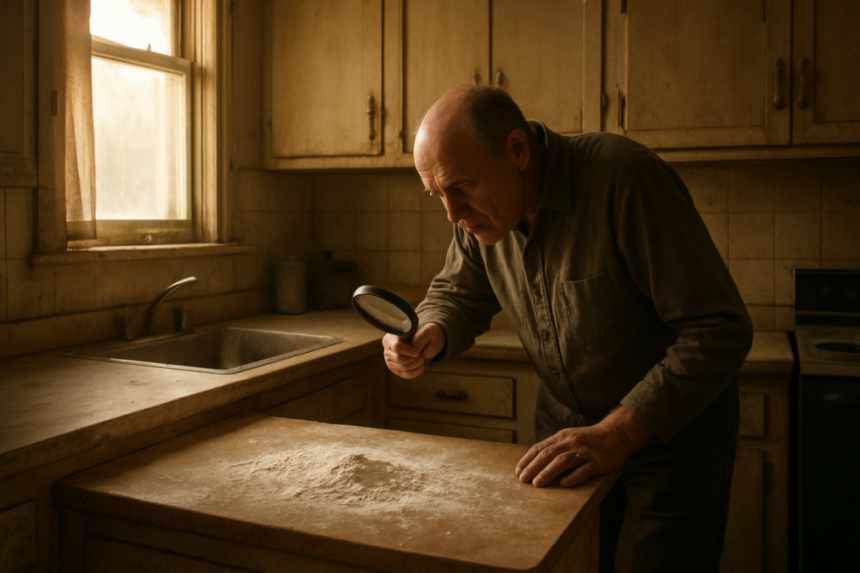
By the end of September I'd decided it was Mr. Halloran coming in, and honestly the decision was almost a relief. A creepy landlord is a known genre. There are subreddits. There is a whole folk technology for it, and I deployed all of it with the grim satisfaction of a person finally doing something. On October 1st, and I know it was the 1st because I did it the same night I paid October rent, I set up what the internet calls telltales. A little tab of Scotch tape low across the seam of my entry door, inside, where you'd never see it. A single long hair, mine, licked and stuck across the gap of the closet door in the bedroom. And in the utility room, because that room had the other door, the one to the crawlspace panel, and because the furnace clause meant it was the room he had the best excuse to enter, I did the flour thing: a fine dusting of flour on the concrete just inside the utility room door, a patch maybe two feet deep, invisible unless you were looking, sifted through a tea strainer, which took three tries to lay right, because pouring from the bag left drifts, ridges, an obvious trap, and I had to wet-mop, wait for the concrete to dry, and start over, and the colander made polka dots, and finally the strainer, tapped from waist height while I walked backward toward the hall so I wouldn't step in my own work, put down something even. Gold Medal all-purpose, if you want the brand, because it was what the canister held. I photographed the patch from the doorway with my phone so I'd have a before. I felt insane doing it and I felt insane in a competent way, like a TV detective, and I texted Dana a photo of the flour patch and she replied something like "CSI: Delling Avenue," and then, a minute later, "if it's the old man just get a chain lock, don't make it weird," which was good advice aimed at the wrong universe.
Here is what the telltales did over the next three weeks, and I'm going to state it as flatly as I can because this is the hinge of the whole thing, this is where my story stops being a story about a landlord and I lose the ability to say what it's a story about. The tape on the entry door was never broken. The hair on the closet was never disturbed. The flour in the utility room doorway kept its texture, my little sifted moonscape, untouched, and I checked it against the photo, zoomed in, matched individual clumps like fingerprints, because by then I was matching individual clumps of flour like fingerprints on a Tuesday night instead of grading quizzes, which, yes, I can hear it too. Nothing crossed my thresholds. And inside, things went on changing. Small, patient, tidying changes. October 9th, the dish rack, again, left to right, tape intact. The night of the 13th or 14th, the six-pack Tyler gave me moved from the bottom shelf of the fridge to the top, all six bottles, labels rotated to face out, which I would absolutely have blamed on myself except that I had not opened that fridge since the morning, I'd eaten on campus at a colloquium reception, mini quiches, I remember the quiches, I remember them because when I saw the bottles I did an inventory of my entire day like a deposition witness and the quiches were load-bearing. Tape intact. Hair intact. Flour intact.
The flour became a discipline of its own. Every Sunday night I re-laid it, wet-mop, dry, sift, photograph, and I learned things nobody sane knows. Gold Medal lays heavy and holds. The Aldi flour, Baker's Corner, 89 cents, is fluffier and drifts, and for the two weeks I used it, it recorded every movement of air in that room as fine combed furrows near the door, parallel, deliberate-looking lines that bought me ten very bad seconds, until I worked out that they appeared whenever the upstairs furnace fired and pulled air under the utility room door, and proved it with a lit match held at the door gap, watching the flame lean. I tried cornstarch once, finer, shows more, showed too much, the house breathing, and anyway I ruined it the second night, shuffled in half asleep to flip a tripped breaker and put my right foot dead in the patch, and stood on one leg swearing with my toes in my own evidence. Sock prints smear soft at the edges. A dry mop leaves crisp lines. A draft combs. A drip from the water heater's relief pipe leaves a little crater with a clean rim, same spot, that one's plumbing. The point of the taxonomy: eleven weeks of Sundays, two flours and a cornstarch, and the patch showed my foot, the mop, the draft, the drip, and not once anything else. In November I laid a second strip along the base of the crawlspace panel itself, figuring if anything so much as breathed on that panel I'd have it, and it lay there perfect until the day I moved out. Whatever kept the chart did not use the floor.
I want to describe what that does to a person, because I'd always assumed fear was a jump-scare economy, a thing that spikes. This wasn't that. This was more like a slow change in the pH of my life. The apartment still looked like my apartment. I still paid $495 for it. I graded in it, slept in it, microwaved in it. But every single object in it had acquired a second question hanging off it, which was, is that where I left you, and you cannot ask that question of every mug and chair and shampoo bottle all day without it costing you something metabolically. I started photographing rooms before I left in the morning. Casually at first, like it was for insurance, and then systematically, kitchen from the doorway, table, counter, rack, then hall, then bedroom. Fourteen, fifteen photos a morning. I'd review them at night against the actual rooms like a returning ship's captain. And mostly, I want to be fair, mostly nothing had changed, day to day. The changes came maybe once, twice a week, and they were always the sort of thing that sat exactly on the line between evidence and paranoia, a chair angle, a label rotation, and I know now that the ambiguity wasn't a bug. I don't know how to say this next part without sounding like I'm assigning intent, so I'll just sound like that: the changes were calibrated. They lived in the exact size range where a reasonable person can't act on them, can't call anyone, can't even tell anyone without editing herself down to sound less crazy. Whoever or whatever chooses sizes chose that size. That is the most frightening sentence I know how to write about October, and it has no ghost in it. Just a size.
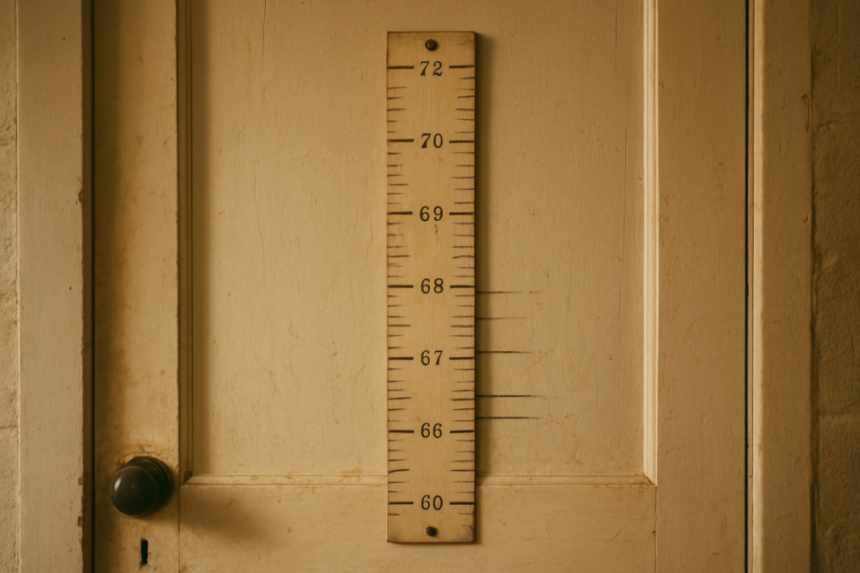
I found the marks on October 10th. Here's exactly how, because the how matters and it's dumb: I was carrying my laundry basket from the bedroom to the kitchen, where I'd stage it before hauling it up to the laundromat on Broad, and I clipped my elbow on the doorframe between the hall and the kitchen, the way you do a hundred times in a tight apartment, and I said something unprintable and stood there rubbing my elbow, and my eyes were exactly at doorframe height for once instead of passing by it, and there they were. Pencil marks. On the kitchen side of the frame, the flat of the casing, faint, the kind of faint where graphite catches light at one angle and vanishes at another. Short horizontal lines, very level, maybe a dozen of them, and beside each one, small and neat, numbers. I remember thinking, before anything else, oh, like a growth chart, because that's what it was, formally speaking, that is exactly the genre of artifact it was. My parents had one on the pantry door in the house I grew up in, me and Dana in two columns of ascending ticks, and there is no object in the world more benign than that pantry door. So the shape of it read as sweet for about two full seconds, some family's kids, decades of birthdays, and then I did the thing you shouldn't do, I looked closer.
The numbers beside the marks were dates. Month and day, slash between, no year: 8/12. 8/19. 8/26. 9/2. 9/9. And so on, weekly, Sundays, I checked that later against a calendar and they were all Sundays, climbing the frame one above another in the same small handwriting, up to the most recent one, which when I found them said 10/7, which had been the previous Sunday. Three days before. I moved in on August 4th. The first mark was dated eight days after I moved in, and the marks went up from there, and I stood in my kitchen doorway with a laundry basket on my hip doing date arithmetic over and over like the dates would come out different, like there was a year in which 8/12 through 10/7 could belong to some previous family, some earlier tenant's kid, and there is no such year, because the marks were not there in August. I want to be careful, because this is one of the places a skeptic will push, and the skeptic should push. Can I prove the marks weren't there in August, faint as they were? Photographs, no. My morning room photos didn't start until October and none of them framed that stretch of doorframe anyway, which has tormented me, of all the things I photographed. But I can tell you that I washed that doorframe on move-in day. Me and a bucket of Murphy Oil Soap, every piece of trim in the kitchen and hall, because the previous occupant had been a smoker of something and the trim had a film on it. I washed that casing with a rag, at eye level, on August 4th, and there was nothing on it. On that I'd testify. And I understand that what I've just said is "I'd testify that I would have noticed something I've told you is nearly invisible," and I understand what that's worth in court, and this is the last time I'll do this dance for you, but I wanted to do it once in full so you know I know.
The other thing about the marks, and I noticed this before I let myself notice it, the way you'll hold a fact at arm's length for a while when you can see its teeth: they were rising toward something. The 8/12 mark was low, around five feet even, maybe a hair over, and each week's mark sat above the last by something like half an inch, three quarters, not perfectly regular, the way a growth chart isn't perfectly regular, and 10/7, the newest one when I found them, was at about five foot six. I am five foot seven. I did not measure anything that first night. I put the laundry basket down and I went and got my phone and I photographed the marks, flash on, and the flash washed the graphite out to nothing so I turned the flash off and shot in the bad hall light and got something usable, and I texted the photo to Dana, and I remember exactly what I typed because it was the first time I'd put the situation into a sentence for another person: "there are height marks on my doorframe with this year's dates on them and they weren't here in august." And Dana, who had been running a light mockery defense on my behalf for two months, because that's her love language, called me instead of texting, which in my family means DEFCON has changed, and the first thing she said was something like, okay, walk me through the whole thing, and I did, tape and hair and flour and dish rack and dates, all of it, out loud, in order, for the first time. There was a silence when I finished. Long enough that I checked the screen. And she said, not joking at all, "whose heights are those," and I said I didn't know, and she said, "is it yours," and I want you to know that until my sister said that, standing in my kitchen I had not let that thought finish anywhere in my body, and when it finished, when it clicked through, I had to sit down on the floor. Because the marks were climbing. Because they had started at five even and they were at five six, and I was five seven, and there were more Sundays coming, and some animal part of me had already done all of this math and had been waiting, politely, for the rest of me.
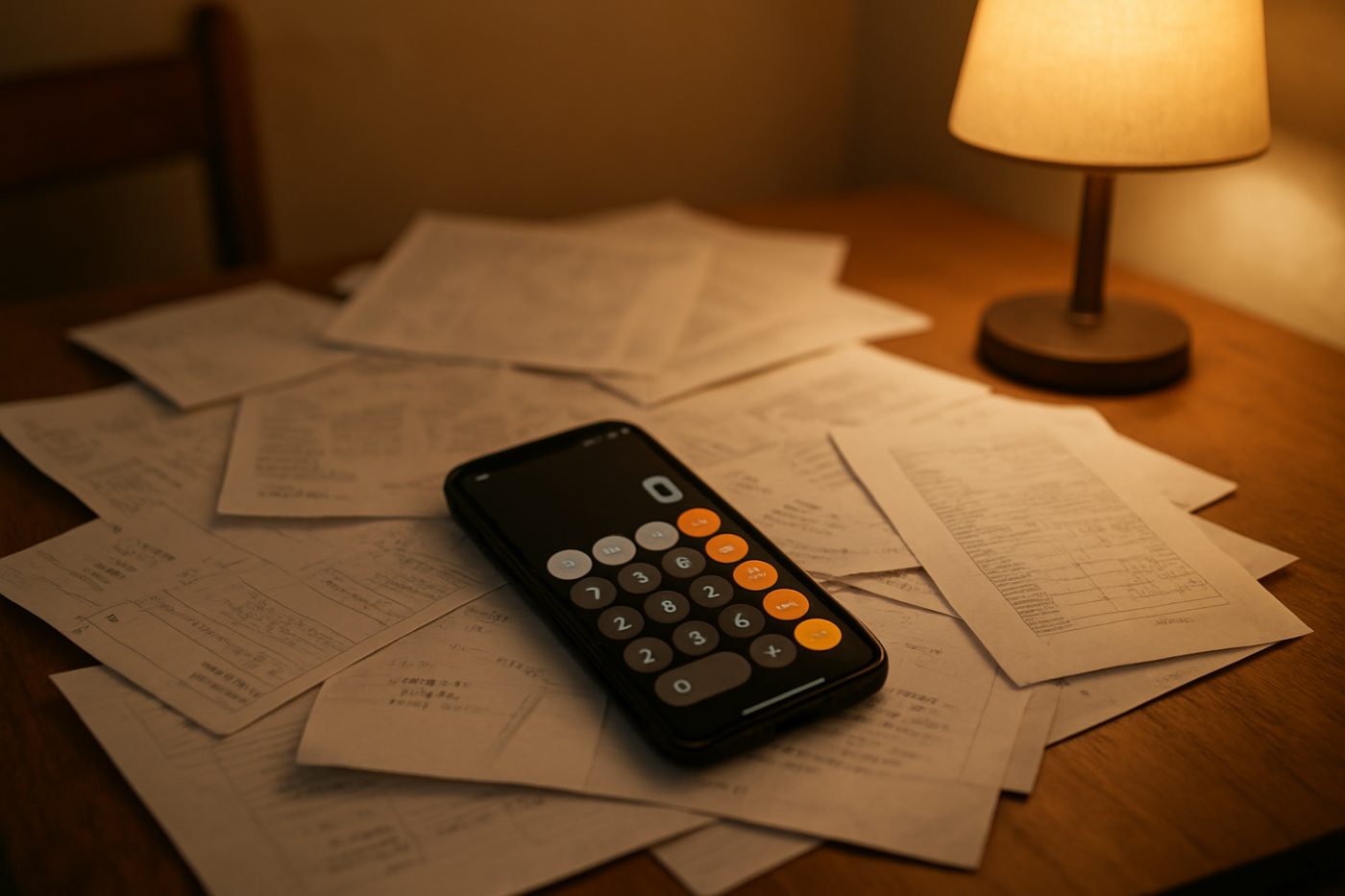
The next Sunday was October 14th. I did not sleep in the apartment that Saturday night, I'm not going to pretend I did, I told a half-lie to my friend Beth from my cohort about my heat being out, which it wasn't, and slept on her futon, and drove back Sunday around noon, and the tape on my entry door was intact, and I checked it before I checked anything else, and then I went and stood in the kitchen doorway. New mark. 10/14, neat and small, a little above the 10/7 mark. Tape intact. Hair intact. Flour intact, matched against its photo. I had been out of the apartment for twenty-two hours and the doors had, as far as three separate telltales could report, never opened, and there was a new pencil line in my doorframe half an inch shy of five foot seven, and that was the day the problem stopped having a shape I could put a locksmith at. I called one anyway the next morning, a Monday, paid $140 I did not have to have the entry lock replaced with something called a Grade 1 deadbolt, and I want to record what the locksmith said because it was the only comedy that whole week: he looked at the old lock and said, "this lock's fine, whoever's coming in, they're not coming in here," and he meant it as a compliment to the lock. And that same week I looked at moving, seriously, with a spreadsheet. Application fees ran $35 to $50 a building, nonrefundable. Everyone wanted first month plus a deposit matching rent plus proof of income at three times rent, and three times $700 is $2,100, and I made $1,478, so on paper I didn't qualify for the apartments I also couldn't afford. With a truck and an overlap month the spreadsheet put moving at $1,600 to $2,000, against $412 in savings and a credit card I'd been raised to treat like a loaded gun. I toured exactly one place, a $680 studio on the Hilltop with the shower in the kitchen, actually in the kitchen, behind a folding screen, and the man showing it said, you get used to it. I drove home to the clean quiet basement that frightened me and paid $495 on the first like always.
I also, that same week, did the thing I'm least proud of in this whole account, which is that I called Mr. Halloran and accused him. I'd written out what I was going to say on an index card, which tells you how nervous I was, bullet points, "entries without notice," "personal effects disturbed," "markings on painted trim, ref. lease clause 11," like I was going to litigate him into confessing. He heard me out completely. He didn't interrupt once, which threw me off my card, because I'd prepared for pushback and instead there was this attentive silence getting deeper and deeper on the other end, and when I finished he was quiet for a second and then he said, and this is close to exact, "the marks on the doorframe. Are they in pencil." Not, what marks. Not, I would never enter your home. The one question. And stupid me, still on my index card, I said yes, pencil, and started to say something about repainting costs coming out of my deposit, and he said, gently, like a man correcting a student who's misread the problem, "I haven't been in the apartment since the gate lock, and that was the yard. I don't go in. That was part of it." And then he didn't say anything else, and I didn't either, because "that was part of it" is a phrase with a door in it, and neither of us opened the door, and after a moment he said if the lock I'd installed made me feel better he'd credit it against November rent, which he did, $140, the check ledger would show it if I still had the checks. I hung up feeling somehow in the wrong, which infuriated me for a week. It took me a long time to understand the call from his side. He'd been braced for that phone call, I think, for years, from tenant after tenant. He'd learned exactly what to ask. Are they in pencil. And the answer told him where in the progression we were, like a doctor asking if the cough is dry.
I should say what I did about the upstairs guys, because a person reading this has been yelling "the crawlspace connects, it's the undergrads, it's a prank" for several paragraphs, and fair, that theory got a full workup from me, weeks of it. Motive, none, but undergrads don't need motive. Means, maybe: if the crawlspace ran under part of the house and their unit had its own access somewhere, closet floor, kitchen, somebody could in principle get from up there to under the house, and from under the house to, well, to nowhere, because my crawlspace panel was painted shut, which I'd known since day one and re-verified now with my face three inches from it, decades of paint bridging panel and frame in an unbroken skin, the latch a solid lump. Nobody had opened that panel in years, from my side. Hold that phrase. From my side. Opportunity, and here's where the theory died on a specific weekend: the marks changed on Sundays, and the weekend of October 20th, all three of them were out of town for the away game, I want to say it was the Purdue game, they'd talked about the drive for days, I watched them load the car Friday afternoon, cornhole boards and a cooler, and their windows stayed dark all weekend and their cars, both cars, were gone until Sunday night. The 10/21 mark was there Sunday morning. I checked at 9 a.m. with coffee in my hand, new mark, and their unit was two hundred miles away eating gas station breakfast. I'll flag, since I'm keeping myself honest: years later I tried to reconstruct the date against the football schedule and I couldn't make the away games line up as neatly as this, the Purdue game seems to have been a night game and possibly a different weekend, so either I have the opponent wrong or the weekend, memory files things under the nearest label. But I stood in my kitchen that Sunday morning knowing the house above me was empty, that's the part I'm sure of, the emptiness was the whole texture of that weekend, and the mark came anyway. And the 10/21 mark was the one. I got the tape measure out that morning, finally, because there was no more room for not knowing. Hooked it on the floor, ran it up the casing, read it twice. Five feet seven inches. On the nose. My height, dated that day, in my doorframe, in a handwriting I'd started, against every effort of my rational mind, to find familiar, not because I'd seen it before but because it was so patient. And I did the thing then that I still can't fully explain, the dumbest thing in this entire account: I backed up against the doorframe, in my socks, heels to the wood, the way you stand for the pediatrician, and I stood very straight under the mark with my hand flat on my head, measuring myself against it. Alone, in my kitchen, at nine in the morning, standing in the spot. Like I was checking their work. Like I owed the chart my cooperation. I caught sight of my own reflection doing it in the dark of the kitchen window and stepped away so fast I knocked a chair over, and that clatter, me alone with an overturned chair and a tape measure at 9 a.m., embarrassed in front of nobody, that's the picture of that fall I'd submit if you could only have one.
There were smaller theories too, duds, and the duds were most of my October. Meter reader: old basements sometimes have the gas meter inside, and meter men have keys, and that was one hopeful afternoon until I walked around the house and found my meter outside on the north wall wearing a gray transmitter cap, remote read, no key needed since 2016. Pest control: some landlords keep a quarterly service, a tech with a key who moves things to spray behind them. I asked Mr. Halloran on a rent call whether the house had a bug service and he said no, he did his own, and then one of his pauses, and then that the basement didn't get bugs, said it like a specification. And it was true, I realized after I hung up, I never saw so much as a cricket down there in fourteen months, nothing alive I didn't carry in myself, except one spider in the hall, who gets a name later in this story. And the previous tenant with a copy of the key: dead the day the locksmith left, deader every morning the tape held, and I kept it warm another week anyway, because it was the last theory with a human being in it, and I had reached the stage where I would honestly rather have been stalked.
The theory I haven't covered yet is me. It deserves the most space and got it at the time, believe me, because it was the last normal explanation standing, and I wanted it to be true with a wanting I can still taste. Sleepwalking. Or some dissociative thing, some fugue, stress, because God knows the ingredients were on the shelf, second-year pressure, thesis drift, money, a semester of bad sleep in a basement. The theory covers so much. It covers the tape and the hair and the flour, because the call is coming from inside the house, nothing has to cross a threshold if the hand holding the pencil sleeps in the bedroom. It covers the tidying, because who else knows my objects well enough to adjust them by inches. It even half-covers the dates, if some night-me was keeping some horrible little ledger. It does have holes and I saw them even at my most hopeful: it doesn't cover the marks above five seven, which were coming, and I could not for the life of me figure out what I'd be standing on, and it doesn't cover the handwriting, which was not mine, and I say that as someone who then spent an evening trying to forge that handwriting with my left hand and my right hand and my eyes closed, sitting at the kitchen table filling a page of a legal pad with tiny 10/21s like a person you'd cross the street to avoid. But the holes weren't fatal, and a mental health explanation, and I want to say this plainly because I think it's the most relatable thing in this whole story, a mental health explanation would have been such good news. People ask, weren't you scared it was you? Scared? I'd have wept with relief. There are professionals for me. There are copays and workbooks and little orange bottles for me. My university literally had a counseling center for me, with a waitlist, which I got on, which is its own subplot that goes nowhere, they called me in January after I'd already moved out and I told the poor scheduler never mind, it resolved, which is one way to put it. And I tested for it, properly, because if it was going to be me I wanted it caught, not suspected. Talcum powder in a band across my bedroom doorway, inside, where night-me would have to cross to reach the kitchen, and two weeks of that showed nothing but my own morning footprints, right direction, right times. A recorder app on the phone all night, listened to at double speed during grading breaks, hours of furnace hum and sighing, and on mark nights the audio runs continuous, no door, no footsteps. Beth's borrowed Fitbit put me asleep by 12:30 on mark nights, one smooth band till morning, deeper if anything in the dead middle of the night, a little trench between three and four that meant nothing to me then and means something now, for reasons the camera part will make clear. And Dana laughed at the question and said I sleep like a dropped phone, face down, dark, same position at seven as at midnight. None of it proves anything, I know. But you run out. You run the tests because the diagnosis is the good ending, and the tests come back clean, and you sit there and realize you'd been rooting against yourself, and lost.
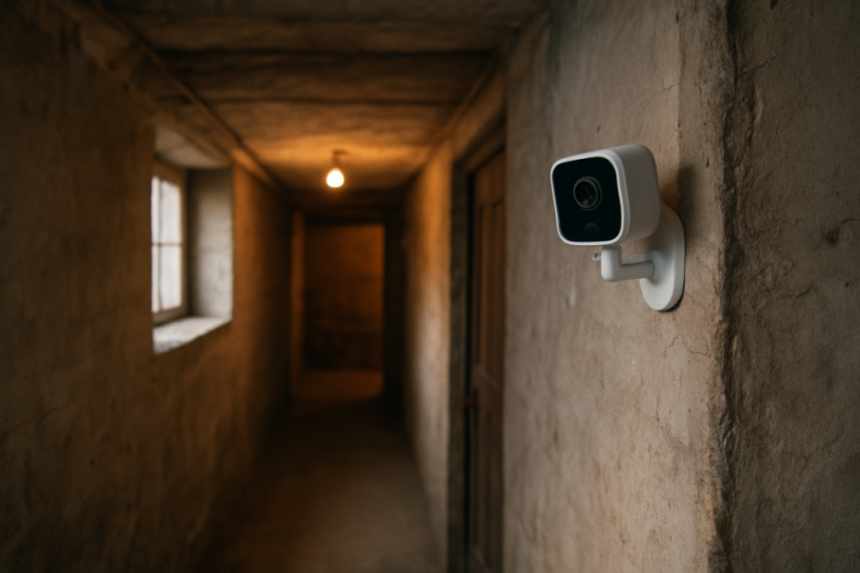
So, the camera. $29.99 on Amazon, a brand called something like VIKKOTEK, all consonants and optimism, a little black cube that took a microSD card and claimed night vision and motion detection. I will tell you now, before the punchline, that it was junk. Genuinely, unambiguously junk, the reviews said junk, one star, two stars, "worked for a week," "clock resets," and I bought it anyway because the good ones started at $80 and I have already shown you my budget. I want the camera's cheapness established with both hands because of where this is going, and because I have gone around this loop five hundred times and the cheapness sits at the exact center of the loop. I set it on the bookshelf in the hall, angle covering the kitchen doorway, the doorframe, the marks. Plugged in, red light, card in, and for a week I got exactly what I hoped for, which was footage of nothing. Me crossing the frame in a towel. The oven clock changing. Motion clips of a spider that lived, I learned, in the hall ceiling corner, and whom I named Gregor, and who is the only character in this story I never suspected of anything.
The next new mark came the night of Sunday November 4th into Monday the 5th. 11/4, five foot eight and a quarter, I measured, above me now, the third one above me, they'd cleared my head on October 28th and kept going, which did something to the pit of my stomach that the earlier marks hadn't, because a chart climbing toward you is a countdown, but a chart climbing past you is a departure, it's leaving you behind for somewhere else, and I found I minded that more. Don't ask me to justify it. Anyway. Monday morning, new mark, and I went to the camera like a farmer to a rain gauge, pulled the card, and the card had motion clips at 11:52 p.m., me, kitchen, water glass, and then 2:19 a.m., nothing visible, probably Gregor, and then the next clip was 3:44 a.m., and the 3:44 clip opens on the kitchen doorway, still, empty, gray in the bad night-vision the way everything was, and nothing happens in it for its whole twenty seconds, and the mark is already there. You can't read it at that resolution, but you can see, at the right part of the frame, a new faint tick that the 2:19 clip does not have. So sometime between 2:19 and 3:44. And the camera's own log, it kept a dumb little text log of events, showed a gap: no entries between 3:11 and 3:44. Not "no motion." No entries. The kind of gap a $30 camera produces when it browns out, or hiccups, or its firmware, written by the lowest bidder, chokes, and I know that, and I called it junk out loud in my kitchen and meant it. Then it did the same thing on November 11th. Log gap, 3:11 to 3:44. Same numbers. To the minute. New mark in the morning, five nine, a little wobble in the line for the first time, as if written from an awkward reach. And on the 18th, the third Sunday, I sat up. I want this in the record even though I've debated leaving it out. I sat up in the hall in my coat in a kitchen chair with coffee, lights on, phone in my hand, facing the doorframe, and the plan was simply to be a witness, and I was awake at 1, awake at 2, I have texts to Dana timestamped 2:40-something saying something like "nothing yet, gregor active," and the next thing I have is me waking up at 6:10 in the chair, neck destroyed, coffee full and cold and skinned over next to me, and no memory of getting sleepy. No drowsy period. Awake, then nothing, like a cut in film. New mark: 11/18. The camera log that night has a gap from 3:11 to 3:44. I did not sit up again. Whatever choreography wanted me asleep for that half hour was a stronger dancer than me, and some part of me, the animal part that had done the math early back in October, understood that being unconscious for it was not an oversight, it was a courtesy, and that I should take the courtesy. I still have the card, for what it's worth, in a drawer in a labeled envelope like evidence for a trial that has no venue. A few years ago I tried to open the clips on my current laptop and the folder shows the files, shows their dates, and every one of them errors out as corrupted. Which is what happens to cheap video files over time. It's also very convenient for me, narratively, I'm aware. Both things are true and I've stopped trying to make them fight.
In the middle of all that, the 15th, Mr. Halloran made his one visit. A postcard came the day before, my address in blue ballpoint: will need access to utility room Thursday 10 a.m., furnace filter, E. Halloran. Twenty-four hours notice, per clause eight, by United States mail, from a man who lived forty feet away. He knocked at ten sharp, called me miss, wiped his feet longer than feet need wiping, and carried a folded drop cloth, a new filter in its printed sleeve, and a flashlight he never turned on. He was lovely. He said I kept the place the way his mother had kept things, which was clearly the top of his scale. He declined coffee with the raised hand men his age decline with, took a glass of water instead, and after he left I found the glass washed, dried, and set upside down on a folded paper towel beside the sink. Eleven minutes, and he never once looked at the crawlspace panel. The utility room is small. The panel sits at knee height directly beside the furnace. Eyes go places, it's what eyes do, and his didn't. When he'd gone I stood at the counter with his postcard next to my phone, the photo of the marks zoomed all the way in, because I'm not stupid, and the two hands had nothing to do with each other, his large and looped and slanting downhill, the marks small, upright, patient, and I felt one more theory go out quietly, like a pilot light. The kindness was real, it went all the way down, I watched him refold that drop cloth into eighths on his knee. And the same man had asked me, gently, on the phone, are they in pencil. Both of those men were true, and a house where both are true is worse than a house with a liar in it, because a liar you can catch.
November is also when the ceiling got worse, and this I have no telltale for, no log, nothing but my professionally trained ears and my word. The chair scrape thing, which had been an occasional coincidence in September, became a pattern I could reproduce. Not always. Maybe one time in five, and never when anyone else was there, which I know, I know. But one time in five: I'd scrape my chair, and overhead, half a second behind, the same scrape, and I mean the same, my chair's bad-leg hitch included, played back at me through the floor like a wet echo. I ran water at the kitchen sink and heard water start above me a beat later, in the same rhythm, though their kitchen, I'd been up there once for thirty seconds in September to return a package, their kitchen is at the other end of the house, over my bedroom, and what's over my kitchen sink is, by any floor plan that makes sense, their living room, where there is no water. I closed my medicine cabinet and something upstairs clicked shut. I know how paper-thin this reads. I'd have rolled my eyes too, sounds in an old house, the plumbing talks, the joists talk. What I can tell you is that I spent my working hours that fall marking time intervals on spectrograms, that half a second is an interval I could clap for you right now, and that the delay never varied. House sounds vary. This was quantized. And the week of Thanksgiving, when Tyler and Devin and Cam-or-Kam were verifiably gone, cars gone, I watched them leave with duffels Tuesday noon, their unit dead dark every night, I sat in my kitchen Wednesday evening in that empty house, and I scraped my chair on purpose. Once. Long scrape, hitch, stop. And I sat with my hands flat on the table and my pulse going in my ears, thirty seconds, sixty, and there was nothing, and I had almost finished being relieved when it came: the scrape, the hitch, the stop. Half a second of delay, delivered forty seconds late, like something had held it, considered it, and then decided, out of whatever it uses for a sense of humor, to pay me anyway. I slept at Beth's again that night. I told her the fumigation story. By the end I had a fumigation story with recurring characters. And I should confess here, because I said I'd confess things: for four nights the week after Thanksgiving I didn't sleep at Beth's or at home, I slept in my shared TA office in Oxley Hall on a camping pad between the desks, which is against I'd guess eleven university policies, setting a phone alarm for 6:15 to be packed up before anyone came in, brushing my teeth in the third-floor bathroom, and on the fourth morning the custodian, a woman named Gloria who I'd been saying hi to for a year, unlocked the door at 6 and found me folding the pad, and she looked at me and the pad and my little grocery bag of toiletries, and she said, not unkindly, "honey, whatever it is, it followed somebody I knew to a nicer building than this," which I have thought about at least weekly ever since, and then she emptied the trash and left and never told anyone as far as I know.
The last thing before Mr. Halloran, because it was the thing that sent me to him: the crawlspace panel. December 2nd, a Sunday, new mark that morning, 12/2, five foot ten and change, the line of them now running up the casing like a ladder out of my reach, and I was in the utility room with a flashlight doing my weekly flour check, feeling like the night watchman of a museum nobody robs, and on an impulse I got down and looked at the painted-shut panel really closely, with the flashlight held flat against the wall so the light raked across it, which is a trick from looking at old documents, raking light shows you topography. And the paint skin over the seam was perfect, unbroken, I'd verified that before. But there was, low on the right side, a place where the paint at the edge of the seam had a bead to it. A tiny rounded lip, like the paint had been pushed while wet, from behind, a hair of it squeezed out through the crack the way filling squeezes out of a sandwich, and then had dried that way. I stared at it for a long time and then I went and got the kitchen chair and sat on it in the utility room doorway and thought about painting. About how, if you painted a panel shut from inside a crawlspace, from the dark side, to seal yourself away from a basement, the squeeze-out would end up exactly there, on the room side, low, where your brush pressed. The panel wasn't painted shut to keep something out of the crawlspace. You couldn't get that bead from my side. I sat there until the flashlight got dim because I was not built to hold the thought, which was that the panel had been painted shut from within, by someone in the crawlspace, working by feel or by no light, neatly, a long time ago, and that every layer of paint since, Halloran's layers, decades of them, had gone on over that first seal like nailing shut a door that's already nailed, the way you keep promising something you're afraid to stop promising. I did not test the latch lump. I want that understood. People ask why I never opened the panel, why I never got one look with the flashlight, and I've stopped being embarrassed by the answer, which is that the accumulated intelligence of every person who had ever painted that seam, and there had been several, and they all knew the house better than me, was: don't. Some inspections you don't conduct. You live your whole life being told curiosity is a virtue and then a two-foot piece of plywood in a rented basement teaches you, in one evening, that it has a load limit.



AI illustrations. Please judge the story itself. About AI images.
Filed by its author.
Before you peek: what share of readers believes this story?
50%
No votes yet
Total verdict votes: 0
Guess first! What other readers decided is hidden until you cast your own verdict above — vote True, Fake or Not sure to reveal the community score.
Changed your mind? Read the strongest arguments of the other camp below. If they convinced you — change your verdict (once).
Your new verdict:
Why did you vote that way? Pick up to two:
Noted — thank you, detective.
My case notes (private — stored only in this browser)
Saved in this browser.
True or Fake? — play the detective
How it works: cast your True/Fake verdict above and see whether you matched the reader majority. Then hit "Next case" for a random story and keep your streak going. Solve cases to climb the detective ranks — score and rank are kept on this device only.
Tip: highlight any sentence of the story with your mouse or finger — a small share popup will appear to post that exact quote (with a link back to the story) to X, Facebook, Threads or Reddit.
Something similar happened to you? Tell your version — the jury is waiting. Tell your story
Keep investigating
- More Unexplained Events cases
- More Landlords cases
- A case the jury believes: The Hotel Room That Was Already Occupied
- A case the jury believes: The Host Lived in the Basement the Whole Time
- A case the jury believes: My Landlord Had a Key and Used It When We Were Out
- The full Rental Nightmares Stories archive
- Cases the jury cannot settle
Comments (0)
Comments here are case materials: pick a role — ask the author a question, or file your evidence FOR or AGAINST the story — and it lands in the right column. Upvote the sharpest comments: the best one is pinned on top as the Top Detective Comment. Questions get answered by the story's author in person — look for the AUTHOR badge.
No comments yet. Be the first!