
The Old Box We Found Behind The Pantry Wall
In one sentence: A couple finds a sealed box behind their old pantry wall, and once they move it, the house starts knocking back.
While restoring an old house, I found a sealed wooden box hidden in the pantry. Moving it was the worst mistake I made there.
* AI Illustration
First impression: judge by the title and the picture alone — you get the real verdict after reading.
Swear It Happened — CASE FILE #397
JURY PENDING
COLD CASE — this file never got enough jurors. Your verdict counts double here (morally).
The house was built sometime in the 1890s, outside a small town in western Massachusetts. I’m changing a few details because I still live close enough that people could guess it, and I don’t want anyone showing up at the current owners’ door asking about ghosts. But the important parts are exactly as I remember them.
We moved in during a cold April. For the first few weeks, everything felt normal in the way old houses are normal. Doors drifted open because the floors leaned. Pipes knocked. The basement smelled like damp stone and old potatoes. I worked from home at the time, so I was alone there most days, listening to the place settle and sigh.
The pantry bothered me from the beginning, but not in a dramatic way. It was just the coldest room in the house. Even in July, when the kitchen was sticky and warm, the pantry felt like standing near an open refrigerator. There was one wall in particular, the back wall, where the paint had bubbled in a long rectangle about waist-high. I figured there had been water damage. My husband, “Matt,” kept saying we’d deal with it once we had money.
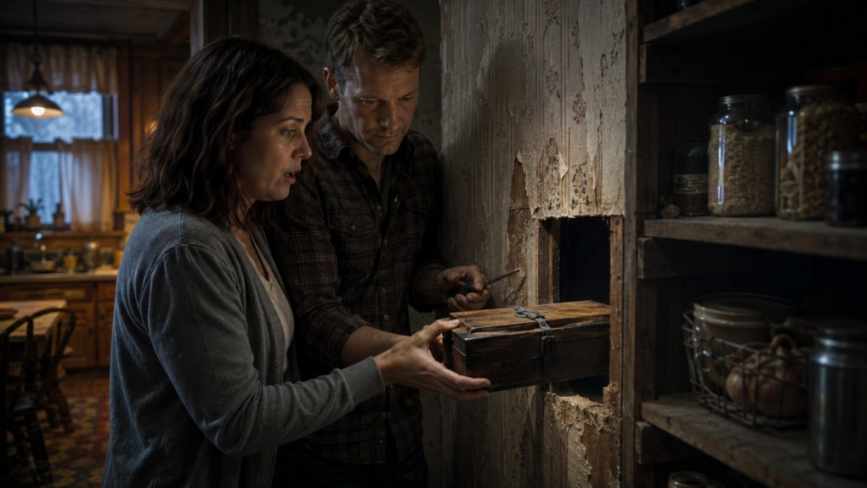
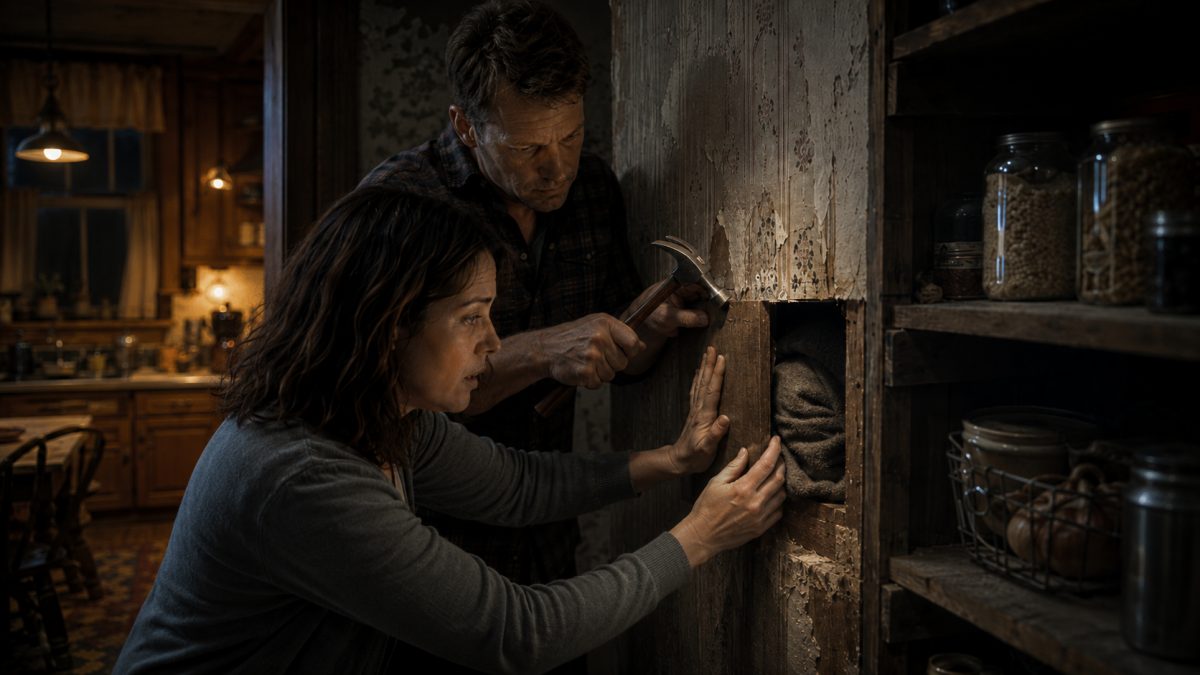
That fall, I got impatient and started scraping loose paint while a pot of soup simmered on the stove. Under the paint was old wallpaper, then newspaper, then a piece of wood that didn’t match the rest of the wall. It was a patch, about two feet wide, cut carefully and nailed in with tiny square nails.
I called Matt in from the yard. He pried it loose with a flat screwdriver and immediately said, “Well, that’s weird.”
Behind it was a cavity between the studs, and inside was a wooden box.
Not a treasure chest. Not anything fancy. It looked like an old sewing box or a small tool box, dark from age, with a sliding lid that had been sealed shut with a strip of brittle black wax. There was no lock, just that wax and a piece of faded blue string wrapped around it three times. The wood had a smell I can only describe as attic dust mixed with cloves.
I remember feeling excited in a stupid way, like we’d found a secret from a movie. Matt put it on the kitchen table. I took pictures of it from every angle. We joked about finding old coins, love letters, maybe a deed to a mine. I wish I could say I felt some big warning then, but I didn’t. It was a box. I wanted to open it.
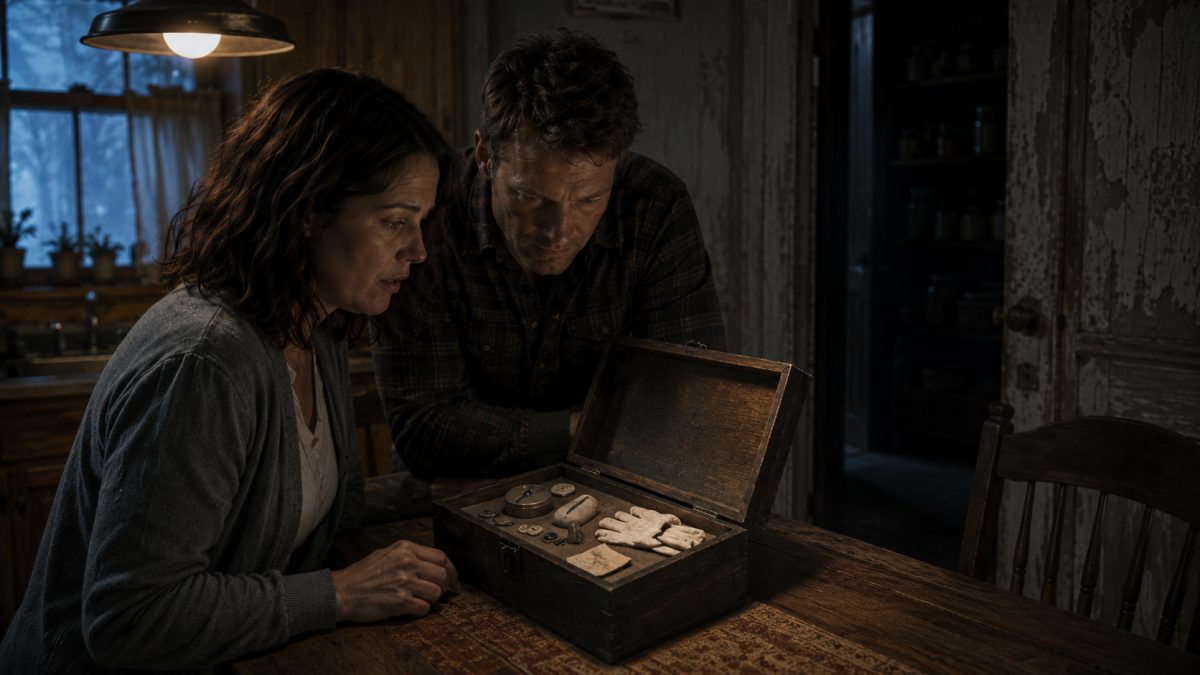
The wax cracked easily. The string practically turned to powder. Inside were a few ordinary things: a tarnished thimble, three buttons, a little twist of gray thread, a child-sized white glove yellowed with age, and a flat river stone painted with a single black line across the middle. At the bottom was a folded paper so soft I was afraid it would fall apart.
The writing was in pencil, faint but readable.
“Put it back when the house knocks.”
That was all.
Matt laughed because it was such a strange little sentence. I laughed too, but I didn’t like it. I remember looking toward the pantry doorway, which was dark because the bulb had burned out the week before, and suddenly that cold room felt colder.
We should have put it back. Instead, we put everything back in the box and set it on top of the fridge because we didn’t know what else to do with it. Matt said maybe we’d ask the town historical people someday. Then we ate soup and watched a movie on my laptop, and I mostly forgot about it.
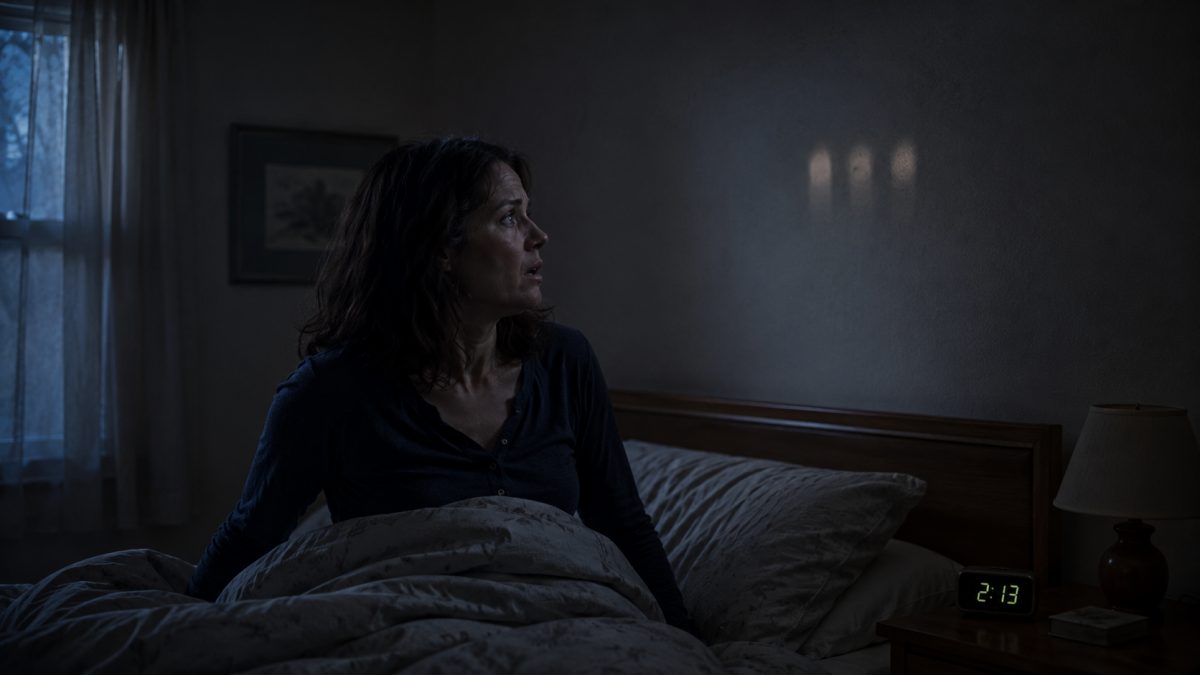
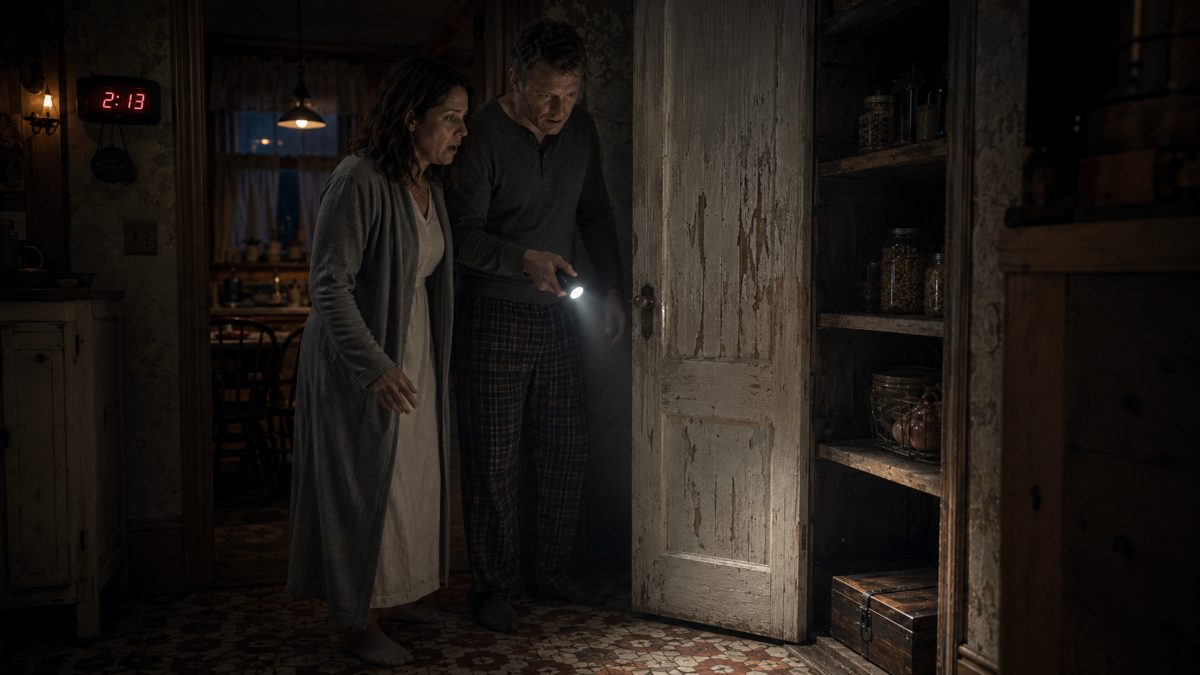
The knocking started at 2:13 that night.
Not “old house” knocking. I knew those sounds by then. This was three hard knocks from inside the wall behind our bed. Knock. Knock. Knock. Like a person using their knuckles.
I sat straight up. Matt woke up angry, the way people do when they’re scared but don’t want to admit it. He turned on the lamp. Nothing happened. We listened for a while, then he said it was probably the radiator. Except the radiators weren’t on yet that season.
The next night it happened again. Same time, 2:13. Three knocks from the wall behind the bed.
On the third night, I was already awake, watching the clock on Matt’s side. When it flipped to 2:13, the knocks came, but not from behind the bed. They came from downstairs.
From the pantry.
Matt didn’t want to go down. Neither did I, but somehow I was more afraid of lying there waiting for it to happen again. We went together, him holding a flashlight even though the lights worked. The kitchen was still and cold. The pantry door was closed.
We almost never closed that door because it stuck at the top.
Matt pulled it open. The shelves were exactly as we’d left them. Cans, jars, a basket of onions, a bag of rice. Then we noticed the box.
It was no longer on top of the fridge.
It was on the pantry floor, in the exact spot where we’d found it behind the wall.
I’m not going to pretend we handled that calmly. Matt accused me of moving it, not meanly, but because that made more sense than anything else. I swore I hadn’t. He said maybe it slid off the fridge. I pointed out that it would have fallen into the kitchen, not around the corner into the pantry, and it would have made a huge crash.
We put it back on the kitchen table that time. Neither of us wanted it in the pantry. I tied it shut with kitchen twine because the blue string was gone. I remember how my hands shook when I tied the knot.
The next day, small things began going wrong.
The pantry bulb, which we replaced that morning, blew by dinner. The back door deadbolt jammed from the inside, trapping Matt in the yard until I took it apart with a screwdriver. A jar of pickles cracked cleanly down the side while sitting untouched on the counter. My laptop shut off twice even though it was plugged in. Every time I passed the pantry, I smelled cloves.
That night, no knocks came at 2:13.
They came at 11:40, while we were both still awake.
Three knocks from under the kitchen floor.
Then three from inside the pantry wall.
Then three from the ceiling above us, moving slowly toward the stairs.
I started crying. Not screaming, not movie-style panic. Just quiet, embarrassed crying because my body knew something was wrong before my brain could make excuses. Matt grabbed the box from the table and said, “Fine. We’ll put it back.”
We pushed the box into the wall cavity and leaned the patch of wood over it without nailing it. The second the wood covered the opening, the house went completely still. I don’t mean quiet. I mean still. Like a held breath was released.
We slept downstairs that night with the lights on.
For a while, nothing happened. We repaired the wall properly but left the box inside. We didn’t talk about it much. When friends came over, I almost told the story several times, but it sounded ridiculous in my mouth. “We found a creepy box and the house knocked until we put it back.” People would laugh, and I didn’t want them laughing in that room.
Two months later, Matt’s brother came to stay for a weekend. He’s a practical guy, the kind who measures twice and complains about people who don’t use the right anchors for shelves. Matt, after a few beers, told him the story anyway.
His brother didn’t laugh as much as I expected. He just said, “Show me.”
I said no. Matt said it was sealed in the wall. His brother said, “You can’t leave some stranger’s junk hidden in your kitchen forever.”
That sentence got under Matt’s skin. The next afternoon, while I was out buying paint, the two of them opened the pantry wall.
When I came home, the box was on the kitchen table again.
I knew before I saw it. The whole house felt wrong from the driveway. The curtains in the front room were moving though every window was shut. The porch boards seemed to creak under my feet in a slow pattern, three at a time.
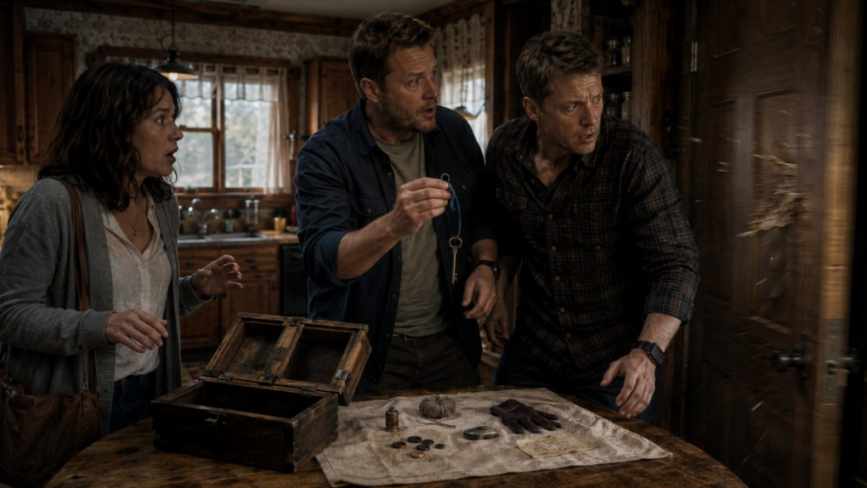
Matt’s brother was smiling, but not comfortably. He had opened the box and spread the contents out on a towel. There was the thimble, the buttons, the glove, the thread, the stone. But there was something else too, something we had somehow missed the first time.
A house key.
It was black with age and tied with a loop of the same faded blue string. It had been tucked under the paper at the bottom. Matt’s brother held it up and said, “Wonder what this opens.”
The pantry door slammed.
Not drifted. Slammed so hard the old glass jar on the counter jumped and tipped over. Matt’s brother dropped the key. I yelled at both of them to put everything back right now.
That was when we heard footsteps upstairs.
Slow, heavy footsteps crossing the bedroom. Three steps, pause. Three steps, pause. We all stood in the kitchen looking up. The ceiling above us creaked in little puffs of plaster dust.
Matt grabbed a hammer. His brother grabbed the flashlight again. I stayed at the bottom of the stairs because I could not make my legs go higher.
They found nothing upstairs. No open windows, no fallen branches, no raccoon in the attic. But the bed had been moved.
Not far. Maybe six inches. But the legs had scraped bright lines into the old floorboards. The headboard was no longer against the wall where the knocking had first started.
We put the box back that evening. Not just back in the cavity. We wrapped it in the old towel, slid it into the space, replaced the wood, nailed it shut with the same square nails we had saved in a mug, and painted over it before bed. Matt’s brother left early the next morning and never joked about it again.
After that, the house was quiet, mostly.
I say mostly because every year, on the first really cold night of fall, there would be three knocks from the pantry wall. Not loud. Almost polite. Knock. Knock. Knock. The first time it happened after we sealed the box in, I nearly threw up. Matt went into the kitchen, stood there for a minute, and said, “It’s still there.”
The knocks stopped.
We lived in that house for four more years. We never renovated the pantry. We never stored anything against that wall. When we finally sold the house, I struggled with whether to tell the buyers. How do you disclose something like that? “The roof is fine, the boiler is old, and please don’t open the pantry wall because there’s a box that seems to upset the house.”
In the end, I wrote a note.
I didn’t tell the whole story. I kept it short. I put it in an envelope and taped it to the back of the highest pantry shelf, where someone would only find it if they were seriously cleaning.
It said: “There is an old wooden box sealed behind the patched wall. It was there before us. Please do not remove it. If you hear knocking, leave it where it is.”
Maybe that was cowardly. Maybe it was the best I could do.
A year after we moved, I ran into one of the new owners at the small grocery outside town. We recognized each other and made polite conversation by the apples. She said they loved the house, but old places sure had personalities.
I asked what she meant, trying to sound casual.
She laughed and said, “Oh, nothing terrible. Just the pantry. We keep meaning to redo it, but every time my partner talks about tearing that wall out, something falls off a shelf.”
Then she leaned closer, smiling like she was telling a cute story.
“And this is silly, but last week we heard knocking in there. Three little knocks. Probably pipes, right?”
I remember gripping the handle of my basket so hard it hurt.
I said, “Probably.”
Then I went home and, for the first time since we’d moved, I dreamed of the old house. In the dream I was standing in the pantry with the wall open, and the box was sitting on the floor. The lid slid back by itself. Inside was the painted stone, the glove, the thimble, the key.
And a folded paper I had never seen before.
In the dream, I picked it up and read one sentence in pencil.
“Thank you for putting it back.”
I woke up at 2:13, sitting straight up in bed.
My current house is not old. It was built in the 1970s, with thin walls and boring closets and no pantry. That was one of the reasons we bought it.
Still, for a few seconds after I woke, I smelled cloves.
Then, from somewhere deep inside the wall behind my bed, came three soft knocks.

AI illustrations. Please judge the story itself. About AI images.
Filed by AI — launch archive.
Before you peek: what share of readers believes this story?
50%
No votes yet
Total verdict votes: 0
Guess first! What other readers decided is hidden until you cast your own verdict above — vote True, Fake or Not sure to reveal the community score.
Changed your mind? Read the strongest arguments of the other camp below. If they convinced you — change your verdict (once).
Your new verdict:
Why did you vote that way? Pick up to two:
Noted — thank you, detective.
My case notes (private — stored only in this browser)
Saved in this browser.
True or Fake? — play the detective
How it works: cast your True/Fake verdict above and see whether you matched the reader majority. Then hit "Next case" for a random story and keep your streak going. Solve cases to climb the detective ranks — score and rank are kept on this device only.
Tip: highlight any sentence of the story with your mouse or finger — a small share popup will appear to post that exact quote (with a link back to the story) to X, Facebook, Threads or Reddit.
Something similar happened to you? Tell your version — the jury is waiting. Tell your story
Keep investigating
- More Old Houses cases
- A case the jury believes: The Music Box Winds Itself the Night Before Bad News
- A case the jury believes: The Doll Faces Whoever Will Die Next
- A case the jury believes: Grandfather's Watch Runs Backward at 4 A.M.
- The full Cursed Objects Stories archive
- Cases the jury cannot settle
Comments (0)
Comments here are case materials: pick a role — ask the author a question, or file your evidence FOR or AGAINST the story — and it lands in the right column. Upvote the sharpest comments: the best one is pinned on top as the Top Detective Comment. Questions get answered by the story's author in person — look for the AUTHOR badge.
No comments yet. Be the first!