
The Elevator Logged an Hour I Never Worked
In one sentence: A grain elevator operator recounts strange power sags, missing time, and unsettling mysteries during autumn night shifts over several years.
Thirty years running a Nebraska grain elevator, third shift. Then the power started sagging for four minutes at a time, my punch card came back stamped with an hour I don't remember, and my own signature turned up on a log I never signed.
* AI Illustration
First impression: judge by the title and the picture alone — you get the real verdict after reading.
Swear It Happened — CASE FILE #553
JURY PENDING
COLD CASE — this file never got enough jurors. Your verdict counts double here (morally).
From September 2013 through the end of harvest 2015 I was the night operator at the Stanhope Farmers Cooperative elevator, just west of Stanhope, Nebraska. If you don't know Stanhope there's no reason you would. Population sign said 341. It sits between the state highway and a rail spur that the co-op loaded maybe forty cuts of cars on a year, which mattered more than you'd think, and I'll get to that too, though I'll warn you now that part goes nowhere. A lot of this goes nowhere. That's most of why I never wrote it down before. It doesn't make a story. It makes a pile of readings that don't reconcile, and if you've never spent a season trying to reconcile readings, I don't know how to make you feel what that's like.
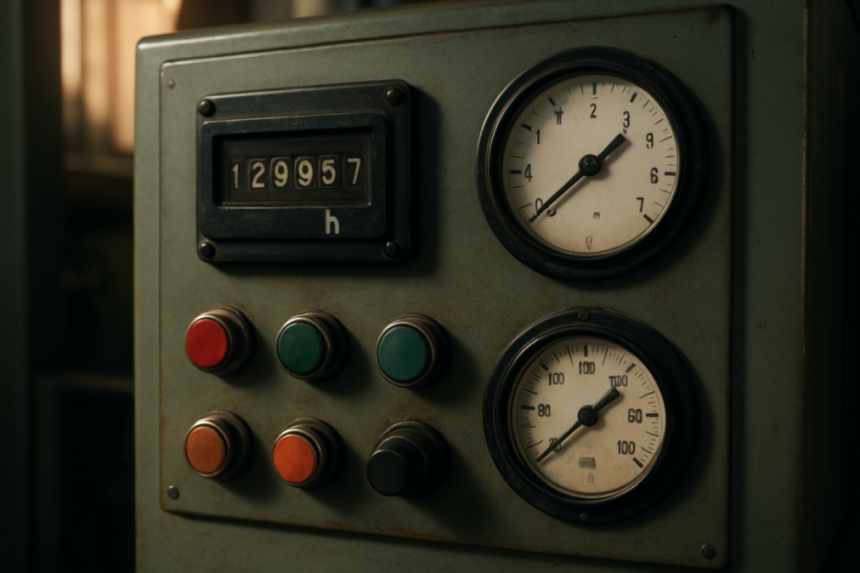
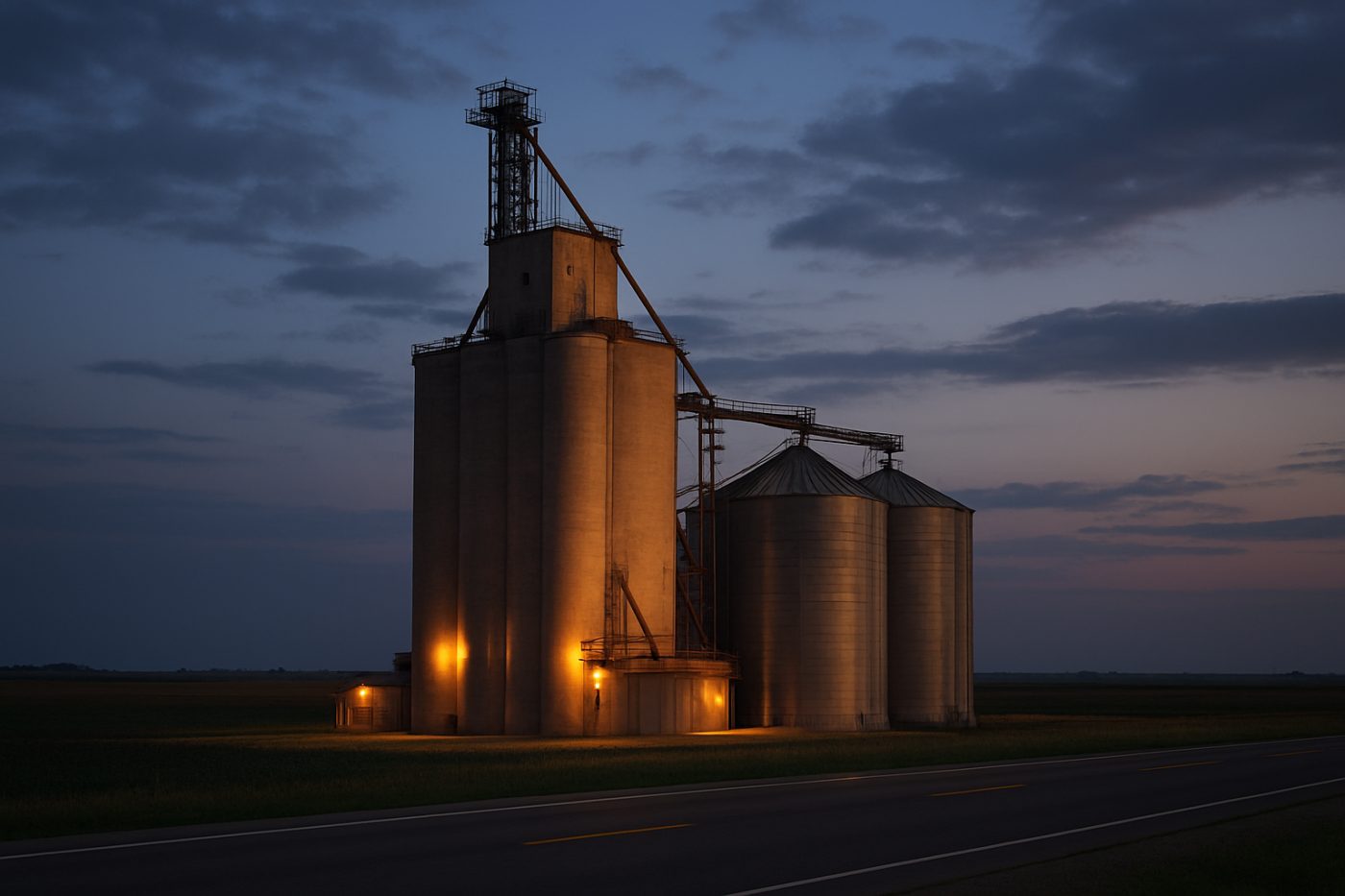
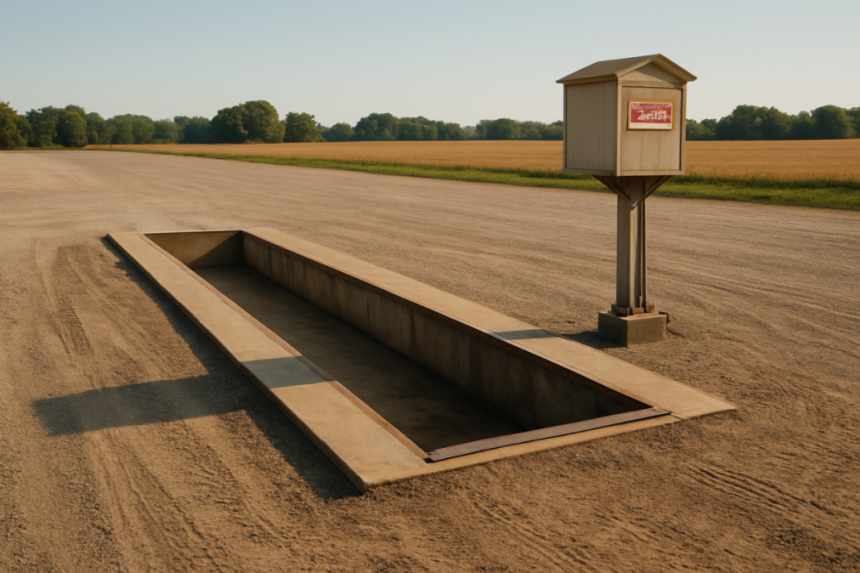
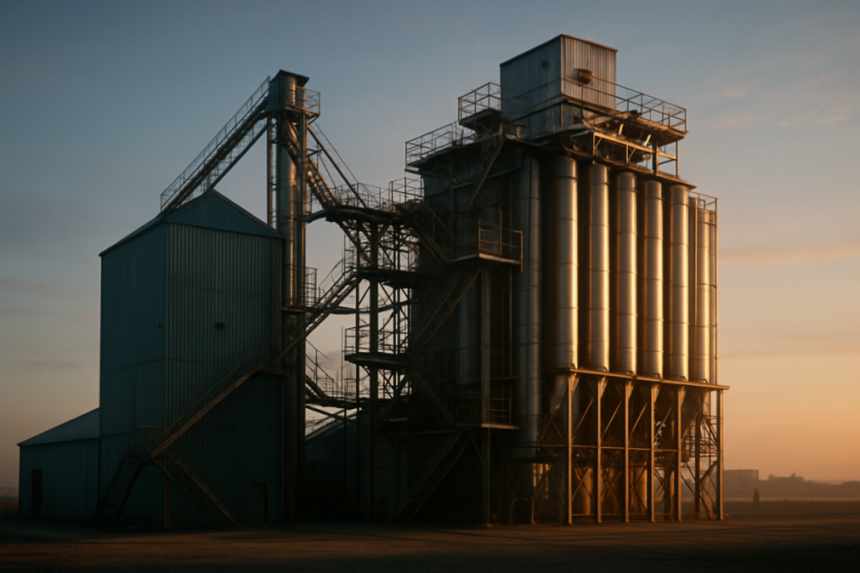
The elevator itself: concrete headhouse poured in 1954, annex bins added in '76, two steel bins on the east side from the '90s, licensed capacity a little over 1.1 million bushels. One receiving leg, rated 10,000 bushel an hour, did maybe 8,500 on a good day with the belt tight. The leg ran up the middle of the headhouse, 120 feet to the head pulley, then a distributor and gravity spouts to the bins. Two dump pits out front under a drive-over grate, 600 bushel apiece, drag conveyor between them. Truck scale was a 70-footer, pit type, Cardinal indicator in the scale house. Dryer was a propane tower unit on the north side, and the dryer is in this story so much that I might as well introduce it like a person. It was a 1998 tower dryer, held about 1,900 bushel in the columns, and it had a little mechanical hour meter on the panel, black with white numbers, the kind that turns over slow like an odometer. Remember the hour meter. Everything I've got comes down to about four things and that's one of them.
I took the job because the ethanol plant work I'd been doing over by Hastings dried up in the spring of 2013 and because I'd hauled grain into that elevator as a kid for my dad and knew which way the driveway ran. I was divorced since '09, no kids, renting a house on Elm Street in town for 400 a month from a widow lady who left zucchini on my porch whether I wanted it or not. I had a 2004 F-150 with a transmission that was starting to hunt between second and third, and the quote to rebuild it was 1,800 dollars, which is a number I can still feel in my back teeth. Night operator paid 13.75 an hour, went to 14.25 my second season, time and a half over forty, and during harvest you were over forty by Wednesday. That was the whole reason. Anybody who tells you they take the night shift at a grain elevator in October for any reason but the overtime is lying to you or to themselves.
The manager was Gary Pohlman. Day operator was Dale Vrba. There was a bookkeeper, Charlene, who left at five, and two seasonal kids on the pit during the day rush, and Merle over on the agronomy side who mostly ran the fertilizer plant and hardly comes into this except one way I'll mention when I get there. At night it was me. That needs saying clearly because people ask me, well, did anybody else see it, and the honest answer is that from seven at night to seven in the morning the payroll of that facility was one man, and the man was me, and I was seeing it, whatever seeing it turns out to mean.
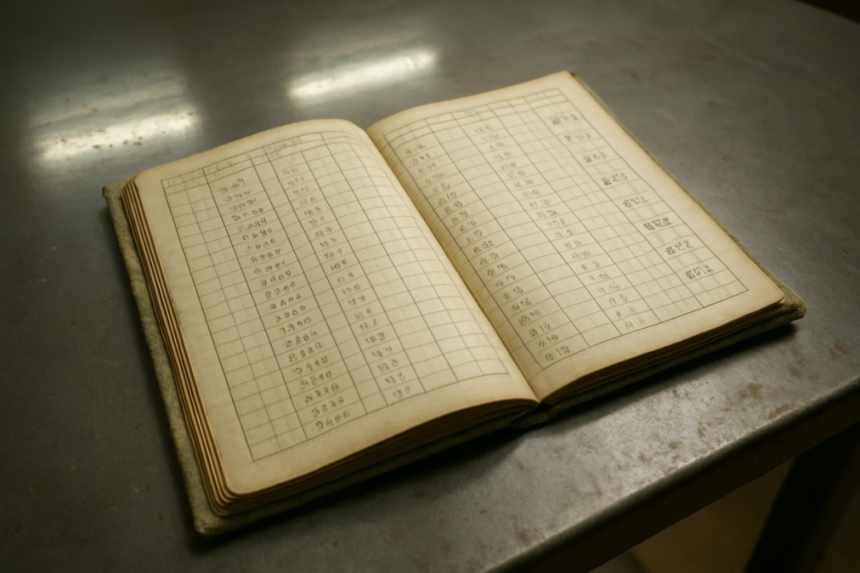
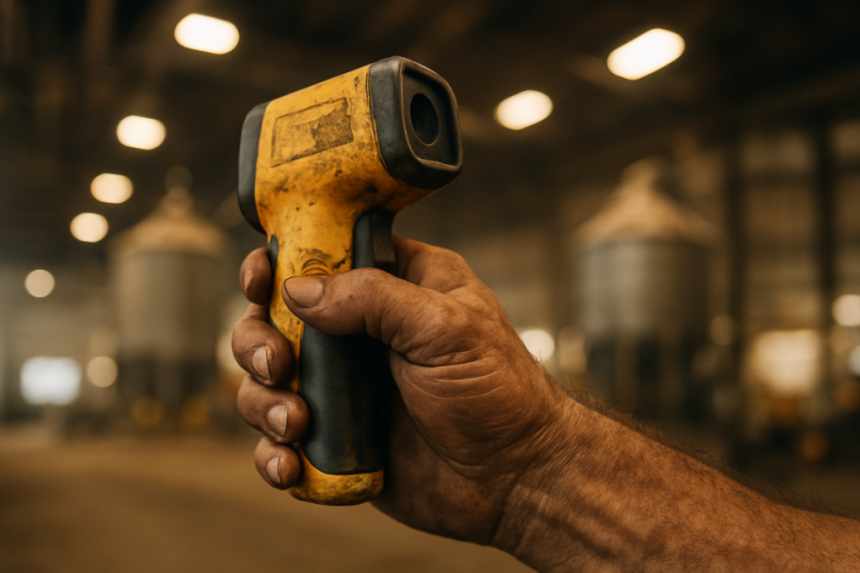
A night went like this, during harvest. Trucks would still be coming hard when I clocked in at 6:45, farmers trying to get one more field out before dew-fall shut the combines down. I'd run the pit and the scale both until nine or ten, probe samples, moisture on the Dickey-john in the scale house, dump, weigh empty, wave them out. By eleven the driveway was usually dead and the real work started, which was drying and moving grain. Wet corn came in anywhere from 17 to 22 percent moisture those years and it has to come down to 15 for storage or you're growing yourself a problem. So the dryer ran all night. My loop was: check the dryer every 45 minutes, plenum temps, discharge moisture, flame; walk the leg boot and check the belt tracking; read bearing temps on the head and boot bearings, and I bought my own infrared thermometer for that, a cheap yellow one, 60 dollars, because the co-op's was always dead when you needed it; check the aeration fans on whatever bins were cooling; climb to the distributor floor once a shift and make sure the spout was actually pointed where the paperwork said it was pointed, because a spout pointed at the wrong bin is how a night man loses his job; and write it all in the log. Green cloth binder, ruled paper, columns Gary made on a copier sometime in the '90s. Time, dryer hours, plenum temp, moisture out, bin, remarks, initials. My initials are R.H. Remember that too.
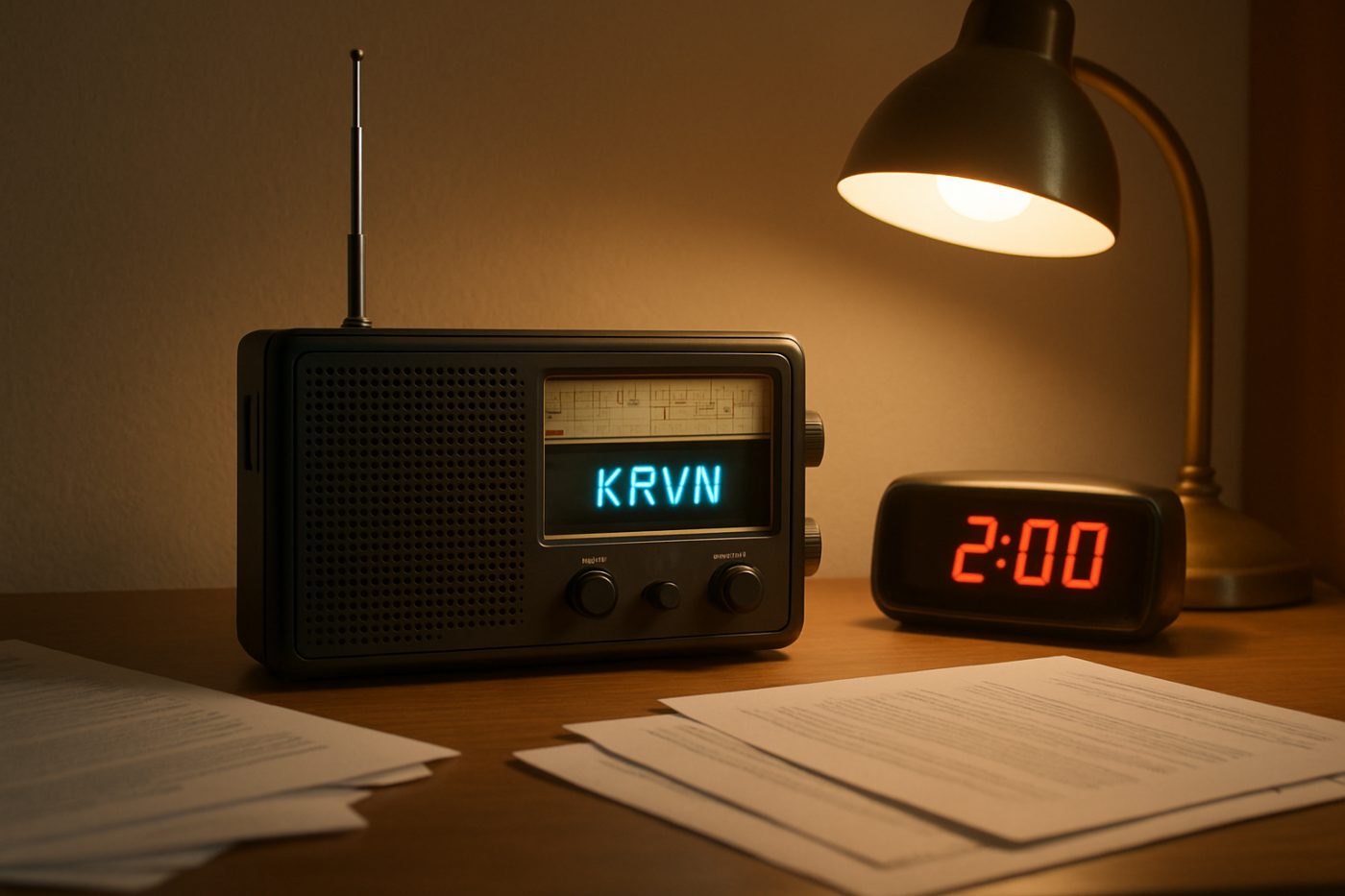
I liked the work. I'm not going to pretend I didn't. The elevator at two in the morning is a decent place to be a person who has had enough talking for one lifetime. You've got the leg running its grain up in the dark, and that's a sound like the world's tallest zipper, and the fans making their steady push, and KRVN out of Lexington on the office radio doing markets and weather for nobody, and the yard light humming orange on its pole by the driveway, and if everything is doing what it should be doing, all those sounds braid together into one sound, and you know that sound the way you know your own furnace at home. Anything wrong sticks out of it like a nail out of a board. That's the part I need city people to understand. I was not a jumpy man imagining things in the dark. I was a man being paid specifically to notice when one sound out of forty changed, and I was decent at it, and that's exactly why the winter of 2015 to '16 was as bad as it was. My noticing worked fine. It was everything downstream of the noticing that quit adding up.
The first power sag was the night of October 8th, 2013. I can give you that date with a straight face because of what I found later, though I'll tell you now the paper and I disagree, and you can decide at the end which of us you like better. It was about 2:15 in the morning. I was in the office eating a sandwich and doing the midnight log line late, which I did more often than I should have, and the lights went down. Not out. Down. The fluorescents in the office browned to about half and buzzed, and out the window the yard light dropped from its regular orange to a deep amber, almost red, like a cigarette end. The leg was running a transfer, bin 4 to bin 7, and I heard the motor pull down into a growl, that lugging sound a three-phase motor makes when the voltage drops out from under it and it starts working for its living. The dryer's flame safety dropped the burner offline like it's supposed to. The aeration fans wound down to maybe half speed and just hung there, moaning.
And it held like that. That's the thing. A blink, a recloser doing its business out on the line, that I knew, that's country power, you get three blinks and a hold in a thunderstorm and you go around resetting things and cussing. This was no storm. Sky clear, dead calm, about 39 degrees. And it didn't blink, it sagged and it stayed sagged, everything at half, that big amber hold, for what I later timed on other nights at right around four minutes. Four minutes is a long time. Stand in your kitchen and watch a clock for four minutes and imagine every motor in your building groaning at half speed the whole while, and nothing you can do about any of it.
Then it came back. No bang at the end of it, no surge. It just came back up smooth, like somebody easing a dimmer, and the leg motor picked its load back up and the fans climbed back to pitch and the yard light went back to its regular orange. Total elapsed, that first night, I honestly didn't time. I was standing in the office door with half a sandwich in my hand like a fool. I'm guessing it at four minutes because of the ones I did time later. Then I went out and purged and relit the dryer, which is a ten-minute procedure you do not rush, checked the leg belt hadn't slipped under the lug, walked my loop, found nothing else disturbed, and wrote it in the log. I remember what I wrote, or I remember remembering it, which I've learned is a different thing. Power sag approx 2:15, approx 4 min, dryer relit, no upset. R.H.
Next morning I called Blue River Public Power District from the office before I went home, because a four-minute brownout with the dryer down is money, and Gary would want it on record. Girl who answered was polite, took the feeder information, said an engineer would call me back. Fellow did call back, that afternoon, woke me up at my house actually, and he was decent about it and here is what he said. No recorded event on that feeder. Substation recorder clean for the whole night. No breaker operations, no recloser counts, nothing off the SCADA. He asked was I sure of the time and I said within a couple minutes yes, and he said, and I want to be fair to him because this is a reasonable thing to say, that rural distribution is long and skinny out there and a big motor start at some neighbor's place, a pivot, a dryer, a shop compressor with a bad start capacitor, can sag the tail of a feeder without the substation ever seeing much. Voltage is local, he said. Your end of the line can have a bad night and my end can sleep right through it.
And I took that, the first time. It's half right, is the thing, and half right answers are the ones that hold you longest. Power out there is not city power, you learn that the first winter you live rural. Except October. The pivots are done in October. The corn is coming out, not getting watered. And I knew every dryer within six miles by ear and by yard light, and I let it go, because a man with a transmission quote in his pocket does not go looking for extra puzzles at eleven in the morning on three hours of sleep. I said thanks. I wrote the callback in the log margin that night. And for eleven days nothing happened, and I mean nothing, normal harvest, ninety-hour weeks, and I'd have told you the sag was one of those things you never explain and never see again, like a noise your truck makes once.
The 19th of October it did it again. Same shape exactly. That's what got my attention, not the event, the sameness of the event. Power problems are sloppy. They flicker, they surge, one leg drops and the other doesn't, a motor single-phases and lets the smoke out. This was the identical performance, browned lights, the amber hold, the fans moaning at half, the dryer safety dropping the flame, smooth ramp back up. That night I did time it, or tried, because timing it turned out to be its own story, and that's where the watches come in, and I'd rather tell the watch part carefully than fast, so let me set it up right.
You have to understand what time is at a grain elevator, because it isn't what time is at your house. Time is money in about six directions at once. The punch clock decides your paycheck. The dryer's hour meter decides the maintenance schedule and, more to the point, decides the propane reconciliation, because Gary figured burn rate against dryer hours every week and if those numbers walked apart he wanted to know why. The scale tickets are stamped with time. The log has a time column. The state can audit any of it. So an elevator is actually full of clocks, more than you'd notice until you start noticing, and the thing about all those clocks is that nobody ever checks them against each other, because why would you. They're all plugged into the same wall, so to speak. They all drink from the same power.
Here's the inventory, because I ended up knowing it cold. The punch clock by the office door was an Amano, a mechanical, older than me, and it kept time off the line frequency like every plug-in clock of that vintage, meaning the utility itself was its pendulum. The wall clock in the scale house, same deal, plug-in, sweep hand. The Cardinal scale indicator had an internal clock that Charlene set whenever she happened to think of it, which was approximately never, and it ran a few minutes fast all fall, and I'll flag that now because that one was a known error. I could name its size. Then the dryer hour meter, which isn't a clock exactly, it's a totalizer, it only turns when the dryer control circuit is energized, but if you know when the dryer started you can do arithmetic with it, and I can do arithmetic. And then my watch. Casio, digital, the 20-dollar one half the county wears, quartz, and quartz doesn't care what the power line is doing, quartz just counts. And then me, my own head, which I would have told you in September 2013 was a pretty fair clock itself after thirty years of shift work. You know how long forty-five minutes is in your body. You know what 3 a.m. feels like versus 4.
So. Night of October 19th, the second sag, I'm standing at the dryer panel when the amber comes down, and this time I've got the Casio up and I time the hold. Three minutes fifty-something, call it four. Fine. I relight the dryer, and while I'm standing there waiting on the purge I look at the hour meter and do the arithmetic I'd done a hundred times that season, hours on the meter versus hours since I lit it at seven, and it was short. Not short by four minutes, which the sag would explain, the meter stops when the control circuit drops, that's expected, that's the meter doing its job. Short by more. I made it 26, 27 minutes short of what my watch and my own memory of the evening said it should read. And I stood there in the cold doing the subtraction three times, getting the same answer three times, and then doing what you do, which is deciding I'd misremembered when I lit the dryer. Wrote the log line. Sag, 4 min, relit, no upset. Didn't write the 27 minutes. There's no column for the 27 minutes.
And I want to stop on that, because people hear this story and think the scary part must have felt scary. It didn't. It felt like being bad at my job. A meter reading short doesn't land on a man as mystery, it lands as, I screwed up my start time, or the meter's going bad, or I can't subtract at two in the morning, and all three of those are more likely than anything else, and you'd be a fool to reach past them. The whole first season, that's all it ever felt like. Small arithmetic shame, over and over, in different corners.
Because then the punch clock started in. I clocked out at 7:02 most mornings, when Dale got settled and took the radio. Home, sleep, back at 6:45. My card that week showed a 6:41 out on the morning after the 19th. I remembered 7:00. Dale remembered me leaving at seven, or said he did, in the way Dale said things, which was mostly grunts with a little language on them. Twenty-one minutes, give or take, between the Amano and my Casio, on that one morning, and never on the mornings before, and the Amano and the Casio agreed fine all the rest of that week, I checked, I started checking, that was the beginning of the checking. And you'd say, the sag, the clock motor, a plug-in clock loses time when voltage drops. And I'd say, I thought of that before you did, believe me. A synchronous clock motor at half voltage for four minutes loses you a few minutes at the outside, and then it runs at line frequency again, and utilities used to trim accumulated frequency error overnight on purpose, the engineer told me, so every plug-in clock in America stayed honest. Four-minute sag, four-minute loss, at the absolute worst. Not twenty-one. And the scale-house wall clock, drinking the same power six feet of conduit away, lost nothing that night that Charlene or I could find.
That's the shape of the thing I want you to hold on to, because everything else hangs off it. The clocks that lost time didn't lose it together, and the losses were bigger than the sag, and my watch, on my wrist, on quartz, on a battery, agreed sometimes with one and sometimes with another, and my head, which I'd trusted for thirty years, started coming up as the least reliable instrument on the property. There were nights that fall, and more the next fall, where I'd have sworn on my mother the loop I'd just walked took forty-five minutes, my dryer checks were built on forty-five minutes, and the Casio said an hour and fifteen. Nothing missing in the middle that I could point at. No gap with edges. Just a loop that came out long, like a board you cut twice and it's still short, except backwards.
I started the notebook in late October 2013. Spiral, pocket-size, kept it in my coveralls, and this is the notebook I still have, and it's the one piece of this I'd grab out of a house fire. Columns, because of course columns. Date. Casio time at the top of the shift, checked against the office phone. Amano stamp. Dryer meter at light-off and at shutdown. Wall clock. Weather, because I was already noticing the weather part. And a remarks column where the remarks get less professional as the pages go on, and I'm not reading you those, some of them, because a man writing to himself at 4 a.m. isn't writing for company.
The pattern, such as it was, and I say such as it was because a jury could kick it apart and I know it: the sags came only in October, both years, and only on the still nights. Dead calm, clear, usually cold. Never in wind. Never in rain, though October out there hardly rains. Five sags in October 2013. My notebook says the 8th, the 19th, the 23rd, the 27th, the 31st. Six in 2014, and by then I had the routine down, Casio up, count the hold, log the meters before and after. The holds ran 3:40 to 4:20. The meter shortfalls, over and above what the sag itself explained, ran anywhere from nothing at all, twice it was nothing at all and I want that on the record because it's the kind of detail that made me keep doubting myself, up to 38 minutes once, the night of Halloween 2014, and the average across both seasons of the nights that were short at all was 24 minutes and change. I've done that average maybe two hundred times. It doesn't improve.
Now the hum. The hum I can't put a start date on, which bothers me more than the things I can, because the notebook man should have a date and he doesn't. Best I can say is I became aware of it around the same October, meaning I noticed I'd already been hearing it for a while, the way you notice a refrigerator when it quits. Low. Below the fans, below the leg. Not a rattle, nothing loose. A pressure more than a sound, and I know exactly how that sentence reads, and I'd ask you to remember I fix things for a living and the last thing in the world I wanted was a pressure more than a sound. I wanted a bearing.
So I treated it like a bearing. The leg has four main bearings you worry about, two up on the head, two down at the boot, and a head bearing letting go 120 feet up is the kind of thing that burns elevators down, friction plus grain dust being what they are, so nobody will ever fault you for chasing one. I chased it for two weeks. Shot every temp twice a shift with the yellow thermometer, logged them, they sat happy between 78 and 96 degrees depending on how hard the leg was loaded, no trend, no spread between paired bearings, which is the tell you actually look for. Greased everything to spec and then a little past spec, which is its own sin, you can cook a bearing over-greasing it, I know better, I did it anyway because I wanted so bad to have found it. Changed nothing. Belt tracking dead center. Buckets tight, I walked the whole case with a light. Head pulley true. The hum didn't care. The hum wasn't in the leg, and I proved it to myself the hard, stupid way, by standing in the boot pit with the leg locked out, whole machine dead and tagged, my own padlock, and hearing it exactly the same as I heard it in the driveway. Same loudness. That's wrong, notice. Sound has a place. You walk toward a sound, it grows. This didn't have a place. Every spot on that property, same loudness, like it wasn't in the air at all but in the part of you that does the hearing.
I blamed the irrigation pivots anyway, for a while, after the bearings let me down. There's wells and pivot motors all over that country and a well motor can carry through the ground a long way, people will tell you they feel their neighbor's well in their floor slab, that's a real thing too. October, again. Pivots parked. I drove my own truck one night on my hour break, which I wasn't supposed to leave the property and I did it anyway, out along the section roads with the windows down, engine off at every stop sign, listening, trying to walk the sound to a wellhead. Silence out there. Genuine deep-country October silence, three miles from the elevator. Then back in the driveway, there it is. Same loudness.
The night I quit blaming things was calm and moonless, first week of November 2013, harvest basically done, and I had the whole facility dark and dead by 1 a.m. for a scheduled power-down, Gary wanted the main panel inspected and I'd shut everything to the mains. Leg locked out, fans off, dryer down, the office furnace off, the pop machine unplugged because that pop machine buzzed and I wanted no alibis left. I stood in the middle of the driveway on the scale deck in the pitch dark with my flashlight off. And I gave it ten minutes, and I'd like the record to show my hands were in my pockets and my breathing was regular and I was a 38-year-old sober man standing on a scale he'd stood on a thousand times. It was there. Soft, under everything, steady as a well pump, and no well pump within earshot, and no anything within earshot, and the nearest live conductor I hadn't personally opened was the service drop at the pole. I stood there and felt it more in my sternum than heard it, honestly, and looked up at the yard light, which was the only thing on the place still burning since it fed off the pole side.
And the yard light is its own chapter, so hold that thought. I've been circling it this whole time. I notice I keep putting it off.
Before the yard light, let me get some of the noise out of the way, because the noise is part of it. If I only tell you the parts that ended up mattering, this turns into a campfire story, and it wasn't a campfire story, it was two years of my life with all the regular garbage of a working life mixed all through it, and half the time the regular garbage was louder.
The railroad thing, for one. Gary spent both of those falls, I'd estimate, a third of his waking hours at war with the short line over car placement. We'd order a cut of fifteen cars for a Tuesday. They'd show up Friday, or they'd show up Tuesday but spotted wrong, past the loadout spout where our track hits the grade, and you can't load a car you can't reach, and the co-op paid demurrage more than once for cars that sat where we couldn't touch them, which is like paying rent on a room they nailed the door shut on. Gary had a folder. Gary had photographs of car positions with a tape measure in frame. He'd be on the phone in the mornings when I clocked out, doing that quiet furious voice, saying mile post numbers to somebody in an office two states away. I mention all this because for a while that fall, whenever anything was strange, my first honest thought was that it was some downstream stupidity connected to the railroad fight, because the railroad fight touched everything, it decided which bins we filled, it backed grain up in the wet tank, it decided whether the dryer ran flat out or idled. It explained so much of our chaos that I kept trying to make it explain the rest. It never did. It was just a railroad being a railroad. Far as I know Gary took that folder into retirement with him.
The scale, for another. The truck scale read heavy all of the 2014 season, and we knew it by August, because the state test truck came through and flagged us 60 pounds heavy at the top end, and the scale company came out and did whatever they do in the pit with the load cells and the standard weights, and certified us, and then farmers with their own drive-over scales at home kept telling us all fall that our scale was heavy, 40, 60, 80 pounds, always heavy, never light. Sixty pounds on an 80,000-pound truck is nothing and it's also not nothing, sixty pounds of corn is about a bushel, and a bushel every load across a whole harvest is real money in somebody's direction, and the direction matters to people, as it should. Gary got the scale company back twice. Certified both times. Farmers grumbled all season anyway, and the next spring the scale company found a cracked pier under one corner of the pit and shimmed it and after that everybody's numbers agreed. So that one had an answer, notice. A boring answer that took eight months. I hold onto that one on purpose, because it's proof I lived in a world where things eventually explained themselves, and I know what that feels like, the click when the boring answer finally shows up. I'm still waiting on the click for the rest of this.
Merle from agronomy was going through a divorce that second fall, and he'd come over on the grain side after his shift some evenings and sit in the office and talk at me while I ran trucks. I'd listen with about a quarter of my head. Custody schedules, lawyer money, who gets the camper. I mention Merle for one reason, which is that people ask me, was anybody else around at night, and the honest answer is Merle, sometimes, until nine or so, in October 2014, on maybe six occasions. And on the night of October 14th, 2014, which is a sag night in my notebook, Merle had left around 8:30, and when I saw him two days later he asked me, unprompted, standing by the LP tank, whether the power had done anything weird Tuesday night, because his kitchen lights at his rental in town had done, and this is his phrase not mine, a long brown blink, around suppertime. Suppertime. Six, six-thirty. My sag that night was 2:41 a.m. So it's not corroboration, whatever it is. It's a different event, or it's nothing, a loose neutral in a rental house kitchen, and his lights doing anything at all that week is either the best detail I have or a coincidence I've inflated because I wanted company. I genuinely cannot tell you which. Merle moved to Grand Island that winter. The camper went to his ex.
And Rick. My brother's part in this is simple and ongoing. Rick got on at a distribution center in Kansas City in 2012, worked his way into a supervisor spot, and from 2013 on, every phone call, and I mean every phone call, ended with him telling me they were hiring and the money and the insurance, and him being right, the money was half again what the co-op paid and I was a single man with a bad transmission and no reason on paper to stay. I'd say I'll think about it. That was a lie the whole time and we both knew it, though I'd have had trouble telling you what exactly I was staying for. The house on Elm with the zucchini. A county where my name meant something at the parts counter. I don't know. People stay where they're planted even when the ground's doing something under them, that's the entire history of Nebraska right there. Anyway you should know that thread runs under this whole account, Rick on the phone every Sunday saying come down, and it colors some of what I did and didn't do, because a man who is halfway ashamed of his own address doesn't go telling people his elevator's clocks are wrong, on top of it.
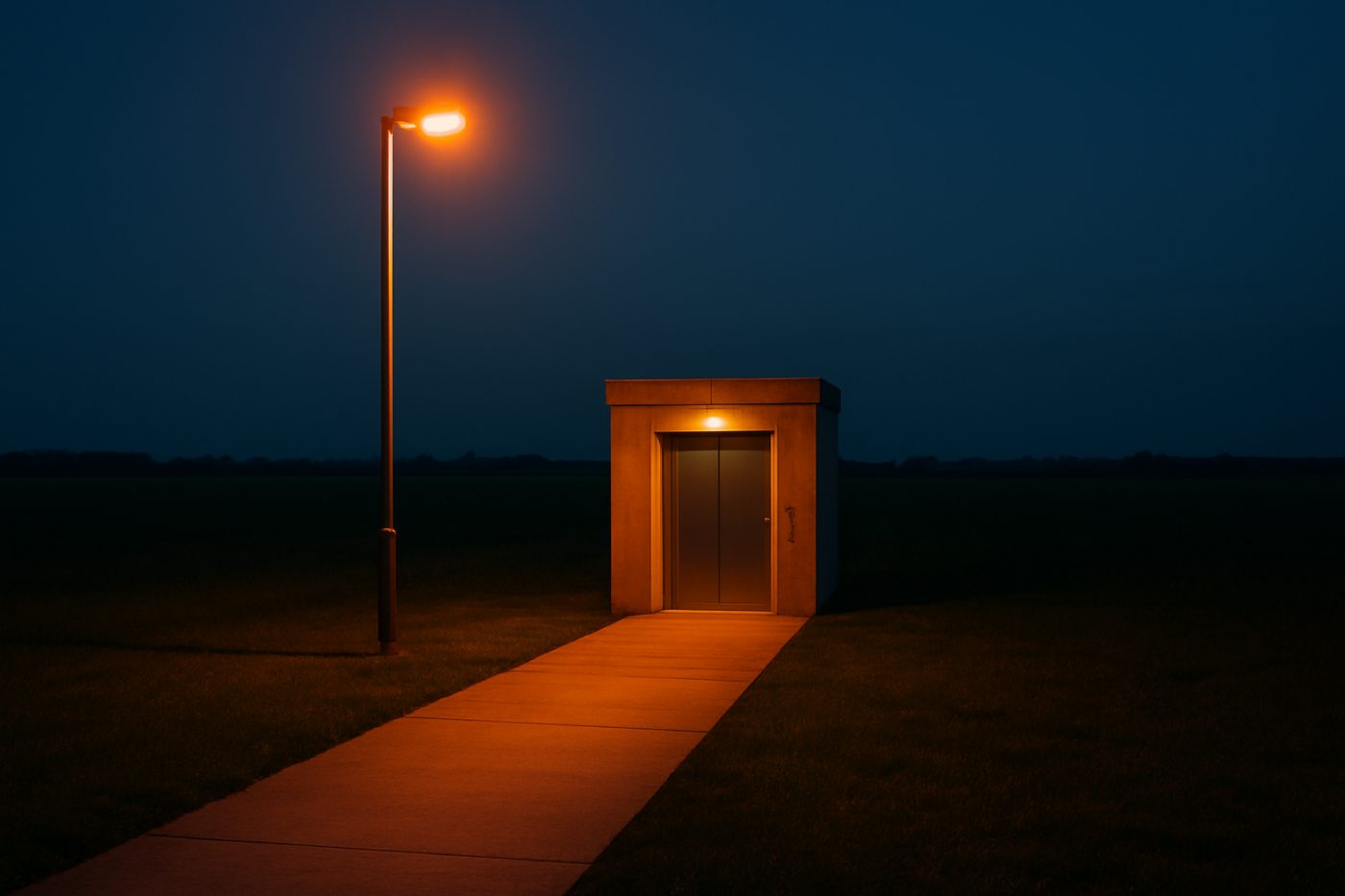
Now the yard light. It was a 250-watt high pressure sodium on a wood pole at the west edge of the driveway, photocell switched, on at dusk off at dawn, and it lit the driveway, the scale, the front of the office, and the first thirty feet of the headhouse wall. Orange, like they all are. Buzzed a little, like they all do. I'd worked under that light or ones like it my whole life and never given one a full minute's thought.
What I noticed, and I have tried very hard to date this and can't, other than that it was after the sags started both years and I never once noticed it in September, was the shadows. My shadow, mainly, because your own shadow is the one you know. Walking the driveway from the office to the dryer, light behind me and left, shadow out ahead and right, same walk eleven times a night for two falls. And some nights, sag nights but I want to be careful, not only sag nights and not every sag night, the shadow lay wrong. Angle's the only word I've got. It lay maybe ten, fifteen degrees off where the pole said it ought to lay, like the light had picked itself up and moved thirty feet south along the fence line, except there it was on its pole, where it's been since Carter. First time I caught it I did the thing you'd do, checked for a second light source, moon, headlights out on the highway, Merle's dome light, the beacon on the water tower in town. Moon that night was a sliver and down early, I looked it up after, I've still got the page printed somewhere. Nothing on the highway. And anyway a second source gives you a second shadow, faint, doubled. This was one shadow, hard-edged, orange-lit like always, in the wrong place.
I'm going to tell you the embarrassing part now because I promised myself I'd put it in. The third or fourth time it happened, late October 2014, I went and got the lumber crayon out of the shop and I marked the driveway. Stood on a crack in the concrete by the scale house corner, marked my boot toes, and traced the line of my own shadow on the ground like a kid, and wrote the date next to it, and then did it again on a normal night from the same boot marks. The two crayon lines are not parallel. They cross. I measured the spread at eight feet out with a tape and worked the angle out later on paper, high school trig, and got twelve degrees and change. And here's the embarrassing part, it's not the crayon. It's that when Gary found the marks that Saturday, orange crayon lines and dates and a pair of boot prints outlined like a crime scene, I looked that man in the eye and told him the state scale inspector had made them checking sight lines to the indicator. Made it up cold, on the spot, a full sentence of lie to my boss of two seasons, because the true sentence was not going to come out of me. He said huh, and that was all. And the marks wore off by Thanksgiving under the truck traffic, and I didn't photograph them, and yes, I know. I had a flip phone is my only defense, and it took photographs the size of a stamp, and I was raised to think a man photographing his own shadow at 3 a.m. had bigger problems than the shadow. I did the trig on a night when the light did it again, though, standing there watching my own dark shape lie there pointed wrong, and the pole not moving, and the buzz off that lamp exactly as always. Twelve degrees. Whatever moved wasn't the lamp is what I'm saying. The lamp and I stayed put. The rest of it moved.
The cat I can be quick about, though she deserves better. Gray shorthair, no tail to speak of, showed up around 2012 per Dale and adopted the scale house, and Charlene called her Weevil, which is a good name for a cat at an elevator. Weevil worked banker's hours in the scale house all summer, slept on the counter by the Dickey-john, milk in a coffee can lid. Mouser like you read about. And in October, both my Octobers, she quit the buildings. Wouldn't come in. Not the scale house, not the shop either, and cold nights too, and this is a cat that spent January on top of the pop machine where the compressor heat came off. October, she sat out by the anhydrous tank on the agronomy side, which is the far corner of the property, seventy yards from the dryer, and faced the dryer. I'd cross the driveway at 2 a.m. and see her out there at the edge of the yard light's reach, sitting up straight like an ornament, facing the dryer. Both Novembers she came back inside like nothing, back on the counter, milk in the lid. Second November, Charlene said something like, well, she's decided we're forgiven, and laughed, and I laughed, and I went out to my truck and sat there a minute because the hair on my arms was up, over a cat, and I felt like an idiot, and I drove home.
Dale. This is the part I'd skip if I could, because Dale was good to me in his way and what happened with Dale is the part I feel worst about, worse than my own scares, because I watched it happening and had the information to maybe say something and I said nothing, because saying something would have meant admitting what I'd been writing in a spiral notebook, and I chose looking sane over whatever the other thing would have been. You want the one genuinely shameful thing in this account, forget the crayon, and forget the lie I told about the crayon. It's this next part.
Dale Vrba ran days at that elevator for 22 years. Bohemian stock from over by the river, thick through the shoulders, maybe 60 then. He talked in nods and half-sentences and knew that facility down to which spout hanger was cracked and which rung on the annex ladder was welded crooked. Him and me overlapped fifteen, twenty minutes at each end of the day, handoff at the office door, him telling me what was wet, what was moving, what the railroad had done to us now. Two seasons of that, twice a day. You get to know a man's weather even if you never learn his opinions.
Around the first week of October 2014 his weather changed. Small stuff first. He started leaving before I got settled, where all season he'd hand off proper, walk me through the loads. Now his truck would be rolling out the driveway at 6:50 while I was still hanging my thermos, and the handoff was a note. Dale didn't write notes. Twenty-two years, the man communicated by grunt and gesture, and now I'm getting a half page of block printing weighted down with a stapler, wet corn in the tank, dryer at 190, watch bin 9. Fine. Harvest wears everybody down. Then I noticed the radio. We ran Motorola handhelds, channel 2 was ours, always had been, channel 1 was agronomy. Dale's handheld started turning up in its charger switched to channel 1. Every day. And one morning I keyed channel 2 to tell him about a fuse and he didn't answer, and I found him standing out north of the dryer, forty feet off its corner in the weeds by the propane tank, not doing anything. Standing, facing the dryer, hands down at his sides. Seven in the morning, good daylight. I said something like, you lose something out here, and he came back to himself and looked at me, and I will not dress this up, it was the look of a man deciding whether to say a thing, the jaw working, the eyes doing that flick to the side. And he said the columns on the dryer needed watching on the north face, discharge was hanging up. And walked past me to his truck. The dryer's discharge was not hanging up. I checked it that night, metered the unload across an hour, dead even on all faces. I wrote that in my notebook too, and next to it I wrote, first time I'd written anything like it, Dale sees something.
He quit the third week of October 2014. Mid-season. Day men at elevators do not quit mid-season, it's like a mailman quitting the week before Christmas, the whole year is October, the overtime he walked away from was probably four grand. No notice to speak of. Gary came in on a Thursday and Dale's keys and his handheld were on the desk on top of a one-line note, and the line was that he was done, thanks. Gary called him, I know, more than once. Charlene took him a casserole even, like there'd been a death, and maybe she read it righter than any of us. He wouldn't say boo. Took a job at the sale barn in the county seat, forty minutes off, hauling panels and pushing cattle for surely half the money.
I ran into him twice after. The one that matters was the following spring, April or May of 2015, at the Idle Hour in town, and I'd had two beers, which for me is talking beers, and Dale was at the end of the bar alone. And I sat by him and we did cattle prices and rain for a while, and then I did a dumb brave thing I'd been building up to for six months and I said, quiet, just between us, that the night shift out there had gotten strange, and that I had some numbers he ought to look at sometime. Numbers, I said. I kept it to numbers on purpose, numbers are safe, and I watched his face close up like a gate. And he looked into his glass for a while, long enough I thought he wasn't going to say anything at all, and then he said, and this is as close to exact as I can carry a sentence for ten years: I'm not going to talk about the light over the dryer, so don't ask me. And I said, Dale, I didn't say anything about a light. And he put a ten on the bar and left. Didn't hurry. That was almost the worst part, he didn't hurry, he moved like a man leaving a funeral, and through the front window I watched him stand by his truck door a second with his head down before he got in.
The light over the dryer. I want to be careful here, because this is the place where anybody listening decides what kind of account this is, and I've got exactly nothing to give you. I never saw a light over the dryer. Two full seasons, eleven trips a night past that dryer, I never saw one thing in the air over it, and God knows after that night at the bar I looked, I looked until looking was half my job out there. The dryer had its own sodium lamp on a bracket over the control panel, and if you want the charitable reading, Dale meant that lamp, something about that lamp, the way I could tell you something about the yard light. I'd like that reading. The bracket lamp was forty watts of nothing, and no man leaves four grand of overtime and 22 years over a bracket lamp, but I'd still like that reading. What I think is that Dale's Octobers had something in them like my Octobers, his in daylight or near it, mine at 3 a.m., his with a light in it where mine had shadows and meters. And he did the math I was trying not to do, and being older, and having 22 years of that place in his body instead of two, he decided he didn't need to know what the answer was, he needed to be gone. He's passed now, I'll say, it was in the paper, heart, in his sleep, at his own place. So that door's shut for good, and whatever he'd have told me if I'd caught him one more beer in, it's nowhere now.
That spring and summer of 2015, in between, I ran my little campaign of sensible explanations, and I want to lay these out fair and complete, because I did not go quiet into the spook stuff, I fought it with everything a man can buy at Bomgaars and every professional I could get to hold still.
Power quality, first. I got the Blue River engineer back out, told Gary it was about protecting the dryer, which was even true. Decent fellow, younger than me, and to his credit he took it serious, and they hung a recorder on our service, a gray box strapped to the pole side of the meter, records voltage events with a time stamp, and it sat there two weeks the tail end of October 2015. Now here's what that box did to me. It caught the sag on the night of October 24th. Caught it plain, and I saw the printout, a sag to 61 percent of nominal, duration three minutes fifty-one seconds, and I stood in the office holding that printout like a diploma. Proof. Instrument proof, off their instrument, not mine, that I wasn't dreaming at least the sags. And the substation, same night, same feeder, showed level rails, no event. The engineer looked at both sheets and said what an honest man says, which was that he couldn't square them, that a sag that deep at our end with no signature at his end wasn't a loose connection, wasn't a pivot, wasn't anything on his list. He said if the box was faulty that would explain it, and they took the box in and bench-checked it, and it wasn't faulty. And then, and I don't blame him, he had substations to keep alive and a real job, it just went in a file. He offered me a power conditioner quote for the dryer controls is what came of it. I keep the printout with the notebook. People have told me the printout is my best evidence and they're wrong, it's my worst, it proves the least interesting quarter of the thing, but it's the one with a utility's name across the top, so it's the one people like.
Carbon monoxide, second. This one I gave real money and real hope. A propane dryer is a combustion appliance the size of a silo, and I ran my checks in and around its heat all night, and CO does exactly what I needed something to do, it eats your time sense, gives you gaps, makes you stupid in ways you can't feel from inside. Rick's the one who raised it, on a Sunday call, and I got a little excited, which tells you where I was by then, a man hoping he's being gassed. I bought a Kidde battery monitor with the digital readout, mounted it inside the dryer control shed where I did my log lines, and a second cheap one I carried in my coveralls pocket on the loop. Fresh batteries every month, I logged the changes. Two full months of October-November 2015 those things rode with me. The pocket one read zero its whole life. The shed one read zero, showed 11 ppm one windy evening when a truck idled against the shed for half an hour, went back to zero. Never an alarm. And my gaps didn't care about the readings, the Halloween-type shortfalls came anyway with both monitors reading goose eggs. So CO is out, and I'm sorrier about that than about any explanation I lost, because CO was the one that made me merely a poisoned man, and I'd have taken poisoned. Poisoned has a fix.
Sleep, third. I went to the doctor in the county seat that summer, told him the true outline minus the spook, shift worker, harvest hours, losing time, memory gaps, is it my brain, is it my heart, is it apnea. He was not very interested in me, which at the time I resented and now think was probably correct. Blood pressure decent, blood work fine, a snore score from a take-home gizmo that said mild, maybe, borderline. And his advice was the advice off any pamphlet, dark room, same bedtime, cut the caffeine after midnight, lose ten pounds, and here's the thing I have to be honest about. I did it, all of it, that whole next season, and I felt better. Sharper at 4 a.m., better in the truck home. The doctor's boring advice worked on everything except the thing. Meters still came up short on the still October nights while a sharper, better-rested man wrote down the numbers. I've thought about that a lot. Every fix I tried worked exactly as advertised on the normal world and slid off the other thing like rain off glass, and after enough of that you start to feel like the other thing is letting your fixes work, the way you let a kid win at checkers.
So that was where I stood going into October 2015. Utility instrument says the sags are real and the utility can't explain them. CO says it isn't CO. Doctor says I'm a tired man aging normally. Dale gone silent at the sale barn. Cat by the anhydrous tank. And me still clocking in at 6:45 every night, because harvest is harvest and the transmission was rebuilt by then but the loan I'd taken for it wasn't paid off, and because, and this is harder to explain, by the third season the strangeness had a shape I thought I knew. It came in October, on the still nights, it took its 20 or 30 minutes off my meters, it laid my shadow down wrong, and it had never once touched me. You can get used to anything that keeps a schedule. Farmers live downstream of hailstorms their whole lives on the same theory.
That third fall I ran countermeasures, is what I called them in my head, though the word's too proud for what they were. I wrote the time on the back of my hand in pen at the top of every loop, so I'd have a mark my own memory couldn't argue with. I bought a second Casio and zip-tied it to the dryer shed doorframe, so I'd have quartz at both ends of the property, and I logged both watches at shift start against the phone time in the office, which comes off the cell network, which nobody's power sag touches. Three quartz clocks, two of them never leaving their posts. I figured I'd finally built a fence the thing couldn't get through. The notebook from October 2015 is the neatest bookkeeping I've ever done in my life, and I include the years I did the books for my dad's trucking.
And the fence held, mostly, that's the God's honest truth and I want it in here. Most nights all three quartz clocks agreed to the second all night, my hand matched my log matched my meters, and the world was just the world, drying corn at 190 degrees, moving it, cooling it. There were only three sag nights in October 2015. The 12th, the 24th, that's the one the utility's box caught, and the 29th. On the 12th, the shed Casio and my wrist Casio came out four minutes apart at the end of the night, and they'd been dead even at 7 p.m., and quartz doesn't do that, quartz drifts a second a month, and the phone sided with the shed. Four minutes, the width of a sag, sitting between two 20-dollar watches that had no wire to anything. I don't have a sentence to put after that fact. On the 24th, everything agreed and the recorder caught the sag and my meters came out short 31 minutes anyway, which means the shortfall isn't even loyal to the clocks, and I know how that sentence sounds too.
The 29th is the night I have to tell now. I've told it out loud maybe five times in ten years. Rick's heard it, the doctor got a version with the corners filed off, a fellow I'll get to at the end heard most of it. Here is all of it.
Still night, clear, 33 degrees, moon down after ten. Dryer running flat out on a big wet load of a neighbor's late corn, me on my regular loop. My hand says, in my own ballpoint on my own skin, 2:10, which is when I started the loop at the dryer. The sag came while I was at the dryer panel, the amber hold, three minutes fifty by the wrist Casio, I stood right there and timed it and wrote 3:50 on my hand under the 2:10, and the burner dropped out like always, and when the power ramped back I started the purge for relight. The purge is ten minutes of standing there. I remember the purge timer counting. I remember thinking the hum was a little above itself, a half-step proud of usual, and looking over at the yard light to see what my shadow thought about it, and my shadow lying there normal for once. I remember the purge timer at somewhere past eight minutes, and being cold, and flexing my toes in my boots.
And then I was standing on the head platform of the leg. A hundred and twenty feet up, on the steel grating, at the rail, facing east over the bins, and the wind you always get up there even on still nights moving past my ears, and the town's lights out past the fields, and I was holding the rail with both gloves and my legs were finishing a step I had no beginning for. That's the piece I can't get across. Not waking up. Nobody wakes up standing. There was no seam in it. One frame I'm at the dryer flexing my toes, next frame I'm at altitude finishing a step, and my body was breathing like a man who'd just climbed 120 feet of ladder, because as far as it knew it had.
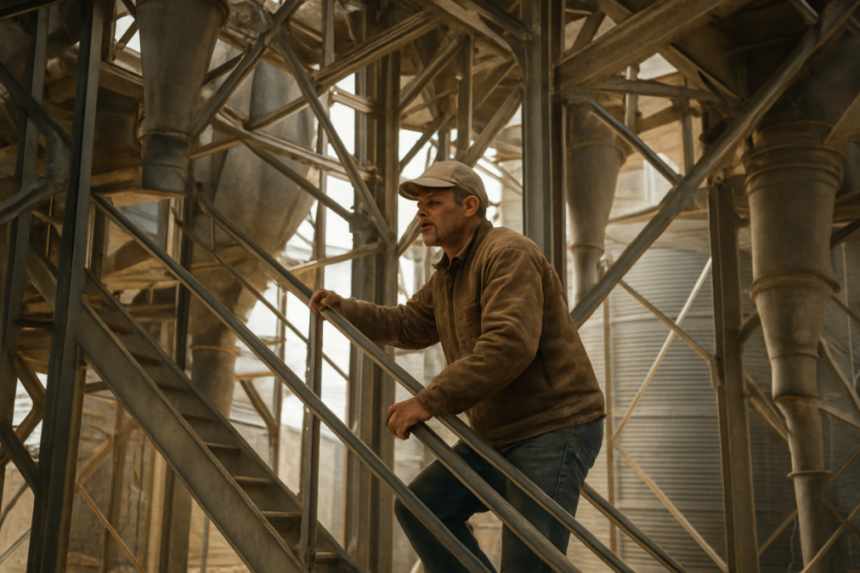
The wrist Casio said 3:26. My hand said 2:10 and 3:50 in my own ink. Call the loop and the sag and the purge maybe forty minutes total. There's most of half an hour between the end of anything I remember and the top of that leg, and the climb itself takes eight, nine minutes at my pace, at night, and I have not one flicker of it. And I want to say, I climbed that ladder in daylight hundreds of times. It's a caged ladder to the distributor floor, then the last run up inside the headhouse to the platform. It's not a thing you do on autopilot. There's two rest stops, a hatch, a fall-arrest cable on the top run you have to hook your shuttle onto.
Which brings me to the harness, and the harness is the whole story, everybody I've ever told this to agrees the harness is the whole story, and they're right for the wrong reason. I was wearing the co-op's fall harness. Over my coveralls, legs buckled, chest strap buckled, and my lanyard shuttle was on the fall-arrest cable, engaged, and where I stood at the rail I was tied off to the platform anchor with the positioning lanyard. Clipped. Correctly. To the correct points, with the gates screwed shut, screw gates, the kind you have to consciously turn a half dozen times.
Here's why that's worse than the alternative, and I need this understood because this is the exact center of the whole ten years for me. I didn't clip in for short checks. Ever. That's an OSHA violation and I'll own it in print, every elevator man of my generation will own it or he's lying, you hook the ladder cage and you skip the rest, up and down, five minutes, done, and Gary knew and Dale knew and the harness hung on its peg by the man-door growing dust on the shoulders except for the annual inspection and the days corporate visited. Wasn't bravado, it was habit and hurry, and habit and hurry is exactly what sleepwalking runs on. If I'd come to up there free-climbing, loose, no gear, I could nearly live with it. That's a man's bad habits walking his body up a ladder while he's absent, that's the sleep experts' story and I'd have taken it with both hands. What I cannot fit anywhere is that my body, absent me, did it right. Better than right. Better than I did it awake. Somebody ran that climb by the book, the book I never followed, buckles, shuttle, screw gates, tied off at the rail like a man being watched by an inspector. And whoever ran that climb was so far from being me that the difference shows in the equipment. My own hands did procedure I'd spent 25 years skipping. You tell me which is scarier, a body on autopilot, or a body on somebody's checklist.
I came down slow. I'll tell you exactly how slow, I counted rungs out loud the whole way, both runs, out loud in the dark like a kid on a diving board, and my voice sounded strange to me and I kept doing it anyway, and I unhooked the shuttle at the bottom with my hands shaking so bad the screw gate took four tries. Hung the harness on its peg. Went to the office, sat, and did the worst inventory of my life. Boots, no scuffs. Coveralls, clean. Hands fine, no grease past the wrists, and you cannot touch that ladder past the hatch without greasing your cuffs at least, everybody's cuffs told on them at that elevator, and mine had nothing, and I'm just now realizing as I write it that I've never once mentioned the cuffs to anybody before tonight, it's been sitting in me for ten years waiting for its turn. Dryer, relit. I hadn't relit it. The purge I'd started would've timed out and locked out waiting on a human to hit ignition, that's the design, it cannot light itself, and it was lit, burning happy, columns full, discharge running 15.1 like a catalog page, and the log,
the log had the 3:00 a.m. line filled in. Time, dryer hours, plenum, moisture out, bin, remarks, initials. R.H. In the remarks it said, all quiet.
I clocked out at 7:04 that morning, said not one word to Gary, drove home past the Methodist church and the co-op's billboard, sat at my kitchen table until noon. And then I did the arithmetic man's version of a breakdown, which is that I got a legal pad and wrote down every option I had left, sleepwalking, seizure, fugue, tumor, liar, and next to each one the readings it explains and the readings it doesn't, and I sat looking at the sheet for a long time. Sleepwalking doesn't do screw gates and doesn't log moisture to the tenth. A seizure doesn't relight a locked-out dryer, the relight is a sequence, hold this, watch that, it's a thing you do with the front of your mind. Tumor, the CT came back clean that winter, I paid for it out of pocket, 900 dollars at the imaging place in Hastings, worth every dime for about a week of relief until I noticed clean meant one more explanation dead. And liar, well. A man can't rule that one out for you. I can only tell you the notebook and I have been over it, and if I built all this to cover something, I picked a story that gets me nothing and costs me plenty, and I've had ten years to improve it and it hasn't improved.
What I did next I'm not proud of and it goes in anyway, it's the second thing I owe this account. I had eleven days left of season and I did not once go up that leg again. The weekly head inspection, belt, buckets, head bearing wear, that's a required climb with a sheet you initial, and I initialed it, twice, at my kitchen table, pencil-whipped it clean, wrote in bearing temps I invented off the last real ones. Falsified a safety record at a licensed grain facility because I was too scared to climb my own leg, and if the head bearing had let go those two weeks and burned the place down, that would've been mine to carry. Nothing happened. Corn came out, trains came, the season died down like they do, first week of November everything went quiet and ordinary, and Weevil moved back onto the counter by the Dickey-john, and I gave Gary my notice the day after Thanksgiving. Told him my knees were done for climbing, which he believed, my knees being no secret on the stairs by then, and it had the advantage of being about one-eighth true. He shook my hand and said the elevator'd been tight two years running and that was mostly the night man. I've thought about that handshake a lot. It's the only performance review I ever got out there, and every reading behind it was true, and the man giving it had no idea what he was reviewing.
I never did move to Kansas City. Rick quit asking around 2018. I got on doing maintenance at the seed conditioning plant in the county seat, days, ground level, and I've been there since, and it's fine work, and every October it is just October, and I want that noted. Whatever it was, it was that place, or that place and me, and it has left me alone for ten years, or it's done with me, or, and this is the thought I don't let stay overnight, it got whatever it was taking a little at a time and doesn't need the rest.
The co-op merged in 2021, the way they all are, and the Stanhope elevator went to a regional outfit that runs it with cameras and one rover crew out of the county seat. In the spring of 2022 the new location manager, young fellow, decent, called me of all people because somebody told him I'd know what in the old office was worth keeping. We spent an afternoon hauling paper to a dumpster, and in the bottom drawer of the file room were the green log binders, back to the '80s, and he said take what you want, it's headed for the burn barrel.
I took my two years. Sat at my kitchen table that night with the notebook alongside, thinking I was going to enjoy myself, honestly, an old man reconciling his readings one last time. And the log matched the notebook, night after night, my own tired ballpoint, until I got to the sag nights. Every sag night, both seasons, all of them, the entries are in my initials and they are not in my hand. I want to say it more carefully than that, because it took me until two in the morning to say what was wrong with them. They are my hand. Same slant, same shapes, my R, my H. And every letter of it is careful. No speed anywhere in it. My log lines hook and drop and trail off, a man writing standing up in the cold, and these sit on the rule like type, like somebody copying my writing out slow and getting it right, the way you'd copy a signature you'd practiced. Eleven nights of it. All quiet, says one. Ran smooth, says another. And the first one is dated October 9th, 2013, when everything I remember and everything I've told you says the 8th, and I have sat with those two dates for three years now, and I'll tell you the truth, that one little slip is the only place in all of it where I ever feel the thing might have been, for one night anyway, less careful than me.
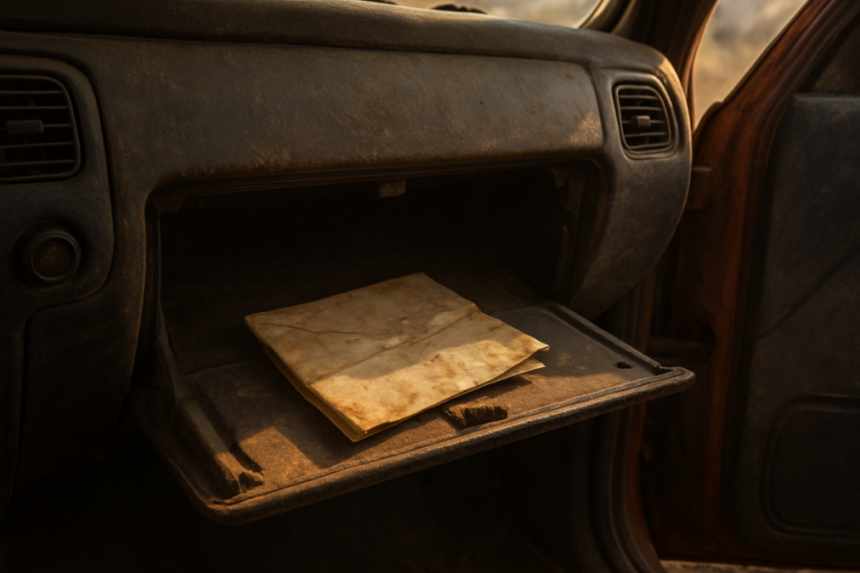
I tore out one page, the 29th, and folded it in the glovebox, and the rest went back in the binders in my closet. The imaging place says my brain is fine. The utility's printout says the power did what I said it did. The state says the scale was a cracked pier. Dale's in the churchyard with whatever he saw. And last month I was filling out a parts order at the plant, date column, and I looked down at the 4 I'd just written. Closed at the top. I've written open fours my whole life, my dad teased me about them, they're all through the notebook. I went back through the order book and I couldn't find where mine stopped.
Somewhere along the line I started closing my fours, and I couldn't tell you when.

AI illustrations. Please judge the story itself. About AI images.
Filed by its author.
Before you peek: what share of readers believes this story?
50%
No votes yet
Total verdict votes: 0
Guess first! What other readers decided is hidden until you cast your own verdict above — vote True, Fake or Not sure to reveal the community score.
Changed your mind? Read the strongest arguments of the other camp below. If they convinced you — change your verdict (once).
Your new verdict:
Why did you vote that way? Pick up to two:
Noted — thank you, detective.
My case notes (private — stored only in this browser)
Saved in this browser.
True or Fake? — play the detective
How it works: cast your True/Fake verdict above and see whether you matched the reader majority. Then hit "Next case" for a random story and keep your streak going. Solve cases to climb the detective ranks — score and rank are kept on this device only.
Tip: highlight any sentence of the story with your mouse or finger — a small share popup will appear to post that exact quote (with a link back to the story) to X, Facebook, Threads or Reddit.
Something similar happened to you? Tell your version — the jury is waiting. Tell your story
Keep investigating
- More Missing Time cases
- More Late Night cases
- More Alien Abductions cases
- A case the jury believes: The Cattle Guard Ate Twenty Minutes Of My Life
- A case the jury believes: The Thing In The Orchard Had Knees That Bent The Wrong Way
- A case the jury believes: The 911 Call I Took That Was Not On The Recording
- The full Alien Stories archive
- Cases the jury cannot settle
Comments (0)
Comments here are case materials: pick a role — ask the author a question, or file your evidence FOR or AGAINST the story — and it lands in the right column. Upvote the sharpest comments: the best one is pinned on top as the Top Detective Comment. Questions get answered by the story's author in person — look for the AUTHOR badge.
No comments yet. Be the first!