
The Same Man Asked Me for Directions Twice, Word for Word
In one sentence: A late-night gas station clerk encounters the same strange man twice asking identical, oddly formal directions in a quiet Maine town.
I work a parts counter in a small Maine town. A man came in asking directions. Two nights later he asked again: same words, same pauses, same wrong way of standing. The store camera saw all of it, and the DVR overwrote itself before I showed one single person.
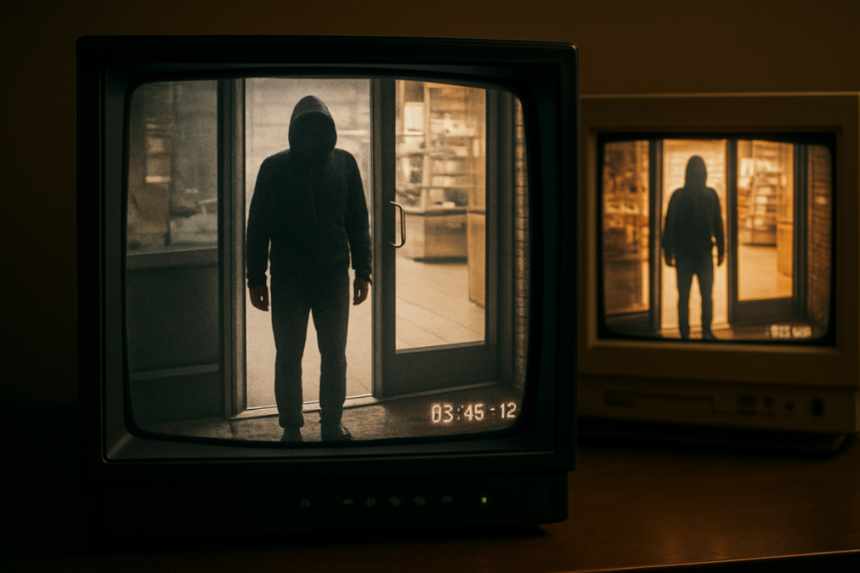
* AI Illustration
First impression: judge by the title and the picture alone — you get the real verdict after reading.
Swear It Happened — CASE FILE #555
JURY PENDING
COLD CASE — this file never got enough jurors. Your verdict counts double here (morally).
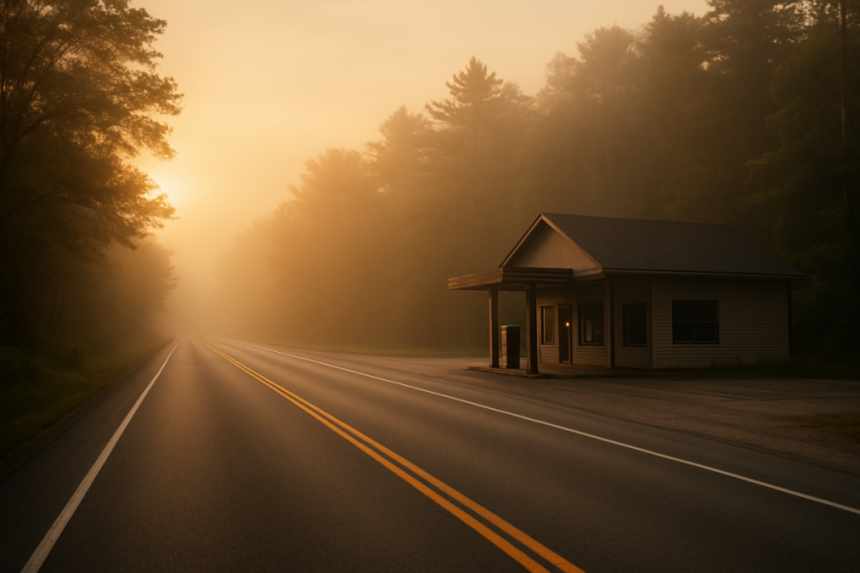
In 2016 I was twenty-seven and I worked the overnight register at a Fuel Mart on Route 2 in inland Maine, outside a little place I'm going to call Harmon Falls because the town doesn't need people driving out there over this. It's the kind of town that's really just a Y in the road with a church, a body shop, and us. The store sat by itself on the highway about two miles east of the actual town, which mattered for the kind of traffic we got. Nights it was long-haul guys, nurses coming off shift at the hospital in Skowhegan, drunks trying to buy beer after one, and loggers. A lot of loggers. If you've never lived along Route 2 you don't know how early those guys start. They'd be at my counter at five in the morning fully awake, boots already dusty somehow, buying Gatorade and Marlboros and those awful pre-wrapped muffins, and they'd been up long enough that five a.m. was practically their lunch.
I worked ten at night to six in the morning, five nights a week, sometimes six when Rick could talk me into it. Rick Thibodeau owned the place. He owned two others, one in Palmyra and one up toward Dover, and he ran all three like a man bailing a boat, whichever leak was squirting hardest got the attention. I'll say more about Rick and the ice machine later because it's part of how I ended up watching the footage in the first place, but the short version of Rick is: decent guy, deeply cheap, and if a piece of equipment could be kept alive with a part off eBay and a Saturday, that's what happened to it.
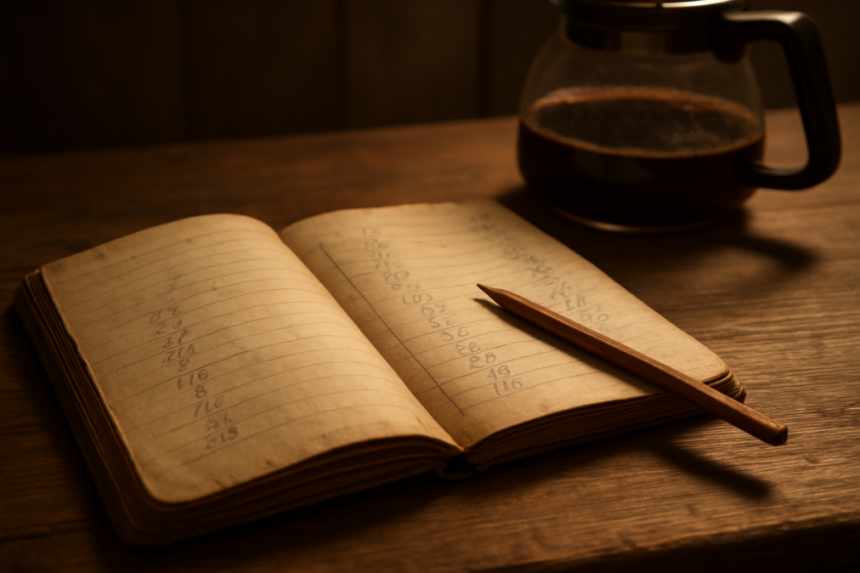
The reason I was on nights was money. Days paid the same but nights were dead enough that I could sit behind the counter with a notebook and do math, and the math I was doing was for the diesel tech program at the community college in Bangor. Two years, and with tools and fees and everything I'd budgeted about eleven grand beyond what aid would cover, and I was at fifty-two hundred that July. I kept the number written in pencil inside the back cover of a Grossman's notebook and I updated it every payday, and I'm telling you this partly so you know who I was then, a guy with a pencil number, not a guy looking for a story. Nobody scrubbing gas station security footage at 4 a.m. on his day off is doing it for fun. I was doing it because Rick wanted the shoplifting thing documented for the insurance, and I was the only one who knew which nights to look at. Again, I'll get there.
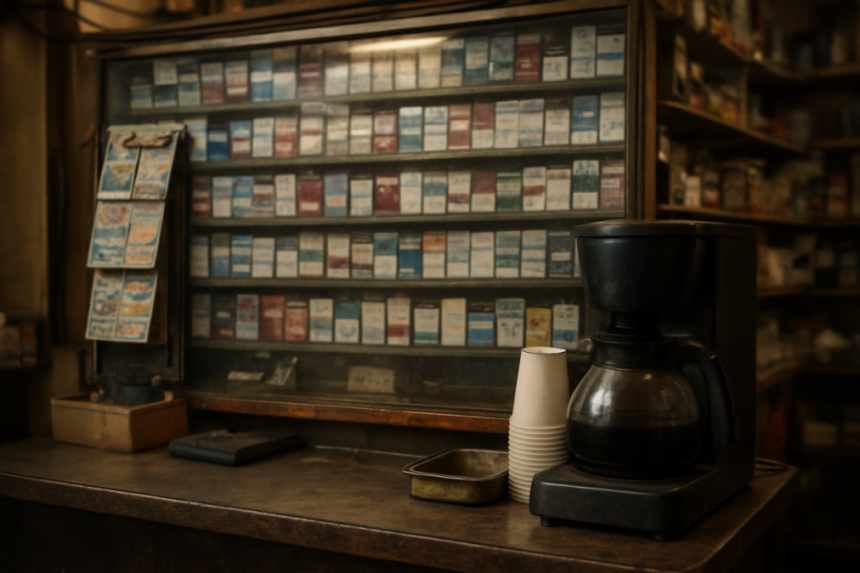
The store itself you've been in a hundred times even if you've never been to Maine. Six pump positions, four that worked reliably. Two coolers of beer, one of soda and energy drinks, a wall of cigarettes behind the counter with the count sheet clipped to the shelf. Lottery machine to my left, scratch ticket dispenser bolted to the counter, coffee station against the front windows with a four-burner Bunn that was older than me. The routine ran the shift more than I did. Elevens, you top off the coffee and face the coolers. Midnight, the beer cutoff argument, if there was going to be one, happened then, and about one weekend a month somebody would take it personally. Two a.m. was the coffee dump. Company rule said dump and rebrew every two hours, Rick's rule said every four, my rule was two o'clock sharp because the smell of four-hour coffee cooking down on a burner is a smell I can still produce in my head on command. Two to three I did the cigarette count and the cooler pull-forwards. Three to four was the dead hour, genuinely nothing, the highway making that sound an empty highway makes, which is not silence, it's more like a room holding its breath between cars. Denny's Oakhurst truck backed in at 4:40 give or take five minutes, and Denny was the first human conversation of the back half of the night, and then the loggers hit at five like a tide, and then it was gray out, and then it was six and I drove home with the windows down to stay awake.
I'm laying all this out because everything that happened, happened against that grid. I didn't wear a watch. I didn't need one. If you asked me what time something happened on a shift I could tell you within ten minutes by what my hands had been doing. That's the thing I'd ask you to keep in mind whenever you feel like I'm being too exact about times. I wasn't checking a clock. I was the clock.
The other thing to establish is June. June was my dog, a shepherd-and-something mix, about fifty pounds, seven years old that summer. My girlfriend Danielle had taken the apartment in Bangor in June (the month, I heard it too, the dog was named three years before the move so it's a coincidence I've been explaining ever since), and she was living up there getting settled into the new job before I theoretically followed her, and the plan had holes in it we were both politely not looking at. Point is the apartment was empty all night and June had started chewing molding, so I began bringing her to work. This was against about four separate policies and I knew it. Rick never worked nights and the cameras were, as established, on a 21-day loop that nobody ever watched. I kept a folded moving blanket for her behind the counter, back by the cigarette cartons, and she'd sleep there the whole shift except when Denny came, because Denny kept dog biscuits in the truck for every dog on his route, and she knew the sound of his lift gate the way I knew the coffee timer. I'm admitting the dog up front because she's in this story and I'm not going to pretend she was allowed to be.
So. July of 2016. I want to say the first night was Tuesday the 12th, and I'll flag right now that I've gone back and forth on this, because I also remember Denny being on vacation that week, and Denny took his vacation the week after the Fourth, which would make it the 5th or the 6th. I've argued with myself about it for years and the honest answer is I don't know, it was one of those two weeks, it was hot, and it was the night after Danielle called me from Bangor to tell me the second bedroom was going to be her sister's for a while, which is its own story that goes nowhere except where you think it goes.
It was around 2:40 in the morning, because the coffee was fresh, I'd done the dump at two and the burners were still ticking as they heated, and I was maybe a third of the way through the cigarette count. The door chime went off. We had one of those two-tone electronic chimes, and I'd worked there long enough that the chime didn't even reach the front of my brain anymore, it just filed itself. Chime, footsteps, cooler door, that's a soda. Chime, straight to the counter, that's smokes or lottery. This one was chime and then nothing. No footsteps I registered. And when I came around the end of the cigarette shelf with the count sheet still in my hand there was a man standing at my counter, square in front of the register, hands at his sides, and I did the little jump you do, and I laughed at myself, and he did not react to any of it.
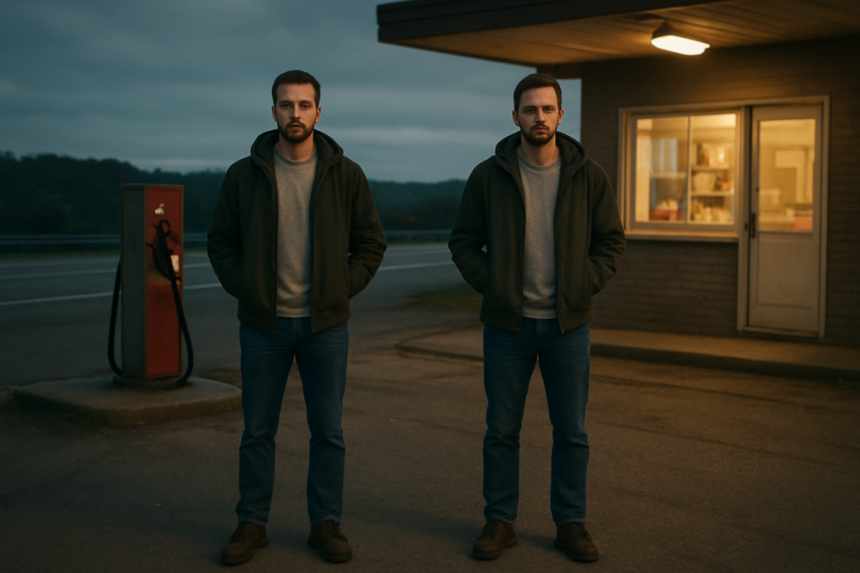
He was tall but not remarkably tall, six foot maybe, and he wore a long canvas coat, the waxed kind, like a duster or one of those Australian drover coats, brown going to no-color at the seams. In July. It had been ninety-one that afternoon and it was still north of seventy in the store at 2:40 with the AC straining, and this man was buttoned into a coat that went past his knees. That alone wasn't a red flag, and I want to be fair about this. You work an overnight register on a highway long enough and you stop making rules about what people wear. I'd sold cigarettes to a man in a bathrobe and swim fins. Heat or no heat, a guy in a big coat at night mostly means a guy who lives outside, or a guy who's cold all the time because of something medical, or a guy about to put forty dollars of merchandise inside the coat. So my first thought, honestly, was shoplifter, and I did the thing you do, which is come to the register smiling with your eyes doing inventory.
Nothing about the coat bulged. His hands were at his sides and he was wearing gloves. Thin ones, leather or something like leather, the color of a grocery bag. And look, gloves in summer is the same category as the coat, circulation problems, eczema, guys who handle chemicals, I'd seen it. I noticed it and filed it. What I couldn't file was the way he was standing, which I have tried to describe three times out loud and always end up doing the same gesture, kind of flattening my hand in the air. He was standing the way a piece of furniture stands. Not stiff. Stiff is a thing bodies do, stiff means muscles holding. This was more like he had been placed there and the placing had been done well. People at a counter at 2:40 a.m. sway. They shift their weight, they look at the scratch tickets, they take out their phone, they do something with their face. He was just concluded, if that makes sense. Finished arriving in a way people aren't.
He said, and I'm going to reproduce this as close as I can because I heard it twice and the second time is welded into me, he said: "Good evening. I hope you may assist. I am looking for the Tarbox Road, that is past the second bridge. Is it far to there."
Flat on the question. Not a question mark, just the shape of a question laid down flat. And the English was, I used to say broken, but broken is wrong, broken implies pieces missing. Everything was there. It was more like assembled by somebody working from very good instructions. "I hope you may assist." Nobody says that. A phrasebook says that. And "the Tarbox Road," with the "the," which, okay, here's a wrinkle, because old-timers in Maine actually do that, they'll say "the Tarbox road" meaning the road that goes to the Tarbox place, that's real, my grandmother said "the Bog road" her whole life. So the "the" alone would've been fine, would've almost been local. It was the local thing inside the phrasebook thing that made my scalp move. Like finding one real bird in a box of decoys.
I said sure, Tarbox Road, and I gave him the directions, which I could do in my sleep because half my job was directions. West on 2 about three miles, you cross the river once in town, that's your first bridge, then the little cement bridge over what's basically a crick, and Tarbox Road is your next left after that, dirt for the first stretch, there's a sign but it's bent. Takes seven, eight minutes. He listened without moving. I mean without moving anything. And when I finished he waited. That's the other thing. There was a pause before everything he said, the same length of pause, and it wasn't a thinking pause. When people pause to think their eyes go somewhere, up, sideways, anywhere. His stayed on me, and the pause was just, I keep wanting to say it was the same size every time. Like a spacer. Then he said, "That is very useful. The second bridge, and then the left. I thank you," and each piece of it landed at the same interval, ta, ta, ta, like a man laying bricks.
I asked him if he was meeting somebody out there, which was me making conversation the way you do at that hour, and also me fishing a little, because Tarbox Road at three in the morning is nothing. It's a town road that runs maybe four miles between Route 2 and the Denbow Road, hay fields at the highway end, then woods, five or six houses total, a gravel pit that hadn't been active since I was in high school. There is no destination on Tarbox Road. If you're going there you live there, and if you live there you don't need directions, and I knew everybody who lived there by their gas habits if nothing else.
He did the pause. Same size. Then he said, "There is a property. We are concerned with the boundaries of it." Which, again, taken alone, fine. Surveyor. Weird hours for a surveyor, but I'd rung up well drillers at 3 a.m. and route salesmen and one time a guy who inspected cell towers rappelling off them in the dark, allegedly. People have jobs you've never heard of. Surveyor went in the file and the file closed and I felt better, and that's a pattern you're going to see me repeat in this story, me finding the file that lets the thing close, because the alternative to filing things, on a highway at night, alone, is not sustainable.
He didn't buy anything. That also wasn't unusual, people came in for directions all night long, that's what a lit building on a dark highway is for. He said the thank-you, did a turn that I want to describe honestly even though it's the kind of detail people roll their eyes at: he turned all at once. Shoulders, hips, feet, one piece. You try it. Your body doesn't want to do it, you have to think about it, it's a dance move basically. He did it the way a lazy Susan does it. And he walked out, and the chime did its two tones, and I watched him cross the lot toward a sedan parked out at the edge of the light, dark color, never got the plate, never even thought about the plate, why would I, and June, and I didn't clock this until later, June was awake on her blanket with her head up, growling. Low, steady, almost below hearing, the growl she saved for thunder that hadn't arrived yet. And she was doing it facing the coffee station. Away from the counter, away from the door, away from the parking lot. Her nose was pointed at the Bunn machine like it owed her money, and the man was forty feet the other direction, and I remember saying something to her like, wrong way, dummy, and she didn't stop until his headlights swung out of the lot, and the second they did she sighed and went back to sleep, and I stood there with the count sheet in my hand listening to fresh coffee tick on the burner.
Here's the first thing a skeptic can have for free. In my memory I can see his boots. Black, high, laced, with a squared-off toe, wrong for summer like everything else. And I've stood behind that counter a thousand times and you cannot see anybody's feet from the register, the counter's got a full front panel, candy racks on the end. For me to have seen his boots I'd have had to lean over the counter or see him walking in, and I told you the truth, I never saw him walk in. So where'd the boots come from. I don't know. Either I saw him leave and my memory moved the boots to the beginning, or I invented them whole. I know the boots are in there wrong, is my point, and I'm telling you about it, and I'd ask for a little credit for that when we get to the parts I'm sure of.
The rest of that shift was normal. I finished the count, did the pull-forwards, the loggers rolled in at five, Big Paul Cyr bought his two coffees, one for him and one that rode in the cupholder for his brother who never came in, and I went home and slept badly, but I slept badly all that summer, that was the Danielle situation, not the coat situation. I told exactly one person about the guy, which was Sherry, who worked two-to-ten and overlapped me at shift change. I told it as a funny thing. Weird dude in a duster asking after Tarbox Road at quarter of three, phrasebook English, gloves in July. Sherry had worked gas stations since the eighties and she just said, and I remember this because it turned out to be the closest anybody came all summer to being right, she said something like, "Was it the guy who doesn't blink? He's been in before." And I said I hadn't noticed whether he blinked, and she said if I hadn't noticed then it wasn't him, because with that guy it's the first thing you notice, and the conversation went on to the ice machine and I forgot about the blinking thing for two days. Until I had reason to check.
Because two nights later he came back. And before I get into the second visit I have to do some housekeeping, because three other things were going on at the store that July and all three of them are load-bearing for how the rest of this went, even though none of them turn out to be anything. If you want the pure creepy stuff you can skim, but I'd rather you didn't, because the boring stuff is where I lived. The boring stuff is what I mean when I say I wasn't primed for this.
Thing one, the shoplifting. We had a crew of teenagers that summer, three or sometimes four of them, who'd figured out the physics of a two-cooler store with one overnight guy. Two of them come to the counter and take forever with a complicated transaction, gas money in dimes, a lottery question, while the third drifts the far aisle and loads a backpack. Beer at first, then they got bolder and it was whole boxes of Slim Jims, phone chargers, once an entire countertop display of 5-hour Energy, which, I hope it worked. I knew roughly who they were. One of them I was pretty sure was a Denbow kid, which complicated things town-politics-wise, and I'd told Rick, and Rick's response was pure Rick: don't confront anybody, don't call the county on minors over Slim Jims, keep a list of dates and times, and we'll pull the footage and do it properly for the insurance. Keep a list of dates and times. Remember that, because that list is the only reason this story has evidence in it, or had, or almost had.
Thing two, the ice machine. The store had a Leer ice merchandiser out front, the big white box, and its compressor died the last week of June, and the correct move was a new unit and Rick instead bought a used compressor off a guy in Corinna, and the used compressor was the wrong size, and his brother-in-law fitted it anyway with, I swear, a wooden shim involved somewhere, and from about July 1 that machine ran twenty hours a day trying to hold temperature and it made a sound. A hum with a click riding on it, and every forty minutes or so a shudder you could feel through the slab. I'm dwelling on the machine for two reasons. One, all summer, any time something felt strange in that store at night, the first thing I learned to do was ask myself whether it was just the machine, because a big compressor cycling under bad load does genuinely strange things, it makes the windows buzz at certain pitches, it put a vibration in the floor you'd lose track of, and once in August I would've sworn on my mother somebody was standing in the beer cooler and it was ice sloughing off the evaporator plate. That machine gaslit me all summer and I knew it. Two, the machine matters because of a specific thing near the end, and I want it established early that it was ALWAYS running. It never stopped. Hold that.
Thing three was Danielle, and I'll keep this short because it's nobody's business, but the shape of it colors everything. She'd moved to Bangor for a job at the hospital, real job, benefits, the kind of thing you don't say no to in this part of the state, and the plan was I'd finish out the year, hit my tools number, and follow, and enroll, and the two halves of the plan would snap together like a trailer coupler. And all that July the phone calls were getting shorter and arriving earlier in the evening, which if you've been on either end of that you know what it means. Her sister moved into the second bedroom "for a while." I'm not going to narrate the rest of it. I'll just say that a man alone in a lit box on a dark highway from ten to six, whose girlfriend's calls now came at 8:15 sharp, is a man with a lot of unassigned attention. I know exactly what a debunker does with that sentence, because I've done it with that sentence, I've sat in my truck and told myself, you were lonely and sleep-deprived and your life was quietly coming apart, of course the wallpaper started moving. And here's my answer and it's the only answer I've got: the wallpaper didn't start moving. Everything I'm telling you stayed nailed down and boring except one man, on two nights, and one field. If my brain was manufacturing this stuff out of loneliness it had all summer and one venue and it produced exactly three scenes. That's a weirdly disciplined haunted brain. Make of it what you want.
Okay. Carl. Carl needs a real introduction because Carl is the only other person in this story who took it seriously, and also because Carl came with his own noise, and for a while I filed everything he said under that noise, which I regret.
Carl Ouellette was a retired game warden, fully retired by then, must've been seventy, and he had the insomnia old cops and old wardens get, and his wife had passed I think two years before, and the result was that Carl showed up at the store most nights somewhere between 1:30 and 3:00 for coffee and one of those shrink-wrapped whoopie pies, and he'd stand at the end of my counter for an hour. Not in the way. Wardens know how to stand somewhere for an hour. He'd read the paper he brought with him, and talk in bursts with long comfortable gaps, and pat June, who adored him, and around three he'd say "well" like a complete sentence and drive home. I want to be honest that Carl was also, that summer, a man with a bug in his ear, because he was in a boundary dispute with a guy from Massachusetts who'd bought the woodlot abutting Carl's back forty, and the guy had had it surveyed, and Carl swore the new pins were thirty feet onto his side of the old blazed line his father had cut. And this dispute ate Carl alive all summer. He had a folder. He'd bring the folder. I heard about iron pins versus stone piles, I heard about the 1958 deed calling for "the ash tree," singular, in a forest, I heard about adverse possession the way other people hear about their coworker's fantasy football team. It went, as far as I know, absolutely nowhere. Last I knew Carl and the Massachusetts guy were still lawyered up over a strip of poplar and mosquitoes worth maybe four hundred dollars. That's not the story. But I need you to know Carl had surveyors on the brain that summer, because when Carl is the one who eventually says the word "surveyors" to me, you're entitled to weigh that, and I want you weighing it with full information, because I did weigh it, and I still ended up where I ended up.
So, the second visit. Two nights after the first one, and this date I can anchor better because it was the night after the teenagers hit us for the 5-hour Energy display, which went on Rick's list as the 14th, so the second visit was the night of the 15th into the morning of the 16th. Unless the first visit was the week of the 5th, in which case the two-nights-later math breaks, and I acknowledge that, and I've decided to stop performing surgery on my own calendar in public. Two visits happened. They were two nights apart. The pair of them sits in the middle of July. That's what I've got.
Same time. And I don't mean also late at night, I mean the coffee was in the same state. I'd dumped at two, rebrewed, and the fresh pots were still ticking on the burners, which puts it in the same ten-minute window as the first visit, and I was on the cigarette count, and I'd bet you anything I was in the same physical posture when the chime went, half-crouched at the menthols with the sheet on my knee. Chime, and then no footsteps, and I came around the shelf and he was at the counter. Same coat. Same gloves. Same standing.
And he said, "Good evening. I hope you may assist. I am looking for the Tarbox Road, that is past the second bridge. Is it far to there."
I want to be careful here, because this is the part where every listener's face changes, and it's also the part where I have the most sympathy for the skeptics, because people do repeat themselves. Old men told me the same joke every Friday for years. Foreigners working from a memorized script will run the script again, that's what a script is for. If a man with shaky English found a phrasing that worked on Tuesday, why wouldn't he deploy it again on Thursday. I know all that. I'd ask you to sit with the actual experience of it, though, which is not "a man repeated himself." It's that nothing had elapsed for him. When a person repeats a request two days later there's a layer on it, a little grease of acknowledgment, hey, me again, still hunting that road. Even a memorized script gets delivered into the room it's in. This had none of that. Same flat pitch. Same spacer pauses, and I was listening hard this time and I will tell you the pauses were the same length as each other and, as far as my nervous system could measure it, the same length as Tuesday's. It was the difference between a man saying a thing again and a thing being played again. The first one includes you. The second one doesn't need you there.
And this time I was checking the things Sherry had put in my head, and: I did not see him blink. I was looking. It's harder to confirm than you'd think, at that hour your own eyes are doing plenty of stuttering. All I'll claim is I watched his face the way you watch a pot you suspect isn't going to boil, and I never caught it. And the gloves. When I started the directions, west on 2, first bridge in town, he brought his hands up to the counter, first time I'd seen the hands do anything, and he set them flat on the mat, the way you'd set down two tools, and with his right hand he pinched the back of the left glove and tugged it snugger, the way anybody does with gloves, and I was looking straight down at his hands from two feet away under the register lights, which are the brightest lights in the store because of counterfeit bills. The glove leather creased when the hand flexed inside it. Fingers going flat, knuckles working. And the creases came up wrong. On the back of the middle finger the leather broke across four ridges. I need you to understand what I mean. Bend your own finger and look at it. Three knuckles, root to tip, three places to fold. The glove folded four times, evenly, like a drinking straw does, one two three four, on the middle finger and I think on the ring finger too, and then the hand relaxed flat and the leather went smooth and there was nothing to look at. Two seconds, maybe less. I kept giving directions. My mouth did the second bridge and the bent sign all on its own, I have no memory of deciding the words, and my whole conscious mind was two feet down and to the left going, count again. And I couldn't count again, because the hand was flat.
You'll say the leather was just cheap, creased in a previous life, folded funny. That's a real possibility and I'll hand it to you for free, gloves have their own history, leather remembers. I'd believe it in a heartbeat about a glove on a table. It's harder to believe about a crease that shows up under a live flexing hand, evenly spaced, two feet away under a counterfeit-check bulb, and how many hours of my life do you suppose I'd spent looking at exactly that patch of counter mat where people's hands go? Thousands. Hands on that mat were my job. Old hands, tattooed hands, hands missing pieces from mills and saws, hands shaking from a bad night. I'm a professional watcher of hands at close range and that hand had one more hinge in it than a hand has. There. That's the claim. It's small enough to fit in a shirt pocket and I've carried it ten years.
The coin thing happened at the end and it happened fast, so let me set it up. I kept a quarter on the register. Specifically an old Canadian quarter that wouldn't scan in the coin counter, and it lived next to the tape dispenser, and I fidgeted with it on the dead hours, walked it across my knuckles badly, that kind of thing. When he did his thank-you, "That is very useful. The second bridge, and then the left. I thank you," word for word, and I mean word for word, same bricks, same intervals, my hand was resting by the register and I had the quarter under two fingers without thinking about it, pure fidget, and as he did his lazy Susan turn my fingers came off the edge of it wrong and the quarter went off the counter on my side. Concrete floor with a rubber mat that ends about a foot short of the register stand. The quarter missed the mat. Hit concrete, that bright coin slap, and bounced.
He flinched before it hit.
I've drawn this on napkins for people. The flinch was small, a head-tick down and left, toward where the sound was going to be, and it happened while the quarter was in the air. Half a second early, give or take, and I know exactly what half a second of quarter-drop looks like from that counter height because I dropped that same quarter probably four hundred times that summer, it was practically the shift's hourglass. The tick came first. Then the slap. In that order. And the two of them together read exactly like sound and echo, except reversed, and the reversal was so clean that my brain genuinely tried to re-file the sequence in real time, and I could feel it trying, like when a word stops looking spelled right. He finished the turn, walked out, chime, crossed the lot into the dark past the pumps.
June had been growling the whole time. I'd tuned it out the way you tune a fridge, and it registered only when it stopped, which was, same as before, the moment his lights swung out onto Route 2. And she'd been facing the Bunn. The whole visit, I'd stake my life, oriented on the coffee station, hackles up in that half-hearted way where just the strip over the shoulders lifts. The man had been at the counter. The coffee station is against the front windows, a good twenty-five feet from the counter, ninety degrees off the line to where he stood. She's a dog that pointed her nose at what she growled at her entire life. Thunder, the UPS man, the vacuum, one specific porcupine. Nose at the thing, every time. Both visits, nose at the coffee machine. I refilled her water bowl after he left and my hand was shaking a little, which embarrassed me, alone, at three in the morning, which tells you something about how deep the training goes, embarrassed for an audience of a dog.
And then, because a shift is a shift, I did the pull-forwards. That's the part nobody believes for the wrong reason. People will swallow the extra knuckle before they'll swallow that I just went and faced the coolers afterward. But what was the alternative. There's no version of the night where I call somebody. Say what. A repeat customer repeated himself, my dog growled at an appliance, and I dropped a quarter and he heard it early? Fear needs a container and there wasn't one, so it just sat in me like coffee sits, and at 4:40 Denny backed in, lift gate, biscuits, told me a long story about his sister-in-law's fifth-wheel camper, and I stood there nodding with the fear cooling in me, and by the time the loggers hit at five the night had almost talked me out of itself. Almost is the operative word. I did start writing things down. Same notebook as the tuition number, back pages, working forward from the back. First entry says, and I'm looking at it right now, "7/16 approx 2:40. Same guy, Tarbox Rd directions again. EXACT same words (I think). Gloves. June/coffee machine again. Quarter." And then underneath, added later that morning in different pencil pressure, because apparently I felt the need to be fair to him in my own notebook: "Maybe rehearsed? Practicing English?"
He didn't come back a third time. I want to state that plainly because every telling of this kind of story trains you to expect the third visit, the escalation, and part of what I trust about my own account, honestly, is that it refuses to behave. Two visits, a pair, like the two bridges. Then nothing at the counter ever again. What happened instead is that the story changed venues on me, twice. Once into the DVR and once into a hay field. But between the second visit and the DVR there's about three weeks of July and August, and those weeks had their own weather, and two things happened in them that I have to include even though one of them undercuts me. Especially because one of them undercuts me.
The first was Carl and the word. This was maybe a week after the second visit, so call it the 22nd, 23rd, one of those thick nights where it doesn't cool down and the moths on the window glass are a whole civilization. Carl was at the end of the counter with his coffee and his folder, because the boundary thing had entered a new phase, the Massachusetts guy's lawyer had sent a letter, and Carl was reading me the letter with commentary, and I was half listening and mostly thinking about whether to tell him. And I decided to tell him, partly to change the subject off the ash tree, and I gave him the light version. Guy in a big canvas coat, twice, same words both times, asking after Tarbox Road, and the pauses, and I left out the glove and the quarter because I was still auditioning the story in those days, feeling out how much a listener could take, and even the light version, I watched it land funny. Carl put the letter down. And he didn't do the face. That's the thing I remember, no eyebrow, no smirk, he just got quiet the way he probably got quiet on a thousand tips about jacked deer, and he said, "Asking for it, or asking about it? Was he ON it, or asking the way TO it?"
Which struck me as a strange first question, and I said asking the way to it, why. And Carl said, roughly, that over the years he'd heard about the surveyors on the Tarbox Road three or four separate times, from separate directions. The way he told it, a fella from the pit crew back when the gravel pit still ran had a guy in a coat flag him down at the pit gate at dawn asking the way to the Tarbox Road, and the pit gate IS on Tarbox Road, you're standing on it, and the pit guy said as much, and the man thanked him and walked off down the shoulder the wrong way, back toward the highway. And a woman who kept horses toward the Denbow Road end had somebody at her door years later, gloves, very formal, asking the way to the road her own driveway emptied onto. Always the same shape, Carl said. Somebody asks how to get to a road, and the asking happens on or next to the road, and nobody ever sees them ON the road afterward. "Surveyors," Carl said, doing quote marks with his voice, that's what the pit fella called them, because of the formality I guess, and it stuck in Carl's head all these years for the same reason it was now sticking in mine. Wardens keep a mental drawer of things that aren't crimes and aren't nothing. He said it was the only story of its kind he'd collected twice.
Now, the fair reading. I've said it already: Carl had surveyors on the brain that summer, the word was charged for him. And Carl was seventy and lonely and I was a captive audience with a story that fit a drawer he already owned. All fair, and none of it explains the detail that made my arms go cold in a ninety-degree store, which is that I had never told Carl that the man asked the way TO the road rather than about something on it. Carl asked me that question before I'd made the distinction out loud. He supplied the shape before I confirmed it. Either he was a sharp old interviewer making a lucky cut, which, being honest, wardens are exactly that, or the shape was real and he'd been carrying it since before I was hired. Both of those live in my head. Neither one has ever fully evicted the other.
The second thing in those weeks is the one that undercuts me, and I'm going to tell it at full length precisely because it would be so easy to leave out. First week of August. Dead hour, so between three and four, and I was doing the thing I did in the dead hour that summer, reading on my phone behind the counter, and what I was reading about, because of all this, was sleep. Microsleeps, specifically. If you don't know the term, it's when a sleep-deprived brain drops offline for a second or three with the eyes open, mid-task, and splices the gap so cleanly you don't know it happened, and people have entire small experiences in them, and the experience gets filed as a memory of the real room. Night-shift workers run on the ragged edge of this constantly. I read that and I felt two things at once, and I wrote them both in the notebook that night, which is the only reason I trust my memory of feeling them. One, relief, an actual physical loosening, because here was a file that could hold everything, the pauses, the flinch, maybe even the glove, the brain does its stitching and the stitching shows. And two, right behind the relief, this stubborn flat refusal, because the visits weren't one-second gaps, they were minutes long, with a before and during and after, and June was in them, and June doesn't microsleep in sync with me.
And then, I swear on the pencil number, THAT SAME NIGHT, the universe handed me a live demonstration of exactly how far I shouldn't trust myself. About 3:40 I looked up from the phone and there was a figure standing out by the propane cage, at the edge of the lot lights, long coat, still as a post, facing the store. And everything in me went off at once, and I stood up so fast the stool went over, and June lifted her head off the blanket, and I looked at her, and she looked at me, completely blank, ears soft, nothing, and I looked back out and there was nobody by the propane cage. Twelve seconds, maybe. Now. The old me, the me from before the phone article, would have filed that as: he came back and I saw him and he did the thing where he's gone. And here's what an honest accounting looks like instead. The register tape. Our register printed a journal tape of every transaction and every no-sale, and I'd hit no-sale at some point to make change for my own coffee, and the timestamps on that tape put my no-sale at 3:38, and the thing is, I remembered making that change AFTER the figure, distinctly, I'd have testified to the order, and the tape said before. My own sequence of five minutes was provably shuffled. Because I'd been dropping. I'd been microsleeping in little slivers all August, is the truth, running on day-sleep in a hot apartment with a phone that stopped ringing at 8:15, and one of those slivers had a man in it, because of course it did, that's what my brain had in the hopper that month. The figure by the propane cage was a dream two seconds wide. I'm certain of it, as certain as I am of anything in this, and I put it in the notebook under a heading I still have: "FALSE ALARM. Tape says 3:38. You are not a reliable instrument. Adjust."
So that's on the table. I caught my own brain forging the man once, red-handed, timestamps and all. You'd think that would have dissolved the whole summer for me and for about four days it nearly did, and they were good days, honestly, I called Danielle on one of them and we talked forty minutes like the old calls. And then I had to go and do the thing Rick had been after me about for a month. The teenagers had hit us again, the second week of August, backpack kid and the dime-counter working their routine while a third one walked a thirty-rack straight out the door, and Rick said enough, we're doing the insurance claim, and you know the dates, so come in on your day off, sit down with the DVR, and pull the clips. And on a Sunday afternoon, me and a legal pad and the list of dates and times, I sat down in the back room with that machine, which is how I found it. I wasn't looking for him. I want that in the record. I was looking for a kid with a backpack, and I was getting paid time and a half.
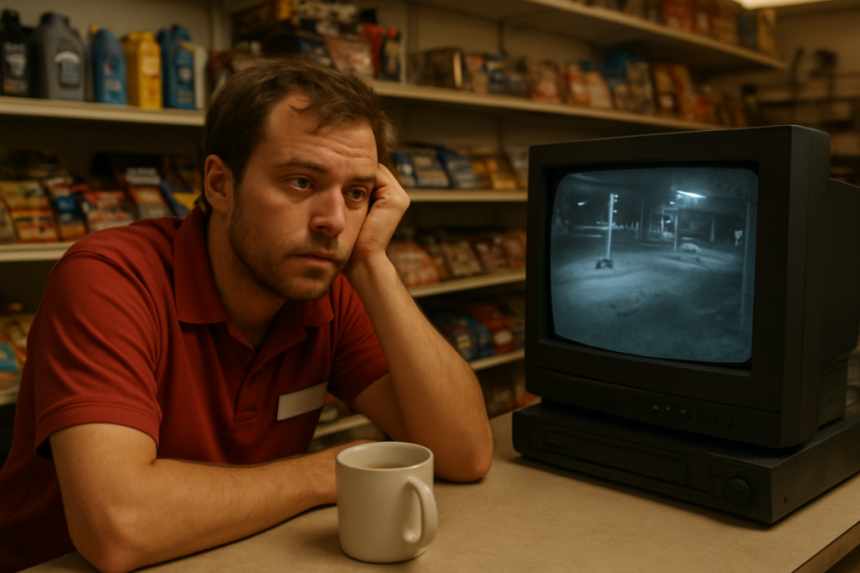
Let me describe the setup, because the setup is where the skeptics go first and they're right to. The DVR was a Chinese-brand sixteen-channel unit, eight cameras actually connected, living on a shelf in the back room above the mop sink, with a monitor on a milk crate. Rick bought it used, obviously. The cameras: two outside under the canopy pointed at the pumps, one on the door, one down each cooler aisle, one on the register from behind and above my right shoulder, one on the back room itself, and one that had shown a ceiling tile since before my time. The unit stamped date and time on every channel, and yes, the clock drifted, this is the first thing I checked and the first thing anybody asks, and I'll give the drift question the space it deserves in a minute, because I checked it that same afternoon and I checked it in a way I'd defend to an engineer. But order of events. I was there for the teenagers.
And I got the teenagers. Two of the three dates on my list were still inside the 21-day loop, and the footage was beautiful, honestly, insurance-wise. Backpack kid worked the far aisle like he'd done a course in it. I clipped it all to a thumb drive Rick had left me, wrote down the timestamps on the legal pad, very satisfying, case closed, kid turned out not to be a Denbow at all which defused the town-politics angle, and the whole affair, I'll close the loop now, ended with restitution and no charges and one extremely uncomfortable mother in the store that September. That thread ends there. Nothing about it matters except that it put me in a folding chair in front of that monitor with the machine's remote in my hand and a working knowledge, by hour two, of how to scrub, and a thought I'd been not-thinking all afternoon, sitting there the way June sat by the counter when I ate: the 16th is still inside the loop.
The night of the second visit was day nineteen of twenty-one. Two days from being eaten. I told myself I was just going to look at the coat. I think I told myself it would be good for me, therapeutic, the August false alarm had me half convinced I'd been dreaming in slivers all month, and here was a chance to see the man boringly walk in a door like everybody walks in a door, and file the whole thing under tired. That is genuinely what I expected. I pulled up channel 3, the door camera, night of the 15th into the 16th, and started scrubbing forward from 2:00 a.m., and almost immediately I had him, and the relief of just seeing him at all was enormous, I remember that clearly, proof the visits weren't dreams, there he is, coat and all, timestamp 02:36:51, pushing the door open, chime would've gone right there, and I watched myself in the corner of frame come around the cigarette shelf with the count sheet, and the whole counter conversation ran, wide angle, no audio, four minutes and change, and he does the turn, and out. Normal. A man in a door, a man at a counter, a man gone. I sat there and actually laughed at myself a little, and the laugh had about four seconds to live, because then I switched to the canopy cameras to watch him cross the lot, because I wanted the sedan, I'd never gotten a look at the sedan, and channel 1, canopy west, showed the lot, and I scrubbed back to catch his arrival, and the headlights swing in off Route 2 at 02:40:58.
I'm going to write that again in words. On the door camera he enters the store at 2:36 and change. On the canopy camera his car enters the lot at 2:40 and change. Four minutes and seven seconds apart, in the wrong order. The man is at my counter, mid-conversation, on one channel, while on another channel his headlights are coming in off the highway, and the car parks out at the edge of the light exactly where I remembered it, and nobody gets out of it. That's the part I didn't have a file for then and don't have one now. Nobody gets out. The car sits, lights off, for the duration, and when he leaves the store, on channel 3, at 02:41:24, he crosses channel 1's frame at 02:41-something toward the sedan, and the interior light never comes on, and at 02:43 the headlights back out and go west on 2. Toward town. Toward the bridges.
Clock drift. Here's the drift section, and I'd ask the people who've been waiting for it to actually read it. Yes, cheap DVR clocks drift, and yes, on a multi-channel unit you'd think channels could disagree, and the first thing I did, sweating in a back room that smelled like mop water and cardboard, was test exactly that, and the test was easy, because the lot and the door share events all night long. Every customer who parks and comes in is a two-camera event. So I scrubbed to Denny's 4:40 delivery that same night: truck crosses channel 1 at 04:38:12, and channel 3 has the door swinging for him a hair later, seconds, consistent. I did the loggers at five, same thing, park, walk, door, everything in order, gaps of seconds, and I checked the night before and the night after, because by then I had the folding chair pulled right up to the milk crate. The channels agreed with each other about every human being who visited that store for three days. They disagreed about one man, once, by four minutes and seven seconds, in the specific direction of him being indoors before he arrived.
And then I did the thing that still wakes me up sometimes, which is I scrubbed channel 3 backward from his entrance, because a horrible specific question had arrived in me, namely, if the car came at 2:40, and the door opened at 2:36, then what does the door camera show BEFORE 2:36, and the answer is the door camera shows the door, closed, empty frame, moths on the glass, for eleven minutes, and at 02:36:51 the door is pushed open from outside by a man who is, and I have to be exact here because it's all I have, simply present at the leading edge of the frame. The camera looked at the door head-on, you'd see anybody approach through the glass. I stepped it frame by frame, the unit did about seven frames a second on that channel, and there is a frame where the glass shows nothing but moth and canopy glare, and there is a frame where there is a shoulder and a coat sleeve, and between them nothing happens. No blur coming up the walk. I sat in that folding chair and stepped those two frames back and forth so many times, click, click, click, that the plastic arrow on the remote went shiny, shoulder, moths, shoulder, moths, and it was a Sunday afternoon, sun outside, cars at the pumps, Sherry ringing people up forty feet away through a plywood door, and I have never in my life felt further from other people than in that chair.
What I did next is the human part, and it's the part I'd do differently, and knowing myself I'd probably do it the same. I copied nothing. The thumb drive was right there. The teenager clips were ON it. The export menu was open, I knew the buttons. And I sat there with my thumb over the remote doing math about a different thing, which was: who sees this drive. Rick sees this drive, because it goes to Rick for the insurance. Maybe an adjuster. And what's on it is the overnight guy's mystery footage of a counter conversation, four minutes out of joint, from the same overnight guy whose unauthorized dog is visible, plainly, on the register channel, in every single clip. That's what I was weighing, I kid you not. The dog. The policy. Rick finding out about June, me losing the shift, or Rick squinting at my four-minute anomaly and saying the clock's junk, I bought it used, and both of us knowing forever after that the night guy sits in the back room making ghost tapes. I was fifty-two hundred dollars into an eleven-thousand-dollar plan and the shift was the plan, and I told myself: it's day nineteen. I've got two days. I'll think about it tonight and pull the clip tomorrow.
You already know. Tomorrow was the day Rick's brother-in-law finally came to deal with the ice machine, and the compressor swap needed the outlet on the back room circuit, and the genius unplugged the DVR at two in the afternoon and it sat dark until somebody noticed the cameras were down, which was me, at ten, and when it booted it did a disk check, and whether it was the disk check or the loop or the outage or the machine just being the piece of junk it always was, the oldest days were gone. Not all of them. It kept sixteen days and change. The 15th and 16th were not in the sixteen days. I stood in the back room at 10:20 at night scrubbing a calendar menu with grayed-out squares where my proof used to be, and the ice machine outside hummed its new hum, fixed, finally, wooden shim and all, and I want to be honest about what I felt, because you'd expect grief and what I actually felt for the first minute was relief, that species of relief when the decision gets taken out of your hands, and I have disliked that minute of myself for ten years. Then the grief showed up on schedule and stayed.
I told two people that week. I told Sherry at shift change, the whole thing this time, glove and quarter and the four minutes, and Sherry listened all the way through while she counted her drawer, didn't stop counting, and at the end she said something I think about more than almost anything anyone's ever said to me. She said, "You know what's funny, I couldn't tell you what the no-blinking guy looked like. I've seen him three, four times over the years and I couldn't pick him out of two people." And I realized right then, standing there with my keys in my hand, that neither could I. I'd been two feet from his face on two nights with a specific professional habit of faces, I could tell you the coat, the gloves, the boots I shouldn't have been able to see, the pauses, and the face is just, there's a region in my memory where the face goes and the region has a "this is a face" label on it and no face. I'd have said before that summer that I never forgot a face, it was my one bar trick, name the regular, name their brand. His I never had. Not forgot. Never had.
And I told Carl. Carl came in that Thursday around two and I laid it all out, and he asked warden questions, plate, direction of travel, did the sedan ever come back, and then he sat with his coffee for a while and told me about a thing I'd half heard before, how when he worked the woods you'd sometimes find a bait pile, corn or apples dumped in a clearing, and the whole art of working a bait pile is you don't watch the pile, you watch the approaches, and he said, "What I never liked about your fella," he called him my fella, "is he keeps asking the approach." And he tapped the counter, and that was the end of the analysis portion, and then, I promise this is true, he opened the folder, because the Massachusetts lawyer had sent another letter about the ash tree, and we spent till three on that, and it was wonderful, it was the most relaxing hour of my month, listening to a boundary dispute where both parties were human beings and the stakes were poplar.
The rest of August went by in the usual way. Danielle and I ended it over the phone on Labor Day weekend, no fireworks, two tired people agreeing on a fact, and the last thing she ever mailed me was my Grossman's notebook that had ended up in a box of hers, which meant for six weeks that fall the tuition number and the other notes were in an apartment in Bangor and I updated nothing and felt like a man holding his breath. The teenagers, like I said, resolved into restitution and an awkward mother. The ice machine ran quiet clear through the fall, Rick's brother-in-law's one triumph, and I'd be lying if I said I didn't miss the hum a little, the store at 3 a.m. was a different room without it, and here's the loose end I promised about that machine and I'll just leave it where it lies: June never growled at the Bunn again. Not once, September, October, November. Whatever her nose or her ears had been doing those two nights in July, it was specific to those two nights. The coffee machine was just a coffee machine again. I don't think it was ever about the coffee machine. I think, and this is ten years of turning it over, that she was pointed at the nearest running motor because the nearest running motor was where the wrongness was loudest, some hum under the hum, and a dog triangulates with what she's got. That's not science. That's a man doing his best with a dog's opinion, which is all a dog leaves you.
The field was the last day of August or the first of September, because the loggers had started wearing sweatshirts at five, and it was my sixth night that week, Rick had talked me into covering for the Palmyra guy's kid's wedding, so I was driving home cooked all the way through. I should explain the route. My apartment was on the far side of town, and the straight shot was Route 2 through Harmon Falls, but that summer the state had 2 torn up west of town for culvert work, one-lane with a pilot car even at dawn some days, so half the mornings I took the shortcut everybody took, which is the Denbow Road, and the Denbow Road, as you know by now, catches the far end of Tarbox Road. I'd driven it all summer without incident and without thinking, that's the truth, whatever the nights had going on I never transferred it to the geography in daylight, a road is a road when the sun's up.
Six-fifteen, maybe six-twenty in the morning. Sun not up over the treeline yet but the sky fully lit, that pewter color, ground fog lying in the low spots in ribbons. I came down the Denbow Road doing forty-five with the windows down and June asleep in the passenger seat, and where Tarbox Road tees in there are the hay fields I mentioned, a big one on the north side that had been cut two weeks before, all stubble with the second growth coming up through it, and I looked at the field the way you look at a field, which is to say barely, and there were four of them in it.
Out in the middle. A long way off the road, a hundred and fifty yards, two hundred, past where the fog ribbons started, standing in the cut stubble in long coats, and they were evenly spaced, and I mean evenly, the way fence posts are evenly, a spacing with arithmetic in it, maybe thirty feet apart on a line, and every one of them was facing the treeline at the back of the field. Away from me. Away from the road. Four coats the color of no-color, hanging dead still past their knees, at 6:15 in the morning in a field that belongs to a man named Verrill who hays it twice a summer and would no sooner stand in it at dawn than swim in it. Not one of them moving. Not turned by the sound of my truck, and the Denbow Road is quiet at that hour and my exhaust wasn't, and anything with ears in that field knew a truck was passing, and no head turned, and the treeline they were facing was just a treeline, spruce and popple with the fog going up through it, nothing to see, nothing happening in it, and that was somehow the whole horror of it, that there was nothing to see and all four of them were seeing it.
I did not slow down. I want this on the record as the one thing in this story I'm sure I did right, and also the thing I have the hardest time explaining to people who weren't ever a tired man alone on a farm road at dawn. Every telling, somebody says, I'd have stopped, I'd have taken a picture, I'd have honked, I'd have driven right up Tarbox Road after them. And all I can tell you is that every instinct I own, the ones from before I worked registers, the ones from before anybody worked anything, came up out of the floor of me at the same moment and agreed with each other, and what they agreed on was: this is not for you, and the payment for passing is that you keep passing. I didn't speed up either. I'm oddly proud of that. I held forty-five like a man holding a full cup, and I watched them in the mirror exactly once, still on their line, still facing the trees, and the road bent, and that was the last I ever saw of any of it. June slept through the whole thing. I got home and sat in the truck in the driveway for a while.
Here's how it lands, or doesn't. I finished out the year, hit the number in March, moved up to Bangor in the fall of 2017 for the program, wrenched on trucks ever since, I'm at a shop in Newport now doing fleet work and it's a good living, and my hands, which I watch more than most people watch their hands, for reasons, are getting to be working man's hands. I never saw the man again. I've never driven Tarbox Road, which is ridiculous, it's a public road, Verrill still hays that field, school buses use it, and I take the long way, and I don't explain it to anybody, I just take the long way. Carl died in the winter of 2020 and the boundary case died with him, unresolved, thirty feet of poplar, and at his funeral I almost told his son the whole story and instead I told him the thing about watching the approaches, just as a warden thing his dad used to say, and his son laughed and said that sounded like him. Sherry still works two-to-ten. The store's a Circle K now.
What's left, on nights I can't sleep, isn't the field, and it isn't even the two frames, moths, shoulder, moths. It's the arithmetic of the four minutes. Because I've timed it, the drive from that counter west to the second bridge, seven minutes, and I gave him directions twice, and his headlights left west toward the bridges twice, and I think about a man being places some minutes before he arrives at them, and then I think about the spacing in that field, thirty feet with arithmetic in it, and I think, whatever they were surveying out there, they were being very careful, and very patient, and the last thing I'd ever want is for my directions to have helped. Anyway, the coffee dump at the shop breakroom is whenever anybody feels like it, and the coffee's terrible, and every so often at two in the afternoon I dump it and rebrew it just for the ritual, and if a customer comes to the counter while I've got a part in my hands, I always look at their hands first. That's it. That's the whole residue. I look at hands first now, and I take the long way.
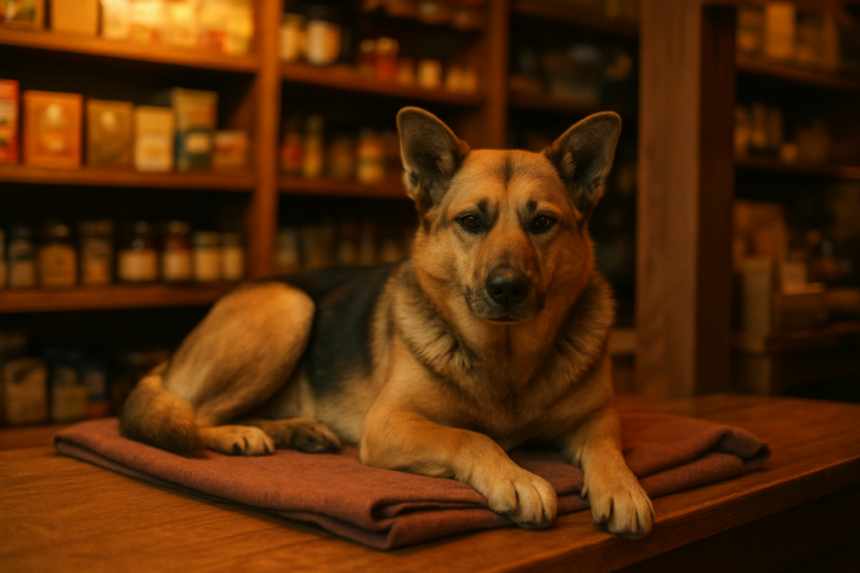
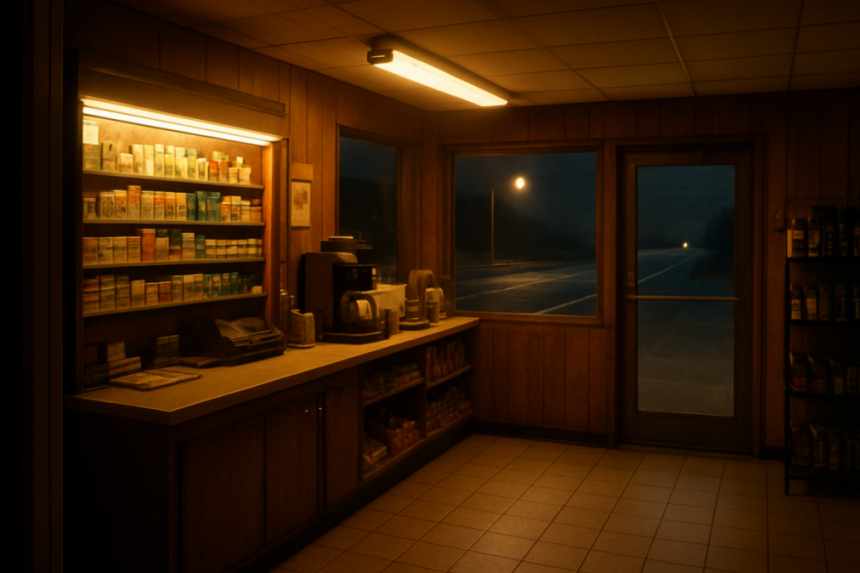
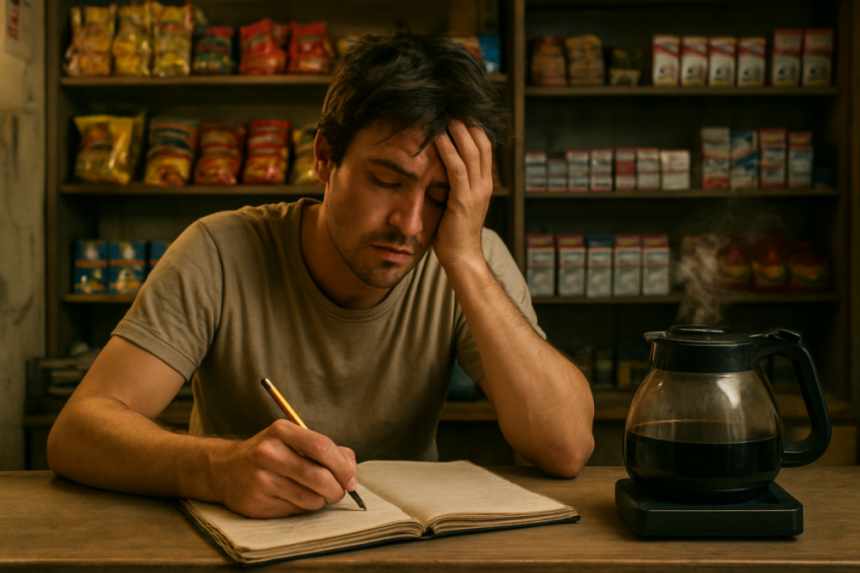

AI illustrations. Please judge the story itself. About AI images.
Filed by its author.
Before you peek: what share of readers believes this story?
50%
No votes yet
Total verdict votes: 0
Guess first! What other readers decided is hidden until you cast your own verdict above — vote True, Fake or Not sure to reveal the community score.
Changed your mind? Read the strongest arguments of the other camp below. If they convinced you — change your verdict (once).
Your new verdict:
Why did you vote that way? Pick up to two:
Noted — thank you, detective.
My case notes (private — stored only in this browser)
Saved in this browser.
True or Fake? — play the detective
How it works: cast your True/Fake verdict above and see whether you matched the reader majority. Then hit "Next case" for a random story and keep your streak going. Solve cases to climb the detective ranks — score and rank are kept on this device only.
Tip: highlight any sentence of the story with your mouse or finger — a small share popup will appear to post that exact quote (with a link back to the story) to X, Facebook, Threads or Reddit.
Something similar happened to you? Tell your version — the jury is waiting. Tell your story
Keep investigating
- More Small Towns cases
- More Close Encounters cases
- A case the jury believes: The Cattle Guard Ate Twenty Minutes Of My Life
- A case the jury believes: The Thing In The Orchard Had Knees That Bent The Wrong Way
- A case the jury believes: The 911 Call I Took That Was Not On The Recording
- The full Alien Stories archive
- Cases the jury cannot settle
Comments (0)
Comments here are case materials: pick a role — ask the author a question, or file your evidence FOR or AGAINST the story — and it lands in the right column. Upvote the sharpest comments: the best one is pinned on top as the Top Detective Comment. Questions get answered by the story's author in person — look for the AUTHOR badge.
No comments yet. Be the first!