
The Clock That Stops the Night Before Someone in Our Family Dies
In one sentence: A family heirloom clock mysteriously stops at moments that seem connected to deaths in the family, blending history with unsettling coincidence.
Our family clock has stopped four times in my life. Each time, someone died within a day. I found the maker's note tucked behind the face and now I understand less than before.
* AI Illustration
First impression: judge by the title and the picture alone — you get the real verdict after reading.
Swear It Happened — CASE FILE #462
56% BELIEVED
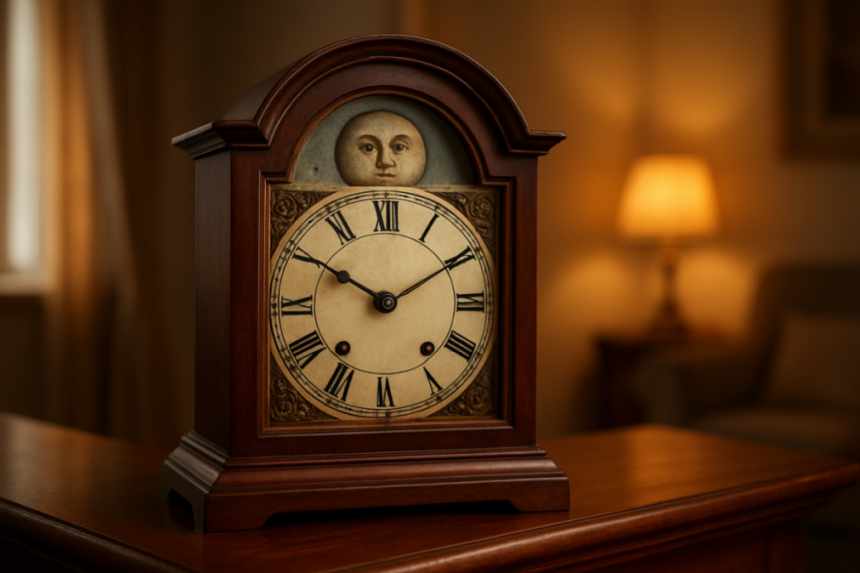
Because four times in my life, that clock has stopped. Not run slow. Not needed winding. Stopped, dead, mid-tick, at a random hour, and each of those four times, someone in our family died within the day.
The first time I was seven. The clock stopped at 3:10 in the afternoon and my mother went white and made a phone call, and that night my great-aunt died two states away, and no one had known she was even sick. The second time I was nineteen. Third, twenty-eight. The fourth was three years ago. Every time: the clock stops, and inside of twenty-four hours the phone rings.
Now, I am a reasonable person. I know how this sounds. And for most of my life I had a reasonable answer ready, which is that a hundred-year-old clock stops sometimes, that people die every day, and that a family this size loses someone often enough that you can always find a stopped clock near a death if you go looking. My grandfather, who owned the clock before me, believed every word of that. He called the family curse nonsense. He wound the clock every Sunday and rolled his eyes at his own sisters, who would not stay in the same house as it.
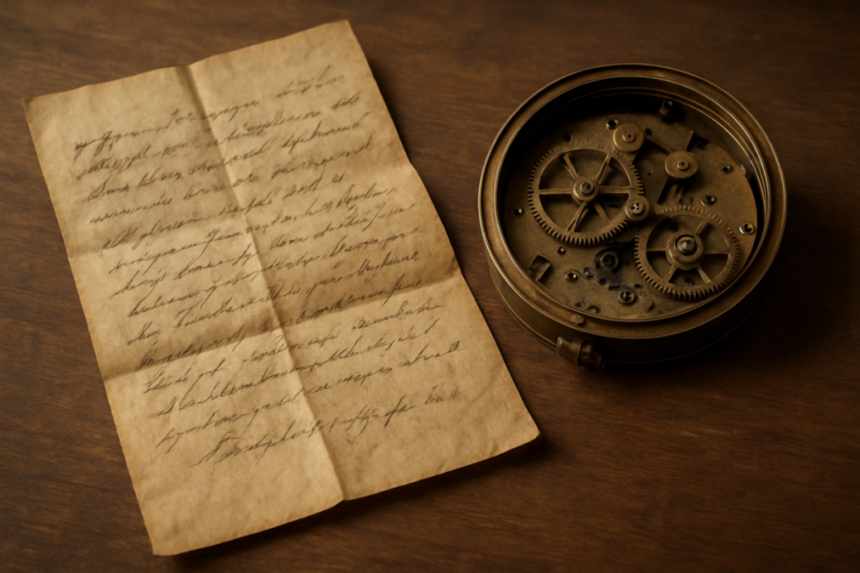
When my grandfather died -- and yes, the clock stopped, at 6:45 in the morning, and he was gone by nightfall -- I inherited it. And when I finally worked up the nerve to have it cleaned, the old repairman took the back off and found, folded behind the movement where it had sat for over a century, a slip of paper in a spidery hand.
It was, as best we can tell, a note from the clockmaker himself. It was dated 1893. And it did not say what I wanted it to say. I wanted it to say something rational, a warranty, a repair note. Instead it said, in translation, that the clock had been made for my family from the wood of a particular tree, a tree that had stood over the graves of the family in the old country, and that the maker had been asked to build a clock that would keep the family, his words, in one another's company across the distance, so that no one would pass alone or unremarked.
So that no one would pass alone.
Read one way, that is beautiful. Read another way, it is the coldest thing I have ever held in my hands. My family, back in the 1890s, scattering across an ocean, terrified of dying among strangers with no one back home ever knowing -- they commissioned a clock to be an alarm bell for their own deaths. A device whose entire purpose was to announce, we have lost one, wherever you are, stop and take notice.
And it works. That is the part I cannot get past. Whatever the mechanism -- and I have theories, none of them satisfying, all of them involving the words coincidence or subconscious or humidity -- the fact remains that four times I have watched that clock die and four times the phone has rung.
My daughter is grown now and she wants nothing to do with it. She says it is morbid, that she will not have a death-clock on her mantel, that when I am gone she is selling it or burying it or burning it. And I understand her. I do.
But I keep thinking about that line. So that no one would pass alone or unremarked. My family were poor people who crossed an ocean and knew they would likely never see their parents or their homeland again, and they were so afraid of vanishing without a witness that they built a witness out of graveyard wood and wound it every Sunday for a hundred and thirty years.
I wind it every Sunday too. I tell myself it is habit. But the truth is I cannot stand the thought of one of my own dying somewhere far away and me not knowing, not feeling it, not stopping whatever I am doing to mark it. The clock terrifies me. And I will keep it until I die, because the alternative -- a family that lets its people pass alone and unremarked -- terrifies me more.
The clock is ticking right now, as I write this. Perfect time. I checked it twice.

AI illustrations. Please judge the story itself. About AI images.
Filed by AI — launch archive.
Before you peek: what share of readers believes this story?
50%
56% of readers believe this story
Total verdict votes: 205
Guess first! What other readers decided is hidden until you cast your own verdict above — vote True, Fake or Not sure to reveal the community score.
Changed your mind? Read the strongest arguments of the other camp below. If they convinced you — change your verdict (once).
Your new verdict:
Why did you vote that way? Pick up to two:
Noted — thank you, detective.
My case notes (private — stored only in this browser)
Saved in this browser.
True or Fake? — play the detective
How it works: cast your True/Fake verdict above and see whether you matched the reader majority. Then hit "Next case" for a random story and keep your streak going. Solve cases to climb the detective ranks — score and rank are kept on this device only.
Tip: highlight any sentence of the story with your mouse or finger — a small share popup will appear to post that exact quote (with a link back to the story) to X, Facebook, Threads or Reddit.
Something similar happened to you? Tell your version — the jury is waiting. Tell your story
Keep investigating
- More Family Curses cases
- More Old Letters cases
- A case the jury believes: The Letter Grandma Sewed Into the Lining of Her Coat
- A case the jury believes: No Firstborn in Our Family Is Ever Allowed to Learn to Swim
- A case the jury believes: Grandma Set a Place at the Table for Someone Who Never Came
- The full Family Legends archive
- Cases the jury cannot settle
Comments (0)
Comments here are case materials: pick a role — ask the author a question, or file your evidence FOR or AGAINST the story — and it lands in the right column. Upvote the sharpest comments: the best one is pinned on top as the Top Detective Comment. Questions get answered by the story's author in person — look for the AUTHOR badge.
No comments yet. Be the first!